


Wydawcy
Katalog tematyczny
- Archeologia (109)
- Ekonomia, finanse, business (13704)
- Filozofia (1445)
- Historia (3040)
- Języki i językoznawstwo (2356)
- Lifestyle, hobby i rozrywka (475)
- Medycyna (9704)
- Nauki humanistyczne (4)
- Nauki o Ziemi i środowisku (2638)
- Nauki ścisłe (20412)
- Nauki społeczne (8486)
- Nauki techniczne (13450)
- Prawo (1696)
- Publikacje informacyjne i interdyscyplinarne (1288)
- Religia i wierzenia (917)
- Technika komputerowa (4067)
- Zdrowie, relacje międzyludzkie i rozwój osobisty (657)





Informacje szczegółowe o książce
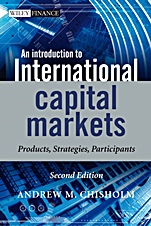
An Introduction to International Capital Markets: Products, Strategies, Participants
ISBN 9780470758984
Autor: Andrew M. Chisholm
Wydawca: Wiley
Dostępność: 3-6 tygodni
Cena: 318,15 zł
Przed złożeniem zamówienia prosimy o kontakt mailowy celem potwierdzenia ceny.
ISBN13: |
9780470758984 |
ISBN10: |
0470758988 |
Autor: |
Andrew M. Chisholm |
Oprawa: |
Hardback |
Rok Wydania: |
2009-05-22 |
Numer Wydania: |
2nd Edition |
Ilość stron: |
448 |
Wymiary: |
260x181 |
Tematy: |
KF |
An Introduction to international capital markets, Second edition
Products, Strategies, Participants
Andrew Chisholm
“Clear, comprehensive and with many practical examples and case studies. An invaluable guide to the modern international capital markets and to the key products and techniques used in the industry.” —Sir George Mathewson CBE, DUniv, LLD, FRSE, FCIBS. Chairman of the Council of Economic Advisers in Scotland and Former Chairman of The Royal Bank of Scotland Group plc.
Fully revised and updated from the hugely popular first edition, this book is an accessible and convenient one–volume introduction to international capital markets, ideal for those entering or planning to enter investment banking or asset management. As well as serving as an invaluable reference tool for professionals already working in the industry looking to extend their knowledge base it will also benefit all those working in trading, sales and support roles.
Describing how the key products and markets work, who the principle participants are and their overall goals and objectives, Andrew Chisholm provides a thorough overview of the global capital markets. The book covers a wide range of equity, debt, foreign exchange and credit instruments as well as the principal derivative products. In a step–by–step fashion, making extensive use of real world cases and examples, it explains money markets, foreign exchange, bond markets, cash equity markets, equity valuation techniques, swaps, forwards, futures, credit derivatives, options, option risk management and convertible bonds. An extensive glossary also explains concisely many of the ‘jargon’ expressions used in the financial markets.
Boasting an international focus, examples are drawn from major international markets around the world. It makes extensive use of numerical examples and case studies to help explain a wide range of cash and derivative products used i
n the capital markets business. It covers both debt and equity products and includes new material on credit products such as collateralized debt obligations and credit derivative structures; equity fundamental analysis, portfolio theory and convertible bonds. Market data has been fully updated from the first edition and recent events such as the ‘credit crisis’ are discussed.
Spis treści:
Acknowledgment.
1 Introduction: The Market Context.
1.1 Capital and the Capital Markets.
1.2 The Euromarkets (International Capital Markets).
1.3 Modern Investment Banking.
1.4 The Clients of Investment Banks.
1.5 About this Book.
2 The Money Markets.
2.1 Chapter Overview.
2.2 Domestic Money Markets.
2.3 US Domestic Markets.
2.4 The European Central Bank (ECB).
2.5 Sterling Money Markets.
2.6 The Bank of Japan.
2.7 Systemic Risks and Moral Hazards.
2.8 Treasury Bills.
2.9 Discounting Treasury Bills.
2.10 US Commercial Paper.
2.11 Credit Risk on USCP.
2.12 Bankers’ Acceptances.
2.13 The Eurocurrency Markets.
2.14 Eurocurrency Loans and Deposits.
2.15 Eurocurrency Interest and Day–Count.
2.16 Eurocurrency Certificates of Deposit.
2.17 CD Yield–to–Maturity.
2.18 Euro–Commercial Paper.
2.19 Repos and Reverses.
2.20 Repo: Case Study.
2.21 Other Features of Repos.
2.22 Chapter Summary.
3 The Foreign Exchange Market.
3.1 Chapter Overview.
3.2 Market Structure.
3.3 FX Dealers and Brokers.
3.4 Spot Foreign Exchange Deals.
3.5 Sterling and Euro Quotations.
3.6 Factors Affecting Spot FX Rates.
3.7 Spot FX Trading.
3.8 Spot Position Keeping.
3.9 FX Risk Control.
3.10 Cross–Currency Rates.
3.11 Outright Forward FX Rates.
3.12 Outright Forward FX Hedge: Case Study.
3.13 Forward FX Formula.
3.14 FX or Forward Swaps.
3.15 FX Swap Two–Way Quotations.
3.16
Chapter Summary.
4 Major Government Bond Markets.
4.1 Chapter Overview.
4.2 Introduction to Government Bonds.
4.3 Sovereign Risk.
4.4 US Government Notes and Bonds.
4.5 US Treasury Quotations.
4.6 US Treasury Strips.
4.7 Bond Pricing.
4.8 Pricing Coupon Bonds: Examples.
4.9 Detailed Bond Valuation: US Treasury.
4.10 Bond Yield.
4.11 Reinvestment Assumptions.
4.12 Annual and Semi–Annual Bond Yields.
4.13 UK Government Bonds.
4.14 Japanese Government Bonds (JGBs).
4.15 Eurozone Government Bonds.
4.16 Chapter Summary.
5 Bond Price Sensitivity.
5.1 Chapter Overview.
5.2 Bond Market Laws.
5.3 Other Factors Affecting Price Sensitivity.
5.4 Macaulay’s Duration.
5.5 Calculating Macaulay’s Duration.
5.6 Duration of a Zero.
5.7 Modified Duration.
5.8 Price Value of a Basis Point.
5.9 Convexity.
5.10 Measuring Convexity.
5.11 Convexity Behaviour.
5.12 Portfolio Duration.
5.13 Dedication.
5.14 Immunization.
5.15 Duration–Based Hedges.
5.16 Convexity Effects on Duration Hedges.
5.17 Chapter Summary.
6 The Yield Curve.
6.1 Chapter Overview.
6.2 Real and Nominal Interest Rates.
6.3 Compounding Periods.
6.4 The Yield Curve Defined.
6.5 Theories of Yield Curves.
6.6 Zero Coupon or Spot Rates.
6.7 Bootstrapping.
6.8 Spot Rates and the Par Curve.
6.9 Pricing Models Using Spot Rates.
6.10 Forward Rates.
6.11 Discount Factors.
6.12 Chapter Summary.
7 Credit Spreads and Securitization.
7.1 Chapter Overview.
7.2 Basics of Credit Spreads.
7.3 The Role of the Ratings Agencies.
7.4 Credit Spreads and Default Probabilities.
7.5 Credit Default Swaps.
7.6 Index Credit Default Swaps.
7.7 Basket Default Swaps.
7.8 Credit–Linked Notes.
7.9 Securitization and CDOs.
7.10 Rationale for Securitization.
7.11 Synthetic CDOs.
7.12 Chapter Summary.
8 Equity Mark
ets and Equity Investment.
8.1 Chapter Overview.
8.2 Comparing Corporate Debt and Equity.
8.3 Additional Features of Common Stock.
8.4 Hybrid Securities.
8.5 Equity Investment Styles.
8.6 Efficient Markets.
8.7 Modern Portfolio Theory (MPT).
8.8 Primary Markets for Common Stock.
8.9 Subsequent Common Stock Issues.
8.10 Secondary Markets: Major Stock Markets.
8.11 Depository Receipts.
8.12 Stock Lending.
8.13 Portfolio (Basket) Trading.
8.14 Chapter Summary.
9 Equity Fundamental Analysis.
9.1 Chapter Overview.
9.2 Principles of Common Stock Valuation.
9.3 The Balance Sheet Equation.
9.4 The Income Statement.
9.5 Earnings Per Share (EPS).
9.6 Dividend Per Share (DPS).
9.7 Ratio Analysis.
9.8 Liquidity Ratios.
9.9 Profitability Ratios.
9.10 Leverage Ratios.
9.11 Investor Ratios and Valuation.
9.12 Applying Valuation Multiples.
9.13 Firm or Enterprise Value Multiples.
9.14 Chapter Summary.
10 Cash Flow Models in Equity Valuation.
10.1 Chapter Overview.
10.2 The Basic Dividend Discount Model.
10.3 Constant Dividend Growth Models.
10.4 The Implied Return on a Share.
10.5 Dividend Yield and Dividend Growth.
10.6 Price/Earnings Ratio.
10.7 Stage Dividend Discount Models.
10.8 Two–Stage Model: Example.
10.9 The Capital Asset Pricing Model (CAPM).
10.10 Beta.
10.11 Estimating the Market Risk Premium.
10.12 The Equity Risk Premium Controversy.
10.13 CAPM and Portfolio Theory.
10.14 Free Cash Flow Valuation.
10.15 Forecasting Free Cash Flows.
10.16 Weighted Average Cost of Capital (WACC).
10.17 Residual Value.
10.18 WACC and Leverage.
10.19 Assets Beta Method.
10.20 Company Value and Leverage.
10.21 Chapter Summary.
11 Interest Rate Forwards and Futures.
11.1 Chapter Overview.
11.2 Forward Rate Agreements (FRAs).
11.3 FRA Application: Case Study.
11.4 Borrowing Costs with an FRA He
dge.
11.5 FRA Market Quotations.
11.6 The Forward Interest Rate.
11.7 Financial Futures.
11.8 CME Eurodollar Futures.
11.9 Eurodollar Futures Quotations.
11.10 Futures Margining.
11.11 Margining Example: EURIBOR Futures on Eurex.
11.12 Hedging with Interest Rate Futures: Case Study.
11.13 Futures Strips.
11.14 Chapter Summary.
Appendix: Statistics on Derivatives Markets.
12 Bond Futures.
12.1 Chapter Overview.
12.2 Definitions.
12.3 The CBOT 30–Year US Treasury Bonds Futures.
12.4 Invoice Amount and Conversion Factors.
12.5 Long Gilt and Euro–Bund Futures.
12.6 Forward Bond Price.
12.7 Carry Cost.
12.8 The Implied Repo Rate.
12.9 The Cheapest to Deliver (CTD) Bond.
12.10 CTD Behaviour.
12.11 Hedging with Bond Futures.
12.12 Basis Risk.
12.13 Hedging Non–CTD Bonds.
12.14 Using Futures in Portfolio Management.
12.15 Chapter Summary.
13 Interest Rate Swaps.
13.1 Chapter Overview.
13.2 Swap Definitions.
13.3 The Basic Interest Rate Swap Illustrated.
13.4 Typical Swap Applications.
13.5 Interest Rate Swap: Detailed Case Study.
13.6 Interest Rate Swap Terms.
13.7 Comparative Advantage.
13.8 Swap Quotations and Spreads.
13.9 Determinants of Swap Spreads.
13.10 Hedging Swaps with Treasuries.
13.11 Cross–Currency Swaps: Case Study.
13.12 Cross–Currency Swap Revaluation.
13.13 Chapter Summary.
Appendix: Swap Variants.
14 Interest Rate Swap Valuation.
14.1 Chapter Overview.
14.2 Valuing a Swap at Inception.
14.3 Valuing the Swap Components.
14.4 Swap Revaluation.
14.5 Revaluation Between Payment Dates.
14.6 The Forward Rate Method.
14.7 Forward Rate Method on a Spreadsheet.
14.8 Swap Rates and LIBOR Rates.
14.9 Pricing a Swap from Futures.
14.10 Hedging Interest Rate Risk on Swaps.
14.11 Chapter Summary.
15 Equity Index Futures and Swaps.
15.1 Chapter Ov
erview.
15.2 Index Futures.
15.3 Margining Procedures.
15.4 Final Settlement and Spread Trades.
15.5 Hedging with Index Futures: Case Study.
15.6 Hedge Efficiency.
15.7 Other Uses of Index Futures.
15.8 Pricing an Equity Forward Contract.
15.9 Index Futures Fair Value.
15.10 The Basis.
15.11 Index Arbitrage Trade.
15.12 Running an Arbitrage Desk.
15.13 Features of Index Futures.
15.14 Equity Swaps.
15.15 Managing the Risks on Equity Swaps.
15.16 Structuring Equity Swaps.
15.17 Benefits and Applications of Equity Swaps.
15.18 Chapter Summary.
16 Fundamentals of Options.
16.1 Chapter Overview.
16.2 Definitions.
16.3 Basic Option Trading Strategies.
16.4 Long Call: Expiry Payoff Profile.
16.5 Short Call: Expiry Payoff Profile.
16.6 Long Put: Expiry Payoff Profile.
16.7 Short Put: Expiry Payoff Profile.
16.8 Summary: Intrinsic and Time Value.
16.9 CBOE Stock Options.
16.10 CME S&P 500 Index Options.
16.11 Stock Options on LIFFE.
16.12 FT–SE 100 Index Options.
16.13 Chapter Summary.
Appendix: Exotic Options.
17 Option Valuation Models.
17.1 Chapter Overview.
17.2 Fundamental Principles: European Options.
17.3 Synthetic Forwards and Futures.
17.4 American Options and Early Exercise.
17.5 Binomial Trees.
17.6 Expanding the Tree.
17.7 Black–Scholes Model.
17.8 Black–Scholes Assumptions.
17.9 Chapter Summary.
Appendix: Measuring Historic Volatility.
18 Option Pricing and Risks.
18.1 Chapter Overview.
18.2 Intrinsic and Time Value Behaviour.
18.3 Volatility Assumption and Option Pricing.
18.4 DELTA (ΔOR δ).
18.5 Delta Behaviour.
18.6 GAMMA (Γor γ).
18.7 Readjusting the Delta Hedge.
18.8 Gamma Behaviour.
18.9 THETA (Θ).
18.10 Vega.
18.11 Rho (p) and Summary of Greeks.
18.12 Chapter Summary.
Appendix: Delta and Gamma Hedging.
19 Option Strategies.
19.1 Chapter Overview.
19.2 Hedging with Put Options.
19.3 Covered Call Writing.
19.4 Collars.
19.5 Bull and Bear Spreads.
19.6 Other Spread Trades.
19.7 Volatility Revisited.
19.8 Volatility Trading: Straddles and Strangles.
19.9 Current Payoff Profiles.
19.10 Profits and Risks on Straddles.
19.11 Chapter Summary.
20 Additional Option Applications.
20.1 Chapter Overview.
20.2 OTC and Exchange–traded Currency Options.
20.3 Hedging FX Exposures with Options: Case Study.
20.4 Pricing Currency Options.
20.5 Interest Rate Options.
20.6 Exchange–Traded Interest Rate Options.
20.7 Caps, Floors, and Collars.
20.8 Interest Rate Cap: Case Study.
20.9 Pricing Caps and Floors: Black Model.
20.10 Swaptions.
20.11 Interest Rate Strategies.
20.12 Convertible Bonds.
20.13 CB Measures of Value.
20.14 Conversion Premium and Parity.
20.15 Convertible Arbitrage.
20.16 Chapter Summary.
Glossary of Financial Terms.
Index.
Nota biograficzna:
ANDREW M. CHISHOLM has designed, developed and taught programmes in derivatives and finance since 1984. In that time he has worked with many of the largest financial institutions around the world, teaching corporate financiers, traders, sales and marketing staff, risk managers, analysts, fund managers, operations and technology professionals. He has worked extensively on seminars at senior management level as well as training programmes designed to introduce new graduate and MBA entrants to the securities industry. He was formerly Head of Professional Development for Europe at JP Morgan and is author of Derivatives Demystified published by John Wiley and Sons in 2004.
Okładka tylna:
An Introduction to international capital markets, Second edition
Products, Strategies, Participants
Andrew Chisholm
“Clear, comprehensive and with many practic
al examples and case studies. An invaluable guide to the modern international capital markets and to the key products and techniques used in the industry.” —Sir George Mathewson CBE, DUniv, LLD, FRSE, FCIBS. Chairman of the Council of Economic Advisers in Scotland and Former Chairman of The Royal Bank of Scotland Group plc.
Fully revised and updated from the hugely popular first edition, this book is an accessible and convenient one–volume introduction to international capital markets, ideal for those entering or planning to enter investment banking or asset management. As well as serving as an invaluable reference tool for professionals already working in the industry looking to extend their knowledge base it will also benefit all those working in trading, sales and support roles.
Describing how the key products and markets work, who the principle participants are and their overall goals and objectives, Andrew Chisholm provides a thorough overview of the global capital markets. The book covers a wide range of equity, debt, foreign exchange and credit instruments as well as the principal derivative products. In a step–by–step fashion, making extensive use of real world cases and examples, it explains money markets, foreign exchange, bond markets, cash equity markets, equity valuation techniques, swaps, forwards, futures, credit derivatives, options, option risk management and convertible bonds. An extensive glossary also explains concisely many of the ‘jargon’ expressions used in the financial markets.
Boasting an international focus, examples are drawn from major international markets around the world. It makes extensive use of numerical examples and case studies to help explain a wide range of cash and derivative products used in the capital markets business. It covers both debt and equity products and includes new material on credit products such as collateralized debt obligations and credit derivativ
Koszyk
Książek w koszyku: 0 szt.
Wartość zakupów: 0,00 zł
Informacje


Kontakt
Gambit
Centrum Oprogramowania
i Szkoleń Sp. z o.o.
Al. Pokoju 29b/22-24
31-564 Kraków
Siedziba Księgarni
ul. Kordylewskiego 1
31-542 Kraków
+48 12 410 5991
+48 12 410 5987
+48 12 410 5989
Subskrypcje
Administratorem danych osobowych jest firma Gambit COiS Sp. z o.o. Na podany adres będzie wysyłany wyłącznie biuletyn informacyjny.
Autoryzacja płatności

Informacje na temat autoryzacji płatności poprzez PayU.

© Copyright 2012: GAMBIT COiS Sp. z o.o. Wszelkie prawa zastrzeżone.
Projekt i wykonanie: Alchemia Studio Reklamy