


Wydawcy
Katalog tematyczny
- Archeologia (109)
- Ekonomia, finanse, business (13704)
- Filozofia (1445)
- Historia (3040)
- Języki i językoznawstwo (2356)
- Lifestyle, hobby i rozrywka (475)
- Medycyna (9704)
- Nauki humanistyczne (4)
- Nauki o Ziemi i środowisku (2638)
- Nauki ścisłe (20412)
- Nauki społeczne (8486)
- Nauki techniczne (13450)
- Budownictwo lądowe (1045)
- Chemia przemysłowa (2258)
- Elektronika i telekomunikacja (3287)
- Energetyka (1122)
- Inne nauki stosowane (363)
- Inżynieria biochemiczna (507)
- Inżynieria transportu (232)
- Mechanika i materiały (3316)
- Nauka o środowisku (321)
- Rolnictwo (507)
- Technika, ogólnie (475)
- Prawo (1696)
- Publikacje informacyjne i interdyscyplinarne (1288)
- Religia i wierzenia (917)
- Technika komputerowa (4067)
- Zdrowie, relacje międzyludzkie i rozwój osobisty (657)





Informacje szczegółowe o książce
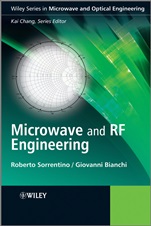
Microwave and RF Engineering
ISBN 9780470758625
Autor: Roberto Sorrentino, Giovanni Bianchi, Kai Chang
Wydawca: Wiley
Dostępność: 3-6 tygodni
Cena: 639,45 zł
Przed złożeniem zamówienia prosimy o kontakt mailowy celem potwierdzenia ceny.
ISBN13: |
9780470758625 |
ISBN10: |
0470758627 |
Autor: |
Roberto Sorrentino, Giovanni Bianchi, Kai Chang |
Oprawa: |
Hardback |
Rok Wydania: |
2010-06-18 |
Ilość stron: |
912 |
Wymiary: |
258x174 |
Tematy: |
TJ |
An essential text for both students and professionals, combing detailed theory with clear practical guidance
This outstanding book explores a large spectrum of topics within microwave and radio frequency (RF) engineering, encompassing electromagnetic theory, microwave circuits and components. It provides thorough descriptions of the most common microwave test instruments and advises on semiconductor device modelling.
With examples taken from the authors’ own experience, this book also covers:
network and signal theory;electronic technology with guided electromagnetic propagation;microwave circuits such as linear and non–linear circuits, resonant circuits and cavities, monolithic microwave circuits (MMICs), wireless architectures and integrated circuits;passive microwave components, control components;microwave filters and matching networks.
Simulation files are included in a CD Rom, found inside the book.
Microwave and RF Engineering presents up–to–date research and applications at different levels of difficulty, creating a useful tool for a first approach to the subject as well as for subsequent in–depth study. It is therefore indispensable reading for advanced professionals and designers who operate at high frequencies as well as senior students who are first approaching the subject.
Spis treści:
About the Authors
Preface
1 Introduction
1 Introduction
1.1 Microwaves and Radiofrequencies
1.2 Frequency bands
1.3 Applications
1.4 References
2 Basic Electromagnetic Theory
2.1. Introduction
2.2. Maxwell’s equations
2.3. Time–harmonic EM fields. Polarization of a vector
2.4. Maxwell’s equations in the harmonic regime
2.5. Boundary conditions
2.6. Energy and power of the EM field. The Poynting’s theorem 9
2.7. Some fundamental theorems
2.8.
Plane waves
2.9. Solution of the wave equation in rectangular coordinates
2.10. Reflection and transmission of plane waves. Snell’s laws
2.11. Electrodynamic potentials
2.12. References
3 Guided Electromagnetic Propagation
3.1. Introduction
3.2. Cylindrical structures.
Solution of Maxwell’s equations as TE, TM and TEM modes
3.3. Modes of propagation as transmission lines
3.4. Transmission lines as 1D circuits
3.5. Phase velocity, group velocity and energy velocity
3.6. Properties of the transverse modal vectors et, ht.
Field expansion in a waveguide
3.7. Loss, attenuation and power handling in real waveguides
3.8. The rectangular waveguide
3.9. The ridge waveguide
3.10. The circular waveguide
3.11. The coaxial cable
3.12. The parallel–plate waveguide
3.13. The stripline
3.14. The microstrip line
3.15. The coplanar waveguide
3.16. Coupled lines
3.17. References
4 Microwave Circuits
4.1. Introduction
4.2. Microwave circuit formulation
4.3. Terminated transmission lines
4.4. The Smith Chart
4.5. Power flow
4.6. Matrix representations
4.7. Circuit model of a transmission line section
4.8. Shifting the reference planes
4.9. Loaded 2–port network
4.10. Matrix description of coupled lines
4.11. Matching of coupled lines
4.12. Two–port networks using coupled line sections
4.13. References
5. Resonators and cavities
5.1 Introduction
5.2 The resonant condition
5.3 Quality factor or Q
5.4 Transmission line resonators
5.5 Planar resonators
5.6 Cavity resonators
5.7 Computation of the Q factor of a cavity resonator
5.8 Dielectric resonators
5.9 Expansion of electromagnetic fields
6 Impedance matching
6.1 Introduction
6.2 Fano’s Bound
6.3 Quarter wavelength transformer
6.4 Multisection quarter wavelength transformers
6.5 Line and stub
transformers. Stub tuners
6.6 Lumped L–networks
6.7 References
6.8 Simulation files
7 Passive Microwave Components
7.1 Introduction
7.2 Matched loads
7.3 Movable short circuit
7.4 Attenuators
7.5 Fixed Phase shifters
7.6 Junctions and interconnections
7.7 Dividers and combiners
7.8 Lumped element realizations
7.9 Multibeam forming networks (MBFN)
7.10 Non reciprocal components
7.11 References
7.12 Simulation files
8 Microwave Filters
8.1 Introduction
8.2 Definitions
8.3 Low–pass Prototype
8.4 Semi–Lumped Low–Pass Filters
8.5 Frequency Transformations
8.6 Kuroda Identities
8.7 Immittance Inverters
8.9 Simulation files
9 Preliminary Concepts for Microwave Component Design
9.1 Introduction
9.2 Cascaded Linear 2–port Networks
Example 9.1. Phase Mismatch Caused by Impedance Mismatch
Example 9.2. Mismatch Resonances
9.3 Signal Flow Graphs
9.4 Noise in 2–port Networks
9.5 Nonlinear 2–port Networks
9.6 Semiconductors Devices
9.7 Electrical Models for High–Frequency Semiconductor Devices
9.8 Related Files
9.9 References
Okładka tylna:
An essential text for both students and professionals, combing detailed theory with clear practical guidance
This outstanding book explores a large spectrum of topics within microwave and radio frequency (RF) engineering, encompassing electromagnetic theory, microwave circuits and components. It provides thorough descriptions of the most common microwave test instruments and advises on semiconductor device modelling.
With examples taken from the authors’ own experience, this book also covers:
network and signal theory;electronic technology with guided electromagnetic propagation;microwave circuits such as linear and non–linear circuits, resonant circuits and cavities, monolithic
microwave circuits (MMICs), wireless architectures and integrated circuits;passive microwave components, control components;microwave filters and matching networks.
Simulation files are included in a CD Rom, found inside the book.
Microwave and RF Engineering presents up–to–date research and applications at different levels of difficulty, creating a useful tool for a first approach to the subject as well as for subsequent in–depth study. It is therefore indispensable reading for advanced professionals and designers who operate at high frequencies as well as senior students who are first approaching the subject.
Koszyk
Książek w koszyku: 0 szt.
Wartość zakupów: 0,00 zł
Informacje


Kontakt
Gambit
Centrum Oprogramowania
i Szkoleń Sp. z o.o.
Al. Pokoju 29b/22-24
31-564 Kraków
Siedziba Księgarni
ul. Kordylewskiego 1
31-542 Kraków
+48 12 410 5991
+48 12 410 5987
+48 12 410 5989
Subskrypcje
Administratorem danych osobowych jest firma Gambit COiS Sp. z o.o. Na podany adres będzie wysyłany wyłącznie biuletyn informacyjny.
Autoryzacja płatności

Informacje na temat autoryzacji płatności poprzez PayU.

© Copyright 2012: GAMBIT COiS Sp. z o.o. Wszelkie prawa zastrzeżone.
Projekt i wykonanie: Alchemia Studio Reklamy