


Wydawcy
Katalog tematyczny
- Archeologia (109)
- Ekonomia, finanse, business (13704)
- Filozofia (1445)
- Historia (3040)
- Języki i językoznawstwo (2356)
- Lifestyle, hobby i rozrywka (475)
- Medycyna (9704)
- Nauki humanistyczne (4)
- Nauki o Ziemi i środowisku (2638)
- Nauki ścisłe (20412)
- Nauki społeczne (8486)
- Nauki techniczne (13450)
- Prawo (1696)
- Publikacje informacyjne i interdyscyplinarne (1288)
- Religia i wierzenia (917)
- Technika komputerowa (4067)
- Zdrowie, relacje międzyludzkie i rozwój osobisty (657)





Informacje szczegółowe o książce
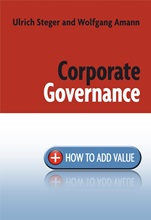
Corporate Governance: How to Add Value
ISBN 9780470754177
Autor: Ulrich Steger, Wolfgang Amann
Wydawca: Wiley
Dostępność: 3-6 tygodni
Cena: 195,30 zł
Przed złożeniem zamówienia prosimy o kontakt mailowy celem potwierdzenia ceny.
ISBN13: |
9780470754177 |
ISBN10: |
0470754176 |
Autor: |
Ulrich Steger, Wolfgang Amann |
Oprawa: |
Paperback |
Rok Wydania: |
2008-04-18 |
Ilość stron: |
308 |
Wymiary: |
244x168 |
Tematy: |
KM |
This book present the value school of corporate governance, outlining a multitude of areas where corporate governance could add real worth, and showing how this can be put into effect.
No “one–size–fits–all” model emerges as a solution. Rather, the insights in this book take idiosyncrasies and dynamics over time into consideration. They consider the main issues and their real causes, ownership settings, country settings and new developments in corporate governance research and practice.International focus places emphasises on typical patterns, predicament and solutions instead of national laws.Points are illustrated with in–depth case studies and highlighted learning nuggets.Alerts the reader to typical dilemmas and traps in attaining the goal of value creation, whilst also pointing to promising avenues forward.
Spis treści:
Foreword.
Acknowledgments.
PART 1: INTRODUCTION.
Chapter 1: Corporate governance – beyond the scandals and buzzwords.
1.1. Every company has a corporate governance.
1.2. The history of corporate governance – a tale of crime and crises.
1.4. Basic corporate governance institutions.
1.5. The shaping factors of corporate governance.
1.8. Typical dilemmas for the board.
1.9. Corporate Governance and financial performance.
1.10 Where does Corporate Governance add specifically value?.
1.11. The contingent role of boards.
1.12. Case study: Developing Corporate Governance at Highfly Logistics Software – but how?.
1.13. Case study: Did Corporate Governance fail at Swissair?.
1.14. Case study: ABB – Corporate Governance during a turnaround.
Chapter 2: International Corporate Governance – similarities across systems.
2.1. Do international differences matter?.
2.2. Case study: DaimlerChrysler – Corporate Governance dynamics in a global company.
PART 2:
BOARDS′ INTERNAL DYNAMICS.
Chapter 3: Information demand and supply for changing Board roles.
3.1. Do new board roles require different information.
3.2. Case study: Conflicts of interests at the Board of Khan AG.
3.3. Case study: ICM: When hidden agendas enter the Board room (A).
3.4. Case study: ICM: Hidden agendas in the board room (B).
Chapter 4: Navigating through typical conflict patterns.
4.1. Are tensions and clashes normal.
4.2. Case study: War at the helm of Elicor.
4.3. Case study: Cobra vs. Commerzbank: Can investors raid their own company.
Chapter 5: Codes of conduct – the value added beyond compliance.
5.1. Codes of conduct as a panacea.
5.2. Case study: Boeing hits turbulence: is it worth losing a successful CEO for a Code of Conduct.
5.3. Case study: Codes of conduct at ConnectU2: Adding value, cost or nothing at all.
Chapter 6: Board evaluation.
PART 3: CORPORATE GOVERNANCE IN SPECIFIC CONTEXTS.
Chapter 7: Corporate Governance dynamics in M&A.
7.1. Why governance as usual is not an option in M&A.
7.2. Case study: The DaimerChrysler merger: The involvement of the boards.
7.3. Case study: DaimlerChrysler Board: after the deal is done.
Chapter 8: Corporate Governance in and with subsidiaries.
8.1. Tension fields and central issues.
8.2. Case study: Pharmagroup Int. and fluvera: when subsidiary governance means losing competitive ground.
Chapter 9: Corporate Governance in developed versus emerging markets.
9.1. The wild, wild East? The wild, wild South.
9.2. Case study: China Prime – Corporate Governance with Chinese traits.
9.3. Case study: Compania Unidas de Argentina: fight for your right or vote with your teeth.
9.4. Case study: Starting from scratch: Corporate Governance at South East bank Europe.
Chapter 10: Responsibilities in alternative forms of governance.
10.1. Differences in non–profit organizations.
10.2. Case study: WWF International – A truly world wide organization.
PART 4: CORPORATE GOVERNANCE IN SPECIAL OWNERSHIP SITUATIONS.
Chapter 11: Corporate Governance in family businesses.
11.1. Good news for family firms.
11.2. Case study: Bata shoes organization.
Chapter 12: Corporate Governance dilemmas in private equity companies.
12.1. Corporate Governance in private equity firms: can it add value.
12.2. Case study: Automotive Machine Tool GmbH&CoKG: From ailing Family Business to accelerating Private Equity.
12.3. Case study: Biocast – Welcome to the board. I knew your three predecessors well.
12.4. Case study: Asian Car Part holding: sold without the knowledge of the board.
Part 5: Conclusion.
About the authors.
Koszyk
Książek w koszyku: 0 szt.
Wartość zakupów: 0,00 zł
Informacje


Kontakt
Gambit
Centrum Oprogramowania
i Szkoleń Sp. z o.o.
Al. Pokoju 29b/22-24
31-564 Kraków
Siedziba Księgarni
ul. Kordylewskiego 1
31-542 Kraków
+48 12 410 5991
+48 12 410 5987
+48 12 410 5989
Subskrypcje
Administratorem danych osobowych jest firma Gambit COiS Sp. z o.o. Na podany adres będzie wysyłany wyłącznie biuletyn informacyjny.
Autoryzacja płatności

Informacje na temat autoryzacji płatności poprzez PayU.

© Copyright 2012: GAMBIT COiS Sp. z o.o. Wszelkie prawa zastrzeżone.
Projekt i wykonanie: Alchemia Studio Reklamy