


Wydawcy
Katalog tematyczny
- Archeologia (109)
- Ekonomia, finanse, business (13704)
- Filozofia (1445)
- Historia (3040)
- Języki i językoznawstwo (2356)
- Lifestyle, hobby i rozrywka (475)
- Medycyna (9704)
- Nauki humanistyczne (4)
- Nauki o Ziemi i środowisku (2638)
- Nauki ścisłe (20412)
- Nauki społeczne (8486)
- Nauki techniczne (13450)
- Budownictwo lądowe (1045)
- Chemia przemysłowa (2258)
- Elektronika i telekomunikacja (3287)
- Energetyka (1122)
- Inne nauki stosowane (363)
- Inżynieria biochemiczna (507)
- Inżynieria transportu (232)
- Mechanika i materiały (3316)
- Nauka o środowisku (321)
- Rolnictwo (507)
- Technika, ogólnie (475)
- Prawo (1696)
- Publikacje informacyjne i interdyscyplinarne (1288)
- Religia i wierzenia (917)
- Technika komputerowa (4067)
- Zdrowie, relacje międzyludzkie i rozwój osobisty (657)





Informacje szczegółowe o książce
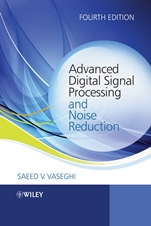
Advanced Digital Signal Processing and Noise Reduction
ISBN 9780470754061
Autor: Saeed V. Vaseghi
Wydawca: Wiley
Dostępność: 3-6 tygodni
Cena: 605,85 zł
Przed złożeniem zamówienia prosimy o kontakt mailowy celem potwierdzenia ceny.
ISBN13: |
9780470754061 |
ISBN10: |
0470754060 |
Autor: |
Saeed V. Vaseghi |
Oprawa: |
Hardback |
Rok Wydania: |
2009-01-23 |
Numer Wydania: |
4th Edition |
Ilość stron: |
544 |
Wymiary: |
251x175 |
Tematy: |
TJ |
Digital signal processing plays a central role in the development of modern communication and information processing systems. The theory and application of signal processing is concerned with the identification, modelling and utilisation of patterns and structures in a signal process. The observation signals are often distorted, incomplete and noisy and therefore noise reduction, the removal of channel distortion, and replacement of lost samples are important parts of a signal processing system.
The fourth edition of Advanced Digital Signal Processing and Noise Reduction updates and extends the chapters in the previous edition and includes two new chapters on MIMO systems, Correlation and Eigen analysis and independent component analysis. The wide range of topics covered in this book include Wiener filters, echo cancellation, channel equalisation, spectral estimation, detection and removal of impulsive and transient noise, interpolation of missing data segments, speech enhancement and noise/interference in mobile communication environments. This book provides a coherent and structured presentation of the theory and applications of statistical signal processing and noise reduction methods.
Two new chapters on MIMO systems, correlation and Eigen analysis and independent component analysis
Comprehensive coverage of advanced digital signal processing and noise reduction methods for communication and information processing systems
Examples and applications in signal and information extraction from noisy data
Comprehensive but accessible coverage of signal processing theory including probability models, Bayesian inference, hidden Markov models, adaptive filters and Linear prediction models
Advanced Digital Signal Processing and Noise Reduction is an invaluable text for postgraduates, senior undergraduates and researchers in the fields of digital signal processing, telecommunications and statistical data analysis. It wil
l also be of interest to professional engineers in telecommunications and audio and signal processing industries and network planners and implementers in mobile and wireless communication communities.
Spis treści:
Contents
Symbols
Abbreviations
1 Introduction
1.1 Signals, Noise and Information
1.2 Signal Processing Methods
1.3 Applications of Digital Signal Processing
1.4 A Review of Sampling and Quantisation
1.5 Summary
Bibliography
2 Noise and Distortion
2.1 Introduction
2.2 White Noise
2.3 Coloured Noise; Pink Noise and Brown Noise
2.4 Impulsive and Click Noise
2.5 Impulsive and Click Noise
2.6 Thermal Noise
2.7 Shot Noise
2.8 Flicker (I/f) Noise
2.9 Burst Noise
2.10 Electromagnetic (Radio) Noise
2.11 Channel Distortions
2.12 Echo and Multi–path Reflections
2.13 Modelling Noise
2.14 Summary
Bibliography
3 Information Theory and Probability Models
3.1 Introduction: Probability and Information Models
3.2 Random Processes
3.3 Probability Models
3.4 Information Models
3.5 Stationary and Non–stationary Processes
3.6 Expected Values of a Process
3.7 Some Useful Classes of Random Processes
3.8 Transformation of a Random Process
3.9 Search Engines: Citation Ranking
3.10 Summary
Bibliography
4 Baseyian Inference
4.1 Bayesian Estimation Theory: Basic Definitions
4.2 Bayesian Estimation
4.3 The Estimate–Maximise Method
4.4 Cramer–Rao Bound on the Minimum Estimator Variance
4.5 Design of Gaussian Mixture Models
4.6 Bayesian Classification
4.7 Modeling the Space of a Random Process
4.8 Summary
Bibliography
5 Hidden Markov Models
5.1 Statistical Models for Non–Stationary Processes
5.2 Hidden Markov Models
5.3 Training Hidden Markov Models
5.4 Decoding of Signals Using Hidde
n Markov Models
5.5 HMM In DNA and Protein Sequence Modelling
5.6 HMMs for Modelling Speech and Noise
5.7 Summary
Bibliography
6 Least Square Error Wiener–Kolmogorov Filters
6.1 Least Square Error Estimation: Wiener–Kolmogorov Filter
6.2 Block–Data Formulation of the Wiener Filter
6.3 Interpretation of Wiener Filters as Projection in Vector Space
6.4 Analysis of the Least Mean Square Error Signal
6.5 Formulation of Wiener Filters in the Frequency Domain
6.6 Some Applications of Wiener Filters
6.7 Implementation of Wiener Filters
6.8 Summary
Bibliography
7 Adaptive Filters, Kalman, RLS, LMS
7.1 Introduction
7.2 State–Space Kalman Filter
7.3 Extended Kalman Filter
7.4 Unscented Kalman Filter
7.5 Sample–Adaptive Filters
7.6 Recursive Least Square(RLS) Adaptive Filters
7.7 The Steepest–Descent Method
7.8 The LMS Filter
7.9 Summary
Bibliography
8 Linear Prediction Models
8.1 Linear Prediction Coding
8.2 Forward, Backward and Lattice Predictors
8.3 Short–term and Long–Term Linear Predictors
8.4 MAP Estimation of Predictor Coefficients
8.5 Formant–Tracking LP Models
8.6 Sub–Band Linear Prediction
8.7 .i.Signal Restoration Using Linear Prediction Models
8.8 Summary
Bibliography
9 Eigenvalue Analysis and Principal Component Analysis
9.1 Introduction
9.2 Eigen Analysis
9.3 Principal Component Analysis
9.4 Summary
Bibliography
10 Power Spectrum Analysis
10.1 Power Spectrum and Correlation
10.2 Fourier Series: Representation of Periodic Signals
10.3.3 Energy–Spectral Density and Power–Spectral Density
10.3 Fourier Transform: Representation of Aperiodic Signals
10.4 Non–Parametric Power Spectrum Estimation
10.5 Model–Based Power Spectral Estimation
10.6 High Re
solution Spectral Estimation Based on Subspace Eigen–Analysis
10.7 Summary
Bibliography
11. Interpolation – Replacement of Lost Samples
11.1 Introduction
11.2 Model–Based Interpolation
11.3 Model–Based Interpolation
11.4 Summary
Bibliography
12 Signal Enhancement via Spectral Amplitude Estimation
12.1Introduction
12.2 Spectral Representation of Noisy Signals
12.3 Vector Representation of Spectrum of Noisy Signals
12.4 Spectral Subtraction
12.5 Bayesian MMSE Spectral Amplitude Estimation
12.6 Estimation of Signal to Noise Ratios
12.7 Application to Speech Restoration and Recognition
12.8 Summary
Bibliography
13 Impulsive Noise: Modelling, Detection and Removal
13.1 Impulsive Noise
13.2 Autocorrelation and Power Spectrum of Impulsive Noise
13.3 Probability Models for Impulsive Noise
13.4 Impulse contamination, Signal to Impulsive Noise Ratio
13.5 Median Filters
13.6 Impulsive Noise Removal Using Linear Prediction Models
13.7 Robust Parameter Estimation
13.8 Restoration of Archived Gramophone Records
13.9 Summary
Bibliography
14 Transient Noise Pulses
14.1 Transient Noise Waveforms
14.2 Transient Noise Pulse Models
14.3 Detection of Noise Pulses
14.4 Removal of Noise Pulse Distortions
14.5 Summary
Bibliography
15 Echo Cancellation
15.1 Introduction: Acoustic and Hybrid.i.Hybrid Echoes
15.2 Echo Return Time: The Sources of Delay in Communication Networks
15.3 Telephone Line Hybrid Echo
15.4 Hybrid Echo Suppression
15.5 .i.Adaptive Echo Cancellation
15.6 Acoustic .i.Echo
15.7 .i.Sub–band Acoustic Echo Cancellation
15.8 .i. Echo Cancellation with Linear Prediction Pre–whitening
15.9 Multiple–Input Multiple–Output (MIMO) Acoustic Echo Cancellation
15.10 Summary
Bibliograph
Koszyk
Książek w koszyku: 0 szt.
Wartość zakupów: 0,00 zł
Informacje


Kontakt
Gambit
Centrum Oprogramowania
i Szkoleń Sp. z o.o.
Al. Pokoju 29b/22-24
31-564 Kraków
Siedziba Księgarni
ul. Kordylewskiego 1
31-542 Kraków
+48 12 410 5991
+48 12 410 5987
+48 12 410 5989
Subskrypcje
Administratorem danych osobowych jest firma Gambit COiS Sp. z o.o. Na podany adres będzie wysyłany wyłącznie biuletyn informacyjny.
Autoryzacja płatności

Informacje na temat autoryzacji płatności poprzez PayU.

© Copyright 2012: GAMBIT COiS Sp. z o.o. Wszelkie prawa zastrzeżone.
Projekt i wykonanie: Alchemia Studio Reklamy