


Wydawcy
Katalog tematyczny
- Archeologia (109)
- Ekonomia, finanse, business (13704)
- Filozofia (1445)
- Historia (3040)
- Języki i językoznawstwo (2356)
- Lifestyle, hobby i rozrywka (475)
- Medycyna (9704)
- Chirurgia (272)
- Inne gałęzie medycyny (1871)
- Medycyna kliniczna (4187)
- Medycyna niekonwencjonalna (14)
- Medycyna przedkliniczna (269)
- Medycyna, ogólnie (1740)
- Historia medycyny (3)
- Lekarze, sprawy zawodowe (8)
- Medycyna, aspekty prawne (10)
- Służba zdrowia (36)
- Wyposażenie medyczne (157)
- Zdrowie publiczne (460)
- Medyczne służby pomocnicze (745)
- Studia medyczne (16)
- Weterynaria (548)
- Nauki humanistyczne (4)
- Nauki o Ziemi i środowisku (2638)
- Nauki ścisłe (20412)
- Nauki społeczne (8486)
- Nauki techniczne (13450)
- Prawo (1696)
- Publikacje informacyjne i interdyscyplinarne (1288)
- Religia i wierzenia (917)
- Technika komputerowa (4067)
- Zdrowie, relacje międzyludzkie i rozwój osobisty (657)





Informacje szczegółowe o książce
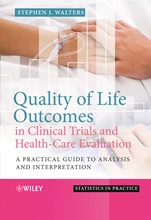
Quality of Life Outcomes in Clinical Trials and Health–Care Evaluation: A Practical Guide to Analysis and Interpretation
ISBN 9780470753828
Autor: Stephen J. Walters
Wydawca: Wiley
Dostępność: 3-6 tygodni
Cena: 411,60 zł
Przed złożeniem zamówienia prosimy o kontakt mailowy celem potwierdzenia ceny.
ISBN13: |
9780470753828 |
ISBN10: |
047075382X |
Autor: |
Stephen J. Walters |
Oprawa: |
Hardback |
Rok Wydania: |
2009-09-25 |
Ilość stron: |
380 |
Wymiary: |
251x173 |
Tematy: |
MBNS |
Quality of Life (QoL) outcomes or Person/Patient Reported Outcome Measures (PROMs) are now frequently being used in randomised controlled trials (RCTs) and observational studies. This book provides a practical guide to the design, analysis and interpretation of studies that use such outcomes.
QoL outcomes tend to generate data with discrete, bounded and skewed distributions. Many investigators are concerned about the appropriateness of using standard statistical methods to analyse QoL data and want guidance on what methods to use. QoL outcomes are frequently used in cross–sectional surveys and non–randomised health–care evaluations.
Provides a user–friendly guide to the design and analysis of clinical trials and observational studies in relation to QoL outcomes.Discusses the problems caused by QoL outcomes and presents intervention options to help tackle them.Guides the reader step–by–step through the selection of appropriate QoLs.Features exercises and solutions and a supporting website (www.wiley.com/go/walters) providing downloadable data files.
Illustrated throughout with examples and case studies drawn from the author’s experience, this book offers statisticians and clinicians guidance on choosing between the numerous available QoL instruments.
Spis treści:
Preface.
1 Introduction.
Summary.
1.1 What is quality of life?
1.2 Terminology.
1.3 History.
1.4 Types of quality of life measures.
1.5 Why measure quality of life?
1.6 Further reading.
2 Measuring quality of life.
Summary.
2.1 Introduction.
2.2 Principles of measurement scales.
2.3 Indicator and causal variables.
2.4 The traditional psychometric model.
2.5 Item response theory.
2.6 Clinimetricscal.
2.7 Measuring quality of life: indicator or causal items.
2.8 Developing and testing questionnaires.
2.9 Further
reading.
3 Choosing a quality of life measure for your study.
Summary.
3.1 Introduction.
3.2 How to choose between instruments.
3.3 Appropriateness.
3.4 Acceptability.
3.5 Feasibility.
3.6 Validity.
3.7 Reliability.
3.8 Responsiveness.
3.9 Precision.
3.10 Interpretability.
3.11 Finding quality of life instruments.
4 Design and sample size issues: How many subjects do I need for my study?
Summary.
4.1 Introduction.
4.2 Significance tests, P–values and power.
4.3 Sample sizes for comparison of two independent groups.
4.4 Choice of sample size method with quality of life outcomes.
4.5 Paired data.
4.6 Equivalence/non–inferiority studies.
4.7 Unknown standard deviation and effect size.
4.8 Cluster randomized controlled trials.
4.9 Non–response.
4.10 Unequal groups.
4.11 Multiple outcomes/endpoints.
4.12 Three or more groups.
4.13 What if we are doing a survey, not a clinical trial?.
4.14 Sample sizes for reliability and method comparison studies.
4.15 Post–hoc sample size calculations.
4.16 Conclusion: Usefulness of sample size calculations.
4.17 Further reading.
5 Reliability and method comparison studies for quality of life measurements.
Summary.
5.1 Introduction.
5.2 Intra–class correlation coefficient.
5.3 Agreement between individual items on a quality of life questionnaire.
5.4 Internal consistency and Cronbach′s alpha.
5.5 Graphical methods for assessing reliability or agreement between two quality of life measures or assessments.
5.6 Further reading.
5.7 Technical details.
6 Summarizing, tabulating and graphically displaying quality of life outcomes.
Summary.
6.1 Introduction.
6.2 Graphs.
6.3 Describing and summarizing quality of life data.
6.4 Presenting quality of life data and results in tables and graphs.
7 Cross–sectional analysis of q
uality of life outcomes.
Summary.
7.1 Introduction.
7.2 Hypothesis testing (using P–values).
7.3 Estimation (using confidence intervals).
7.4 Choosing the statistical method.
7.5 Comparison of two independent groups.
7.6 Comparing more than two groups.
7.7 Two groups of paired observations.
7.8 The relationship between two continuous variables.
7.9 Correlation.
7.10 Regression.
7.11 Multiple regression.
7.12 Regression or correlation?.
7.13 Parametric versus non–parametric methods.
7.14 Technical details: Checking the assumptions for a linear regression analysis.
8 Randomized controlled trials.
Summary.
8.1 Introduction.
8.2 Randomized controlled trials.
8.3 Protocols.
8.4 Pragmatic and explanatory trials.
8.5 Intention–to–treat and per–protocol analyses.
8.6 Patient flow diagram.
8.7 Comparison of entry characteristics.
8.8 Incomplete data.
8.9 Main analysis.
8.10 Interpretation of changes/differences in quality of life scores.
8.11 Superiority and equivalence trials.
8.12 Adjusting for other variables.
8.13 Three methods of analysis for pre–test/post–test control group designs.
8.14 Cross–over trials.
8.15 Factorial trials.
8.16 Cluster randomized controlled trials.
8.17 Further reading.
9 Exploring and modelling longitudinal quality of life data.
Summary.
9.1 Introduction.
9.2 Summarizing, tabulating and graphically displaying repeated QoL assessments.
9.3 Time–by–time analysis.
9.4 Response feature analysis – the use of summary measures.
9.5 Modelling of longitudinal data.
9.6 Conclusions.
10 Advanced methods for analysing quality of life outcomes.
Summary.
10.1 Introduction.
10.2 Bootstrap methods.
10.3 Bootstrap methods for confidence interval estimation.
10.4 Ordinal regression.
10.5 Comparing two independent groups:
Ordinal quality of life measures (with less than 7 categories).
10.6 Proportional odds or cumulative logit model.
10.7 Continuation ratio model.
10.8 Stereotype logistic model.
10.9 Conclusions and further reading.
11 Economic evaluations.
Summary.
11.1 Introduction.
11.2 Economic evaluations.
11.3 Utilities and QALYs.
11.4 Economic evaluations alongside a controlled trial.
11.5 Cost–effectiveness analysis.
11.6 Cost–effectiveness ratios.
11.7 Cost–utility analysis and cost–utility ratios.
11.8 Incremental cost per QALY.
11.9 The problem of negative (and positive) incremental cost–effectiveness ratios.
11.10 Cost–effectiveness acceptability curves.
11.11 Further reading.
12 Meta–analysis.
Summary.
12.1 Introduction.
12.2 Planning a meta–analysis.
12.3 Statistical methods in meta–analysis.
12.4 Presentation of results.
12.5 Conclusion.
12.6 Further reading.
13 Practical issues.
Summary.
13.1 Missing data.
13.2 Multiplicity, multi–dimensionality and multiple quality of life outcomes.
13.3 Guidelines for reporting quality of life studies.
Solutions to exercises.
Appendix A: Examples of questionnaires.
Appendix B: Statistical tables.
References.
Index.
Okładka tylna:
Quality of Life (QoL) outcomes or Person/Patient Reported Outcome Measures (PROMs) are now frequently being used in randomised controlled trials (RCTs) and observational studies. This book provides a practical guide to the design, analysis and interpretation of studies that use such outcomes.
QoL outcomes tend to generate data with discrete, bounded and skewed distributions. Many investigators are concerned about the appropriateness of using standard statistical methods to analyse QoL data and want guidance on what methods to use. QoL outcomes are frequently used in cross
–sectional surveys and non–randomised health–care evaluations.
Provides a user–friendly guide to the design and analysis of clinical trials and observational studies in relation to QoL outcomes.Discusses the problems caused by QoL outcomes and presents intervention options to help tackle them.Guides the reader step–by–step through the selection of appropriate QoLs.Features exercises and solutions and a supporting website (www.wiley.com/go/walters) providing downloadable data files.
Illustrated throughout with examples and case studies drawn from the author’s experience, this book offers statisticians and clinicians guidance on choosing between the numerous available QoL instruments.
Koszyk
Książek w koszyku: 0 szt.
Wartość zakupów: 0,00 zł
Informacje


Kontakt
Gambit
Centrum Oprogramowania
i Szkoleń Sp. z o.o.
Al. Pokoju 29b/22-24
31-564 Kraków
Siedziba Księgarni
ul. Kordylewskiego 1
31-542 Kraków
+48 12 410 5991
+48 12 410 5987
+48 12 410 5989
Subskrypcje
Administratorem danych osobowych jest firma Gambit COiS Sp. z o.o. Na podany adres będzie wysyłany wyłącznie biuletyn informacyjny.
Autoryzacja płatności

Informacje na temat autoryzacji płatności poprzez PayU.

© Copyright 2012: GAMBIT COiS Sp. z o.o. Wszelkie prawa zastrzeżone.
Projekt i wykonanie: Alchemia Studio Reklamy