


Wydawcy
Katalog tematyczny
- Archeologia (109)
- Ekonomia, finanse, business (13704)
- Filozofia (1445)
- Historia (3040)
- Języki i językoznawstwo (2356)
- Lifestyle, hobby i rozrywka (475)
- Medycyna (9704)
- Nauki humanistyczne (4)
- Nauki o Ziemi i środowisku (2638)
- Nauki ścisłe (20412)
- Nauki społeczne (8486)
- Nauki techniczne (13450)
- Budownictwo lądowe (1045)
- Chemia przemysłowa (2258)
- Elektronika i telekomunikacja (3287)
- Energetyka (1122)
- Inne nauki stosowane (363)
- Inżynieria biochemiczna (507)
- Inżynieria transportu (232)
- Mechanika i materiały (3316)
- Nauka o środowisku (321)
- Rolnictwo (507)
- Technika, ogólnie (475)
- Prawo (1696)
- Publikacje informacyjne i interdyscyplinarne (1288)
- Religia i wierzenia (917)
- Technika komputerowa (4067)
- Zdrowie, relacje międzyludzkie i rozwój osobisty (657)





Informacje szczegółowe o książce
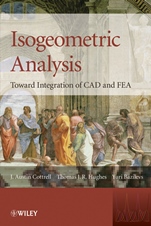
Isogeometric Analysis: Toward Integration of CAD and FEA
ISBN 9780470748732
Autor: J. Austin Cottrell, Thomas J. R Hughes, Yuri Bazilevs
Wydawca: Wiley
Dostępność: 3-6 tygodni
Cena: 580,65 zł
Przed złożeniem zamówienia prosimy o kontakt mailowy celem potwierdzenia ceny.
ISBN13: |
9780470748732 |
ISBN10: |
0470748737 |
Autor: |
J. Austin Cottrell, Thomas J. R Hughes, Yuri Bazilevs |
Oprawa: |
Hardback |
Rok Wydania: |
2009-08-14 |
Ilość stron: |
360 |
Wymiary: |
242x169 |
Tematy: |
TG |
“The authors are the originators of isogeometric analysis, are excellent scientists and good educators. It is very original. There is no other book on this topic.” ––René de Borst, Eindhoven University of Technology
Written by leading experts in the field and featuring fully integrated colour throughout, Isogeometric Analysis provides a groundbreaking solution for the integration of CAD and FEA technologies. Tom Hughes and his researchers, Austin Cottrell and Yuri Bazilevs, present their pioneering isogeometric approach, which aims to integrate the two techniques of CAD and FEA using precise NURBS geometry in the FEA application. This technology offers the potential to revolutionise automobile, ship and airplane design and analysis by allowing models to be designed, tested and adjusted in one integrative stage.
Providing a systematic approach to the topic, the authors begin with a tutorial introducing the foundations of Isogeometric Analysis, before advancing to a comprehensive coverage of the most recent developments in the technique. The authors offer a clear explanation as to how to add isogeometric capabilities to existing finite element computer programs, demonstrating how to implement and use the technology. Detailed programming examples and datasets are included to impart a thorough knowledge and understanding of the material.
Provides examples of different applications, showing the reader how to implement isogeometric modelsAddresses readers on both sides of the CAD/FEA divideDescribes Non–Uniform Rational B–Splines (NURBS) basis functions
Spis treści:
Preface
1 From CAD and FEA to Isogeometric Analysis: An Historical Perspective
1.1 Introduction
1.2 The evolution of FEA basis functions
1.3 The evolution of CAD representations
1.4 Things you need to get used to in order to understand NURBSR
11;based isogeometric analysis
Notes
2 NURBS as a Pre–analysis Tool: Geometric Design and Mesh Generation
2.1 B–splines
2.2 Non–Uniform Rational B–Splines
2.3 Multiple patches
2.4 Generating a NURBS mesh: a tutorial
2.5 Notation
Appendix 2.A: Data for the bent pipe
Notes
3 NURBS as a Basis for Analysis: Linear Problems
3.1 The isoparametric concept
3.2 Boundary value problems
3.3 Numerical methods
3.4 Boundary conditions
3.5 Multiple patches revisited
3.6 Comparing isogeometric analysis with classical finite element analysis
Appendix 3.A: Shape function routine
Appendix 3.B: Error estimates
Notes
4 Linear Elasticity
4.1 Formulating the equations of elastostatics
4.2 Infinite plate with circular hole under constant in–plane tension
4.3 Thin–walled structures modeled as solids
Appendix 4.A: Geometrical data for the hemispherical shell
Appendix 4.B: Geometrical data for a cylindrical pipe
Appendix 4.C: Element assembly routine
Notes
5 Vibrations and Wave Propagation
5.1 Longitudinal vibrations of an elastic rod
5.2 Rotation–free analysis of the transverse vibrations of a Bernoulli–Euler beam
5.3 Transverse vibrations of an elastic membrane
5.4 Rotation–free analysis of the transverse vibrations of a Poisson–Kirchhoff plate
5.5 Vibrations of a clamped thin circular plate using three–dimensional solid elements
5.6 The NASA aluminum testbed cylinder
5.7 Wave propagation
Appendix 5.A: Kolmogorov n–widths
Notes
6 Time–Dependent Problems
6.1 Elastodynamics
6.2 Semi–discrete methods
6.3 Space–time finite elements
7 Nonlinear Isogeometric Analysis
7.1 The Newton–Raphson method
7.2 Isogeometric analysis of nonlinear differential equations
7.3 Nonlinear time integration: The generalized–α<
/i> method
Note
8 Nearly Incompressible Solids
8.1 B formulation for linear elasticity using NURBS
8.2 F formulation for nonlinear elasticity
Notes
9 Fluids
9.1 Dispersion analysis
9.2 The variational multiscale (VMS) method
9.3 Advection–diffusion equation
9.4 Turbulence
Notes
10 Fluid–Structure Interaction and Fluids on Moving Domains
10.1 The arbitrary Lagrangian–Eulerian (ALE) formulation
10.2 Inflation of a balloon
10.3 Flow in a patient–specific abdominal aorta with aneurysm
10.4 Rotating components
Appendix 10.A: A geometrical template for arterial blood flow modeling
11 Higher–order Partial Differential Equations
11.1 The Cahn–Hilliard equation
11.2 Numerical results
11.3 The continuous/discontinuous Galerkin (CDG) method
Note
12 Some Additional Geometry
12.1 The polar form of polynomials
12.2 The polar form of B–splines
Note
13 State–of–the–Art and Future Directions
13.1 State–of–the–art
13.2 Future directions
Appendix A: Connectivity Arrays
A.1 The INC Array
A.2 The IEN array
A.3 The ID array
A.3.1 The scalar case
A.3.2 The vector case
A.4 The LM array
Note
References
Index
Okładka tylna:
“The authors are the originators of isogeometric analysis, are excellent scientists and good educators. It is very original. There is no other book on this topic.” ––René de Borst, Eindhoven University of Technology
Written by leading experts in the field and featuring fully integrated colour throughout, Isogeometric Analysis provides a groundbreaking solution for the integration of CAD and FEA technologies. Tom Hughes and his researchers, Austin Cottrell and Yuri Bazilevs, present their pioneering isogeometric approach
, which aims to integrate the two techniques of CAD and FEA using precise NURBS geometry in the FEA application. This technology offers the potential to revolutionise automobile, ship and airplane design and analysis by allowing models to be designed, tested and adjusted in one integrative stage.
Providing a systematic approach to the topic, the authors begin with a tutorial introducing the foundations of Isogeometric Analysis, before advancing to a comprehensive coverage of the most recent developments in the technique. The authors offer a clear explanation as to how to add isogeometric capabilities to existing finite element computer programs, demonstrating how to implement and use the technology. Detailed programming examples and datasets are included to impart a thorough knowledge and understanding of the material.
Provides examples of different applications, showing the reader how to implement isogeometric modelsAddresses readers on both sides of the CAD/FEA divideDescribes Non–Uniform Rational B–Splines (NURBS) basis functions
Koszyk
Książek w koszyku: 0 szt.
Wartość zakupów: 0,00 zł
Informacje


Kontakt
Gambit
Centrum Oprogramowania
i Szkoleń Sp. z o.o.
Al. Pokoju 29b/22-24
31-564 Kraków
Siedziba Księgarni
ul. Kordylewskiego 1
31-542 Kraków
+48 12 410 5991
+48 12 410 5987
+48 12 410 5989
Subskrypcje
Administratorem danych osobowych jest firma Gambit COiS Sp. z o.o. Na podany adres będzie wysyłany wyłącznie biuletyn informacyjny.
Autoryzacja płatności

Informacje na temat autoryzacji płatności poprzez PayU.

© Copyright 2012: GAMBIT COiS Sp. z o.o. Wszelkie prawa zastrzeżone.
Projekt i wykonanie: Alchemia Studio Reklamy