


Wydawcy
Katalog tematyczny
- Archeologia (109)
- Ekonomia, finanse, business (13704)
- Filozofia (1445)
- Historia (3040)
- Języki i językoznawstwo (2356)
- Lifestyle, hobby i rozrywka (475)
- Medycyna (9704)
- Chirurgia (272)
- Inne gałęzie medycyny (1871)
- Medycyna kliniczna (4187)
- Choroby wewnętrzne (514)
- Dermatologia (51)
- Diagnostyka medyczna (3)
- Endokrynologia (144)
- Gastroenterologia (27)
- Geriatria (50)
- Ginekologia i położnictwo (134)
- Hematologia (46)
- Hepatologia (10)
- Kardiologia (71)
- Laryngologia (12)
- Nefrologia (10)
- Neurologia (500)
- Oftalmologia (50)
- Pediatria (33)
- Pulmunologia (32)
- Reumatologia (14)
- Terapia genowa (1)
- Układ mięśniowo-szkieletowy (1)
- Urologia (14)
- Medycyna niekonwencjonalna (14)
- Medycyna przedkliniczna (269)
- Medycyna, ogólnie (1740)
- Medyczne służby pomocnicze (745)
- Studia medyczne (16)
- Weterynaria (548)
- Nauki humanistyczne (4)
- Nauki o Ziemi i środowisku (2638)
- Nauki ścisłe (20412)
- Nauki społeczne (8486)
- Nauki techniczne (13450)
- Prawo (1696)
- Publikacje informacyjne i interdyscyplinarne (1288)
- Religia i wierzenia (917)
- Technika komputerowa (4067)
- Zdrowie, relacje międzyludzkie i rozwój osobisty (657)





Informacje szczegółowe o książce
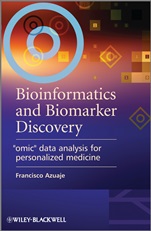
Bioinformatics and Biomarker Discovery: "Omic" Data Analysis for Personalized Medicine
ISBN 9780470744604
Autor: Francisco Azuaje
Wydawca: Wiley
Dostępność: 3-6 tygodni
Cena: 639,45 zł
Przed złożeniem zamówienia prosimy o kontakt mailowy celem potwierdzenia ceny.
ISBN13: |
9780470744604 |
ISBN10: |
047074460X |
Autor: |
Francisco Azuaje |
Oprawa: |
Hardback |
Rok Wydania: |
2010-02-12 |
Ilość stron: |
248 |
Wymiary: |
252x178 |
Tematy: |
MJ |
Bioinformatics and Biomarker Discovery: “Omic” Data Analysis for Personalized Medicine is designed to introduce biologists, clinicians and computational researchers to fundamental data analysis principles, techniques and tools for supporting the discovery of biomarkers and the implementation of diagnostic/prognostic systems.
The focus of the book is on how fundamental statistical and data mining approaches can support biomarker discovery and evaluation, emphasizing applications based on different types of “omic” data. The book also discusses design factors, requirements and techniques for disease screening, diagnostic and prognostic applications.
Readers are provided with the knowledge needed to assess the requirements, computational approaches and outputs in disease biomarker research. Commentaries from guest experts are also included, containing detailed discussions of methodologies and applications based on specific types of “omic” data, as well as their integration.Covers the main range of data sources currently used for biomarker discovery Puts emphasis on concepts, design principles and methodologies that can be extended or tailored to more specific applications Offers principles and methods for assessing the bioinformatic/biostatistic limitations, strengths and challenges in biomarker discovery studiesDiscusses systems biology approaches and applicationsIncludes expert chapter commentaries to further discuss relevance of techniques, summarize biological/clinical implications and provide alternative interpretations
Spis treści:
Author and guest contributor biographies
Acknowledgements
Preface
1 Biomarkers and bioinformatics
1.1 Bioinformatics, translational research and personalized medicine
1.2 Biomarkers: fundamental definitions and research principles
1.3 Clinical resources for biomarker stud
ies
1.4 Molecular biology data sources for biomarker research
1.5 Basic computational approaches to biomarker discovery: key applications and challenges
1.6 Examples of biomarkers and applications
1.7 What is next?
2 Review of fundamental statistical concepts
2.1 Basic concepts and problems
2.2 Hypothesis testing and group comparison
2.3 Assessing statistical significance in multiple–hypotheses testing
2.4 Correlation
2.5 Regression and classification: basic concepts
2.6 Survival analysis methods
2.7 Assessing predictive quality
2.8 Data sample size estimation
2.9 Common pitfalls and misinterpretations
3 Biomarker–based prediction models: design and interpretation principles
3.1 Biomarker discovery and prediction model development
3.2 Evaluation of biomarker–based prediction models
3.3 Overview of data mining and key biomarker–based classification techniques
3.4 Feature selection for biomarker discovery
3.5 Critical design and interpretation factors
4 An introduction to the discovery and analysis of genotype–phenotype associations
4.1 Introduction: sources of genomic variation
4.2 Fundamental biological and statistical concepts
4.3 Multi–stage case–control analysis
4.4 SNPs data analysis: additional concepts, approaches and applications
4.5 CNV data analysis: additional concepts, approaches and applications
4.6 Key problems and challenges
Guest commentary on chapter 4: Integrative approaches to genotype–phenotype association discovery
Ana Dopazo
References
5 Biomarkers and gene expression data analysis
5.1 Introduction
5.2 Fundamental analytical steps in gene expression profiling
5.3 Examples of advances and applications
5.4 Examples of the roles of advanced data mining and computational intelligence
5.5 Key limitations, common pitfalls and challenges
Guest
commentary on chapter 5: Advances in biomarker discovery
with gene expression data
Haiying Wang, Huiru Zheng
Unsupervised clustering approaches
Module–based approaches
Final remarks
References
6 Proteomics and metabolomics for biomarker discovery: an introduction to spectral data analysis
6.1 Introduction
6.2 Proteomics and biomarker discovery
6.3 Metabolomics and biomarker discovery
6.4 Experimental techniques for proteomics and metabolomics: an overview
6.5 More on the fundamentals of spectral data analysis
6.6 Targeted and global analyses in metabolomics
6.7 Feature transformation, selection and classification of spectral data
6.8 Key software and information resources for proteomics and metabolomics
6.9 Gaps and challenges in bioinformatics
Guest commentary on chapter 6: Data integration in proteomics and metabolomics for biomarker discovery
Kenneth Bryan
Data integration and feature selection
References
7 Disease biomarkers and biological interaction networks
7.1 Network–centric views of disease biomarker discovery
7.2 Basic concepts in network analysis
7.3 Fundamental approaches to representing and inferring networks
7.4 Overview of key network–driven approaches to biomarker discovery
7.5 Network–based prognostic systems: recent research highlights
7.6 Final remarks: opportunities and obstacles in network–based biomarker research
Guest commentary on chapter 7: Commentary on ‘disease biomarkers and biological interaction networks’
Zhongming Zhao
Integrative approaches to biomarker discovery
Pathway–based analysis of GWA data
Integrative analysis of networks and pathways
References
8 Integrative data analysis for biomarker discovery
8.1 Introduction
8.2 Data aggregation at the model input level
8.3 Model integration ba
sed on a single–source or homogeneous data sources
8.4 Data integration at the model level
8.5 Multiple heterogeneous data and model integration
8.6 Serial integration of source and models
8.7 Component– and network–centric approaches
8.8 Final remarks
Guest commentary on chapter 8: Data integration: The next big hope?
Yves Moreau
References
9 Information resources and software tools for biomarker discovery
9.1 Biomarker discovery frameworks: key software and information resources
9.2 Integrating and sharing resources: databases and tools
9.3 Data mining tools and platforms
9.4 Specialized information and knowledge resources
9.5 Integrative infrastructure initiatives and inter–institutional programmes
9.6 Innovation outlook: challenges and progress
10 Challenges and research directions in bioinformatics and biomarker discovery
10.1 Introduction
10.2 Better software
10.3 The clinical relevance of new biomarkers
10.4 Collaboration
10.5 Evaluating and validating biomarker models
10.6 Defining and measuring phenotypes
10.7 Documenting and reporting biomarker research
10.8 Intelligent data analysis and computational models
10.9 Integrated systems and infrastructures for biomedical computing
10.10 Open access to research information and outcomes
10.11 Systems–based approaches
10.12 Training a new generation of researchers for translational bioinformatics
10.13 Maximizing the use of public resources
10.14 Final remarks
Guest commentary (1) on chapter 10: Towards building knowledge–based assistants for intelligent data analysis in biomarker discovery
Riccardo Bellazzi
References
Guest commentary (2) on chapter 10: Accompanying commentary on ‘challenges and opportunities of bioinformatics in disease biomarker discovery’
Gary B. Fogel
Introductio
n
Biocyberinfrastructure
Government Regulations on biomarker discovery
Computational intelligence approaches for biomarker discovery
Open source data, intellectual property, and patient privacy
Conclusions
References
References
Index
Nota biograficzna:
Francisco Azuaje has more than fifteen years of research experience in the areas of computer science, medical informatics. His contributions have been reflected in several national and international research projects and an extensive publication record in journals, conference proceedings and books. Dr Azuaje is a Senior Member of the IEEE. He held a lectureship and readership in computer science and biomedical informatics at Trinity College Dublin, Ireland, and at the University of Ulster, UK, from January 2000 to February 2008. He is currently leading research in translational bioinformatics and systems biology approaches to prognostic biomarker development at the Laboratory of Cardiovascular Research, CRP–Santé, Luxembourg. He has been a member of the editorial boards of several journals and scientific committees of international conferences disseminating research at the intersection of the physical and computer sciences, engineering and biomedical sciences. He is an Associate Editor of the IEEE Transactions on Nanobioscience and BioData Mining. Dr Azuaje co–edited the books: Data Analysis and Visualization in Genomics and Proteomics, Artificial Intelligence Methods and Tools for Systems Biology, and Advanced Methods and Tools for ECG Data Analysis. He is currently a Section Editor of the Encyclopedia of Systems Biology.
Okładka tylna:
Bioinformatics and Biomarker Discovery: “Omic” Data Analysis for Personalized Medicine is designed to introduce biologists, clinicians and computational researchers to fundamental data analysis principles, techniques and tools for supporting the discov
ery of biomarkers and the implementation of diagnostic/prognostic systems.
The focus of the book is on how fundamental statistical and data mining approaches can support biomarker discovery and evaluation, emphasizing applications based on different types of “omic” data. The book also discusses design factors, requirements and techniques for disease screening, diagnostic and prognostic applications.
Readers are provided with the knowledge needed to assess the requirements, computational approaches and outputs in disease biomarker research. Commentaries from guest experts are also included, containing detailed discussions of methodologies and applications based on specific types of “omic” data, as well as their integration.Covers the main range of data sources currently used for biomarker discovery Puts emphasis on concepts, design principles and methodologies that can be extended or tailored to more specific applications Offers principles and methods for assessing the bioinformatic/biostatistic limitations, strengths and challenges in biomarker discovery studiesDiscusses systems biology approaches and applicationsIncludes expert chapter commentaries to further discuss relevance of techniques, summarize biological/clinical implications and provide alternative interpretations
Koszyk
Książek w koszyku: 0 szt.
Wartość zakupów: 0,00 zł
Informacje


Kontakt
Gambit
Centrum Oprogramowania
i Szkoleń Sp. z o.o.
Al. Pokoju 29b/22-24
31-564 Kraków
Siedziba Księgarni
ul. Kordylewskiego 1
31-542 Kraków
+48 12 410 5991
+48 12 410 5987
+48 12 410 5989
Subskrypcje
Administratorem danych osobowych jest firma Gambit COiS Sp. z o.o. Na podany adres będzie wysyłany wyłącznie biuletyn informacyjny.
Autoryzacja płatności

Informacje na temat autoryzacji płatności poprzez PayU.

© Copyright 2012: GAMBIT COiS Sp. z o.o. Wszelkie prawa zastrzeżone.
Projekt i wykonanie: Alchemia Studio Reklamy