


Wydawcy
Katalog tematyczny
- Archeologia (109)
- Ekonomia, finanse, business (13704)
- Filozofia (1445)
- Historia (3040)
- Języki i językoznawstwo (2356)
- Lifestyle, hobby i rozrywka (475)
- Medycyna (9704)
- Nauki humanistyczne (4)
- Nauki o Ziemi i środowisku (2638)
- Nauki ścisłe (20412)
- Nauki społeczne (8486)
- Nauki techniczne (13450)
- Prawo (1696)
- Publikacje informacyjne i interdyscyplinarne (1288)
- Religia i wierzenia (917)
- Technika komputerowa (4067)
- Zdrowie, relacje międzyludzkie i rozwój osobisty (657)





Informacje szczegółowe o książce
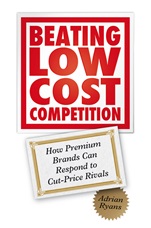
Beating Low Cost Competition: How Premium Brands can respond to Cut–Price Rivals
ISBN 9780470742976
Autor: Adrian Ryans
Wydawca: Wiley
Dostępność: 3-6 tygodni
Cena: 173,25 zł
Przed złożeniem zamówienia prosimy o kontakt mailowy celem potwierdzenia ceny.
ISBN13: |
9780470742976 |
ISBN10: |
0470742976 |
Autor: |
Adrian Ryans |
Oprawa: |
Hardback |
Rok Wydania: |
2009-01-26 |
Ilość stron: |
272 |
Wymiary: |
236x164 |
Tematy: |
KM |
“A very useful step–by–step approach to guide managers towards creating their own answers for winning against low–cost competition.”
Yves Serra, President and CEO, Georg Fischer, Schaffhausen, Switzerland
“Low cost competition has moved from being an out–of–the–box concept to changing the way business gets done. It is an issue for every industry and this book has insights that are practical and relevant for every manager. Adrian Ryans has put together a compelling storyline that is a must read for tomorrow’s successful leader.”
Arkadi Kuhlmann, CEO, ING Direct, Wilmington, Delaware, USA
“The single biggest competitive threat faced by multinational companies operating in low cost environments, does not come from the Low Cost Competitors, but rather from your company′s ability to fully grasp the massive threat in time and understand how to deal with it successfully. This book – your survival guide for dealing with low cost competitors – will enable you to understand and devise an execution–focused strategy to meet your specific competitive challenge. Make sure your CEO and country managers read this book from cover to cover.”
Lars A. Andersen, President, Vestas China, Beijing, China
“Adrian Ryans has clearly highlighted the challenges of competing to win in the global economy. Competitors from Asia are no longer producing low cost, low quality products that are not competitive. Rather the same companies that needed help from market leaders ten years ago and were used as low cost suppliers are now world–class competitors in their own right. Beating Low Cost Competition frames the nature of the competitive game for the next generation of executives. Answer the questions at the end of each chapter of Beating Low Cost Competition; if the answers don
’t scare you today, they might tomorrow!”
David Churchill, Vice President and General Manager, Agilent Technologies, Inc, Colorado Springs, Colorado, USA
“Whether or not you believe you are vulnerable to low cost competition is irrelevent –you are! Low cost competitors can be beaten, if companies apply the principles of speed and imitation to their own business models and strategies. Beating Low Cost Competition provides concrete tools and concepts to help you do it”.
Richard Brook, President – Europe, Middle East & Africa, Cochlear Limited, Lane Cove, NSW, Australia
“Our volume business was being seriously challenged by low cost competitors. The tools, concepts and examples described by Adrian Ryans helped us develop a new, innovative strategy to beat the competition.”
René Lenggenhager, General Manager, Mettler Toledo, Greifensee, Switzerland
Spis treści:
Contents
Preface
Acknowledgments
1 The Growing Challenge from Low Cost Competitors
The Challenge is Real and It is Here to Stay
Retailing
Airlines
Banking
Fast–moving consumer goods
Consumer electronics
Business–to–business products and services
In Many Industries the Major Threat is Coming from Asia
Many Customers Prefer Good Enough Products and Services
Low Cost Competition Is Not All Bad News
Understanding and Responding to the Challenge of Low Cost Competition
2 Why the Threat from Low Cost Competition is Intensifying
Value Propositions Have Three Core Elements
Performance value
Price value
Relational value
One core value proposition is usually emphasized
The relative size of the different value segments may evolve over time
Product category life cycles are getting shorter
T
he Traditional Integrated Business Model is Disintegrating
Three core processes underpin any business
Giving balanced attention to all three core processes can lead to conflict
Companies are leveraging the specialized players
Companies with focused business models are playing a much bigger role in many industries
Many more companies are opening their business models
But there are significant risks in relying more on strategic partners
Total solution coordinators are helping some companies leverage these networks
Growing Support for Low Cost Competitors
Low cost entrants sometimes have powerful supporters
Customers are increasingly willing to buy from low cost players
Challenge Questions
3 Understanding How Low Cost Competitors Play the Game
Ryanair
Performance has been outstanding
Value proposition is crystal clear
Business model is innovative and focused
Extreme focus on cost control
Created a virtuous cycle
So far . . . so good
ING DIRECT USA
Borrowed with pride
Appealing value proposition
Early success
Competition finally responds and ING DIRECT raises the stakes
Learning from Low Cost Competitors
Question every element of the traditional business model
Have very simple and straightforward value propositions
Avoid complexity at any cost
Break through the communication clutter
Be a cost innovator
Remember that the customer is not always right
Have the courage to drop prices significantly below competition
Traditional Players Can Learn from Low Cost Competitors
Challenge Questions
4 Realistically Assessing the Threat
Some Industries Are Less Vulnerable to the Low Cost Threat
Why Companies Fail to Respond to the Low Cost Threat in a Timely Manner
The low cos
t threat is underestimated
The low cost threat often takes time to gain momentum
Sometimes it is the second–order effects that have the biggest impact
Realistically Assessing the Threat ... and the Opportunity
“Beat my business” exercises can be a useful tool
Identifying actual and potential low cost competitors is key
Understanding what is driving the strategy of the low cost competitors
Core capabilities, distinctive resources and major gaps are often key drivers of a low cost competitor’s strategy
Low cost competitors can overcome critical gaps in creative ways
How might a low cost competitor significantly enhance its position?
Low cost competitors often follow similar strategies to improve their position
It is a challenge to anticipate the moves of unconventional competitors
Most Business Models Have Limited Reach
Developing a Worst Case Scenario Can Provide a “Burning Platform”
Framing the Financial Analysis as a Comparison of Two Futures is Critical
Challenge Questions
5 Confronting Low Cost Competitors in the Price Value Segment of the Market
Competing at All Levels in the Market is Usually Not Necessary
The Challenge Decision Requires Thinking Through Many Issues
Arguments for Entering the Price Value Segment
“Good enough” products can meet a real market need
Opportunity to engage price value customers and develop better solutions to their needs over time
Opportunity to grow with customer as their strategies evolve
May provide an opportunity for “up–selling”
Gives traditional players some “control” over low cost competitors
Arguments For Not Entering the Price Value Segment
Conflicts with the traditional value proposition of the business
Encourages cannibalization of high–
Koszyk
Książek w koszyku: 0 szt.
Wartość zakupów: 0,00 zł
Informacje


Kontakt
Gambit
Centrum Oprogramowania
i Szkoleń Sp. z o.o.
Al. Pokoju 29b/22-24
31-564 Kraków
Siedziba Księgarni
ul. Kordylewskiego 1
31-542 Kraków
+48 12 410 5991
+48 12 410 5987
+48 12 410 5989
Subskrypcje
Administratorem danych osobowych jest firma Gambit COiS Sp. z o.o. Na podany adres będzie wysyłany wyłącznie biuletyn informacyjny.
Autoryzacja płatności

Informacje na temat autoryzacji płatności poprzez PayU.

© Copyright 2012: GAMBIT COiS Sp. z o.o. Wszelkie prawa zastrzeżone.
Projekt i wykonanie: Alchemia Studio Reklamy