


Wydawcy
Katalog tematyczny
- Archeologia (109)
- Ekonomia, finanse, business (13704)
- Filozofia (1445)
- Historia (3040)
- Języki i językoznawstwo (2356)
- Lifestyle, hobby i rozrywka (475)
- Medycyna (9704)
- Nauki humanistyczne (4)
- Nauki o Ziemi i środowisku (2638)
- Nauki ścisłe (20412)
- Astronomia (294)
- Biologia (5119)
- Chemia (6540)
- Fizyka (3309)
- Elektryczność i magnetyzm (90)
- Fizyka atomowa i molekularna (110)
- Fizyka cząstek elementarnych (36)
- Fizyka jądra atomowego (36)
- Fizyka kwantowa (210)
- Fizyka matematyczna (121)
- Fizyka relatywistyczna (36)
- Fizyka statystyczna (51)
- Fizyka stosowana (498)
- Mechanika klasyczna (186)
- Optyka i światło (133)
- Stany materii (202)
- Matematyka (4574)
- Nauki ścisłe, ogólnie (503)
- Nauki społeczne (8486)
- Nauki techniczne (13450)
- Prawo (1696)
- Publikacje informacyjne i interdyscyplinarne (1288)
- Religia i wierzenia (917)
- Technika komputerowa (4067)
- Zdrowie, relacje międzyludzkie i rozwój osobisty (657)





Informacje szczegółowe o książce
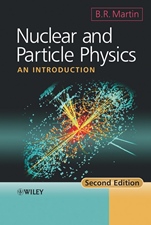
Nuclear and Particle Physics: An Introduction
ISBN 9780470742747
Autor: Brian R. Martin
Wydawca: Wiley
Dostępność: 3-6 tygodni
Cena: 773,85 zł
Przed złożeniem zamówienia prosimy o kontakt mailowy celem potwierdzenia ceny.
ISBN13: |
9780470742747 |
ISBN10: |
0470742747 |
Autor: |
Brian R. Martin |
Oprawa: |
Hardback |
Rok Wydania: |
2009-02-06 |
Numer Wydania: |
2nd Edition |
Ilość stron: |
454 |
Wymiary: |
252x180 |
Tematy: |
PH |
An accessible introduction to nuclear and particle physics with equal coverage of both topics, this text covers all the standard topics in particle and nuclear physics thoroughly and provides a few extras, including chapters on experimental methods; applications of nuclear physics including fission, fusion and biomedical applications; and unsolved problems for the future. It includes basic concepts and theory combined with current and future applications. An excellent resource for physics and astronomy undergraduates in higher–level courses, this text also serves well as a general reference for graduate studies.
Spis treści:
Preface to Second Edition.
Notes.
1. Basic Concepts.
1.1 History.
1.2 Relativity and Antiparticles.
1.3 Space–Time Symmetries and Conservation Laws.
1.4 Interactions and Feynman Diagrams.
1.5 Particle Exchange: Forces and Potentials.
1.6 Observable Quantities: Cross–sections and Decay Rates.
1.7 Units: Length, Mass and Energy.
Problems.
2. Nuclear Phenomenology.
2.1 Mass Spectroscopy .
2.2 Nuclear Shapes and Sizes.
2.3 Semi–Empirical Mass Formula: the Liquid Drop Model.
2.4 Nuclear Instability.
2.5 Radioactive Decay.
2.6 βDecay Phenomenology.
2.7 Fission.
2.8 γDecays.
2.9 Nuclear Reactions.
Problems.
3. Particle Phenomenology.
3.1 Leptons.
3.2 Quarks.
3.3 Hadrons.
Problems.
4. Experimental Methods.
4.1 Overview.
4.2 Accelerators and Beams.
4.3 Particle Interactions with Matter.
4.4 Particle Detectors.
4.5 Multi–Component Detector Systems.
Problems.
5. Quark Dynamics: The Strong Interaction .
5.1 Colour.
5.2 Quantum Chromodynamics (QCD).
5.3 Heavy Quark Bound States.
5.4 The Strong Coupling Constant and Asymptotic Freedom.
5.5 Quark–Gluon Plasma.
5.6 Jets and Gluons.
5.7 Colour Counting.
5.8 Deep Inelastic Scattering and
Nucleon Structure.
Problems.
6. Weak Interactions And Electroweak Unification.
6.1 Charged and Neutral Currents.
6.2 Symmetries of the Weak Interaction.
6.3 Spin Structure of the Weak Interactions.
6.4 W± and Z0 Bosons.
6.5 Weak Interactions of Hadrons: Charged Currents.
6.6 Meson Decays and CP Violation.
6.7 Neutral Currents and the Unified Theory.
Problems.
7. Models And Theories Of Nuclear Physics .
7.1 The Nucleon–Nucleon Potential.
7.2 Fermi Gas Model.
7.3 Shell Model.
7.4 Non–Spherical Nuclei.
7.5 Summary of Nuclear Structure Models.
7.6 α–Decay.
7.7 β–Decay.
7.8 γ–Emission and Internal Conversion.
Problems.
8. Applications Of Nuclear Physics.
8.1 Fission.
8.2 Fusion.
8.3 Nuclear Weapons.
8.4 Biomedical applications.
Problems.
9. Outstanding Questions and Future Prospects.
9.1 Overview.
9.2 Hadrons and Nuclei .
9.3 The Origin of Mass: the Higgs Boson .
9.4 The Nature of the Neutrino.
9.5 Beyond the Standard Model: Unification Schemes.
9.6 Particle Astrophysics.
9.7 Nuclear Medicine.
9.8 Power Production and Nuclear Waste.
Appendix A: Some Results In Quantum Mechanics.
A.1 Barrier Penetration.
A.2 Density of States.
A.3 Perturbation Theory and the Second Golden Rule.
A.4 Isospin Formalism.
A.4.1 Isospin operators and quark states.
A.4.2 Hadron states.
Appendix B: Relativistic Kinematics.
B.1 Lorentz Transformations and Four–Vectors.
B.2 Frames of Reference.
B.3 Invariants.
Problems B.
Appendix C: Rutherford Scattering.
C.1 Classical Physics.
C.2 Quantum Mechanics.
Problems C.
Appendix D: Gauge Theories.
D.1 Gauge Invariance and the Standard Model.
D.1.1 Electromagnetism and the gauge principle.
D.1.2 The standard model.
D.2 Particle Masses and the Higgs Field.
Appendi
x E: Data.
E.1 Physical Constants and Conversion Factors.
E.2 Tables of Particle Properties.
D.2.1 Gauge bosons.
D.2.2 Leptons.
D.2.3 Quarks.
D.2.4 Baryons.
D.2.5 Mesons.
E.3 Tables of Nuclear Properties.
D.3.1 Properties of naturally occurring isotopes.
D.3.2 The periodic table.
Appendix F: Solutions To Problems.
References.
Bibliography.
Index.
Koszyk
Książek w koszyku: 0 szt.
Wartość zakupów: 0,00 zł
Informacje


Kontakt
Gambit
Centrum Oprogramowania
i Szkoleń Sp. z o.o.
Al. Pokoju 29b/22-24
31-564 Kraków
Siedziba Księgarni
ul. Kordylewskiego 1
31-542 Kraków
+48 12 410 5991
+48 12 410 5987
+48 12 410 5989
Subskrypcje
Administratorem danych osobowych jest firma Gambit COiS Sp. z o.o. Na podany adres będzie wysyłany wyłącznie biuletyn informacyjny.
Autoryzacja płatności

Informacje na temat autoryzacji płatności poprzez PayU.

© Copyright 2012: GAMBIT COiS Sp. z o.o. Wszelkie prawa zastrzeżone.
Projekt i wykonanie: Alchemia Studio Reklamy