


Wydawcy
Katalog tematyczny
- Archeologia (109)
- Ekonomia, finanse, business (13704)
- Filozofia (1445)
- Historia (3040)
- Języki i językoznawstwo (2356)
- Lifestyle, hobby i rozrywka (475)
- Medycyna (9704)
- Nauki humanistyczne (4)
- Nauki o Ziemi i środowisku (2638)
- Nauki ścisłe (20412)
- Nauki społeczne (8486)
- Nauki techniczne (13450)
- Budownictwo lądowe (1045)
- Chemia przemysłowa (2258)
- Elektronika i telekomunikacja (3287)
- Energetyka (1122)
- Inne nauki stosowane (363)
- Inżynieria biochemiczna (507)
- Inżynieria transportu (232)
- Mechanika i materiały (3316)
- Nauka o środowisku (321)
- Rolnictwo (507)
- Technika, ogólnie (475)
- Prawo (1696)
- Publikacje informacyjne i interdyscyplinarne (1288)
- Religia i wierzenia (917)
- Technika komputerowa (4067)
- Zdrowie, relacje międzyludzkie i rozwój osobisty (657)





Informacje szczegółowe o książce
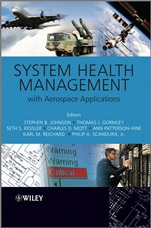
System Health Management: with Aerospace Applications
ISBN 9780470741337
Autor: Stephen B Johnson, Thomas Gormley, Seth Kessler, Charles Mott, Ann Patterson–Hine, Karl Reichard,
Wydawca: Wiley
Dostępność: 3-6 tygodni
Cena: 859,95 zł
Przed złożeniem zamówienia prosimy o kontakt mailowy celem potwierdzenia ceny.
ISBN13: |
9780470741337 |
ISBN10: |
0470741333 |
Autor: |
Stephen B Johnson, Thomas Gormley, Seth Kessler, Charles Mott, Ann Patterson–Hine, Karl Reichard, |
Oprawa: |
Hardback |
Rok Wydania: |
2011-07-08 |
Ilość stron: |
664 |
Wymiary: |
250x177 |
Tematy: |
TG |
System Health Management: with Aerospace Applications
Stephen B. Johnson
NASA Marshall Space Flight Center and University of Colorado at Colorado Springs
Thomas J. Gormley
Gormley & Associates
Charles Mott
Complete Data Management
Seth S. Kessler
Metis Design Corporation
Ann Patterson–Hine
NASA Ames Research Center
Karl M. Reichard
Pennsylvania State University Applied Research Laboratory
Philip A. Scandura, Jr.
Honeywell International
System Health Management: with Aerospace Applications provides the first complete reference text for System Health Management (SHM), the set of technologies and processes used to improve system dependability. Edited by a team of engineers and consultants with SHM design, development, and research experience from NASA, industry, and academia, each heading up sections in their own areas of expertise and co–coordinating contributions from leading experts, the book collates together in one text the state–of–the–art in SHM research, technology, and applications. It has been written primarily as a reference text for practitioners, for those in related disciplines, and for graduate students in aerospace or systems engineering.
There are many technologies involved in SHM and no single person can be an expert in all aspects of the discipline.System Health Management: with Aerospace Applications provides an introduction to the major technologies, issues, and references in these disparate but related SHM areas. Since SHM has evolved most rapidly in aerospace, the various applications described in this book are taken primarily from the aerospace industry. However, the theories, techniques, and technologies discussed are applicable to many engineering disciplines and application areas.
Readers will find sections on the basic theories and concepts of SHM, how it is applied in t
he system life cycle (architecture, design, verification and validation, etc.), the most important methods used (reliability, quality assurance, diagnostics, prognostics, etc.), and how SHM is applied in operations (commercial aircraft, launch operations, logistics, etc.), to subsystems (electrical power, structures, flight controls, etc.) and to system applications (robotic spacecraft, tactical missiles, rotorcraft, etc.).
Spis treści:
About the Editors.
List of Contributors.
Foreword.
Series Editor Preface.
Preface
Acronyms.
Part One The Socio–technical Context of System Health Management (Charles D. Mott).
1 The Theory of System Health Management (Stephen B. Johnson).
Overview.
1.1 Introduction.
1.2 Functions, Off–Nominal States, and Causation.
1.3 Complexity and Knowledge Limitations.
1.4 SHM Mitigation Strategies.
1.5 Operational Fault Management Functions
1.6 Mechanisms.
1.7 Summary of Principles.
1.8 SHM Implementation.
1.9 Some Implications.
1.10 Conclusion.
Bibliography.
2 Multimodal Communication (Beverly A. Sauer).
Overview.
2.1 Multimodal Communication in SHM.
2.2 Communication Channels.
2.3 Learning from Disaster
2.4 Current Communication in the Aerospace Industry.
2.5 The Problem of Sense–making in SHM Communication.
2.6 The Costs of Faulty Communication.
2.7 Implications.
2.8 Conclusion.
Acknowledgments.
Bibliography.
3 Highly Reliable Organizations (Andrew Wiedlea).
Overview.
3.1 The Study of HROs and Design for Dependability.
3.2 Lessons from the Field: HRO Patterns of Behavior.
3.3 Dependable Design, Organizational Behavior, and Connections to the HRO Project.
Bibliography.
4 Knowledge Management (Edward W. Rogers).
Overview.
4.1 Systems as Embedded Knowledge.
4.2 KM and Inform
ation Technology.
4.3 Reliability and Sustainability of Organizational Systems.
4.4 Case Study of Building a Learning Organization: Goddard Space Flight Center.
4.5 Conclusion.
Bibliography.
5 The Business Case for SHM (Kirby Keller and James Poblete).
Overview.
5.1 Business Case Processes and Tools.
5.2 Metrics to Support the Decision Process.
5.3 Factors to Consider in Developing an Enterprise Model.
5.4 Evaluation of Alternatives.
5.5 Modifications in Selected Baseline Model.
5.6 Modeling Risk and Uncertainty.
5.7 Model Verification and Validation.
5.8 Evaluation Results.
5.9 Summary and Conclusions.
Bibliography.
Part Two SHM and the System Lifecycle (Seth S. Kessler).
6 Health Management Systems Engineering and Integration (Timothy J. Wilmering and Charles D. Mott).
Overview.
6.1 Introduction.
6.2 Systems Thinking.
6.3 Knowledge Management.
6.4 Systems Engineering.
6.5 Systems Engineering Lifecycle Stages.
6.6 Systems Engineering, Dependability, and Health Management.
6.7 SHM Lifecycle Stages.
6.8 SHM Analysis Models and Tools.
6.9 Summary.
Acknowledgments.
Bibliography.
7 Architecture (Ryan W. Deal and Seth S. Kessler).
Overview
7.1 Introduction.
7.2 SHM System Architecture Components.
7.3 Examples of Power and Data Considerations.
7.4 SHM System Architecture Characteristics.
7.5 SHM System Architecture Advanced Concepts.
7.6 Summary.
Bibliography.
8 System Design and Analysis Methods (Irem Y. Tumer).
Overview.
8.1 Introduction.
8.2 Lifecycle Considerations.
8.3 Design Methods and Practices for Effective SHM.
8.4 Summary.
Acknowledgments.
Bibliography.
9 Assessing and Maturing Technology Readiness Levels (Ryan M. Mackey).
Overview.
9.1 Introduction.
9.2 Motivating Maturity Assessment.
9.3 Review of Technology Readiness Leve
ls.
9.4 Special Needs of SHM.
9.5 Mitigation Approaches.
9.6 TRLs for SHM.
9.7 A Sample Maturation Effort.
9.8 Summary.
Bibliography.
10 Verification and Validation (Lawrence Z. Markosian, Martin S. Feather, and David E. Brinza).
Overview.
10.1 Introduction.
10.2 Existing Software V&V.
10.3 Feasibility and Sufficiency of Existing Software V&V Practices for SHM.
10.4 Opportunities for Emerging V&V Techniques Suited to SHM.
10.5 V&V Considerations for SHM Sensors and Avionics.
10.6 V&V Planning for a Specific SHM Application.
10.7 A Systems Engineering Perspective on V&V of SHM.
10.8 Summary.
Acknowledgments.
Bibliography.
11 Certifying Vehicle Health Monitoring Systems (Seth S. Kessler, Tom Brotherton, and Grant A. Gordon).
Overview.
11.1 Introduction.
11.2 Durability for VHM Systems.
11.3 Mechanical Design for Structural Health Monitoring Systems.
11.4 Reliability and Longevity of VHM Systems.
11.5 Software and Hardware Certification.
11.6 Airworthiness Certification.
11.7 Health and Usage Monitoring System Certification Example.
11.8 Summary.
Acknowledgments.
Bibliography.
Part Three Analytical Methods (Ann Patterson–Hine).
12 Physics of Failure (Kumar V. Jata and Triplicane A. Parthasarathy).
Overview.
12.1 Introduction.
12.2 Physics of Failure of Metals.
12.3 Physics of Failure of CMCs.
12.4 Summary.
Bibliography.
13 Failure Assessment (Robyn Lutz and Allen Nikora).
Overview.
13.1 Introduction.
13.2 FMEA.
13.3 SFMEA.
13.4 FTA.
13.5 SFTA.
13.6 BDSA.
13.7 Safety Analysis.
13.8 Software Reliability Engineering.
13.9 Tools and Automation.
13.10 Future Directions.
13.11 Conclusion.
Acknowledgments.
Bibliography.
14 Reliability (William Q. Meeker and Luis A. Escobar).
Ov
erview.
14.1 Time–to–Failure Model Concepts and Two Useful Distributions.
14.2 Introduction to System Reliability.
14.3 Analysis of Censored Life Data.
14.4 Accelerated Life Testing.
14.5 Analysis of Degradation Data.
14.6 Analysis of Recurrence Data.
14.7 Software for Statistical Analysis of Reliability Data.
Acknowledgments.
Bibliography.
15 Probabilistic Risk Assessment (William E. Vesely).
Overview.
15.1 Introduction.
15.2 The Space Shuttle PRA.
15.3 Assessing Cumulative Risks to Assist Project Risk Management.
15.4 Quantification of Software Reliability.
15.5 Description of the Techniques Used in the Space Shuttle PRA.
15.6 Conclusion.
Bibliography.
16 Diagnosis (Ann Patterson–Hine, Gordon Aaseng, Gautam Biswas, Sriram Narasimhan, and Krishna Pattipati).
Overview.
16.1 Introduction.
16.2 General Diagnosis Problem.
16.3 Failure Effect Propagation and Impact.
16.4 Testability Analysis.
16.5 Diagnosis Techniques.
16.6 Automation Considerations for Diagnostic Systems.
16.7 Conclusion.
Acknowledgments.
Bibliography.
17 Prognostics (Michael J. Roemer, Carl S. Byington, Gregory J. Kacprzynski, George Vachtsevanos, and Kai Goebel).
Overview.
17.1 Background.
17.2 Prognostic Algorithm Approaches.
17.3 Prognosis RUL Probability Density Function.
17.4 Adaptive Prognosis.
17.5 Performance Metrics.
17.6 Distributed Prognosis System Architecture.
17.7 Conclusions.
Bibliography.
Part Four Operation (Karl M. Reichard).
18 Quality Assurance (Brian K. Hughitt).
Overview.
18.1 NASA QA Policy Requirements.
18.2 Quality System Criteria.
18.3 Quality Clauses.
18.4 Workmanship Standards.
18.5 Government Contract Quality Assurance.
18.6 Government Mandatory Inspection Points.
18.7 Quality System Audit.
18.8 Conclusions.
Bibliography.
19 Main
tainability: Theory and Practice (Gary O′Neill).
Overview.
19.1 Definitions of Reliability and Maintainability.
19.2 Reliability and Maintainability Engineering.
19.3 The Practice of Maintainability .
19.4 Improving R&M Measures.
19.5 Conclusions.
Bibliography.
20 Human Factors (Robert S. McCann and Lilly Spirkovska).
Overview.
20.1 Background.
20.2 Fault Management on Next–Generation Spacecraft.
20.3 Integrated Fault Management Automation Today.
20.4 Human–Automation Teaming for Real–Time FM.
20.5 Operations Concepts for Crew–Automation Teaming.
20.6 Empirical Testing and Evaluation.
20.7 Future Steps.
20.8 Conclusions.
Bibliography.
21 Launch Operations (Robert D. Waterman, Patricia E. Nicoli, Alan J. Zide, Susan J. Waterman, Jose M. Perotti, Bob A. Ferrell, and Barbara L. Brown).
Overview
21.1 Introduction to Launch Site Operations.
21.2 Human–Centered Health Management.
21.3 SHM.
21.4 LS Abort and Emergency Egress.
21.5 Future Trends Post Space Shuttle.
21.6 Summary.
Bibliography.
22 Fault Management Techniques in Human Spaceflight Operations (Brian O′Hagan and Alan Crocker).
Overview.
22.1 The Flight Operations Team.
22.2 System Architecture Implications.
22.3 Operations Products, Processes, and Techniques.
22.4 Lessons Learned from Space Shuttle and ISS Experience.
22.5 Conclusions.
Bibliography.
23 Military Logistics (Eddie C. Crow and Karl M. Reichard).
Overview.
23.1 Focused Logistics.
23.2 USMC AL.
23.3 Benefits and Impact of SHM on Military Operations and Logistics.
23.4 Demonstrating the Value of SHM in Military Operations and Logistics.
23.5 Conclusion .
Bibliography.
Part Five Subsystem Health Management (Philip A. Scandura, Jr).
24 Aircraft Propulsion Health Management (Al Volpon
i and Bruce Wood).
Overview.
24.1 Introduction.
24.2 Basic Principles.
24.3 Engine–Hosted Health Management.
24.4 Operating Conditions.
24.5 Computing Host.
24.6 Software.
24.7 On–Board Models.
24.8 Component Life Usage Estimation.
24.9 Design of an Engine Health Management System.
24.10 Supporting a Layered Approach.
24.11 Conclusion.
Bibliography.
25 Intelligent Sensors for Health Management (Gary Hunter, Lawrence Oberle, George Baaklini, Jose Perotti, and Todd Hong).
Overview.
25.1 Introduction.
25.2 Sensor Technology Approaches.
25.3 Sensor System Development .
25.4 Supporting Technologies: High–Temperature Applications Example.
25.5 Test Instrumentation and Non–destructive Evaluation (NDE).
25.6 Transition of Sensor Systems to Flight.
25.7 Supporting a Layered Approach.
25.8 Future Directions.
Acknowledgments.
Bibliography.
26 Structural Health Monitoring (Fu–Kuo Chang, Johannes F.C. Markmiller, Jinkyu Yang, and Yujun Kim).
Overview.
26.1 Introduction.
26.2 Proposed Framework.
26.3 Supporting a Layered Approach.
26.4 Conclusion.
Acknowledgments.
Bibliography.
27 Electrical Power Health Management (Robert M. Button and Amy Chicatelli).
Overview.
27.1 Introduction.
27.2 Summary of Major EPS Components and their Failure Modes.
27.3 Review of Current Power System HM.
27.4 Future Power SHM.
27.5 Supporting a Layered Approach.
27.6 Conclusion.
Bibliography.
28 Avionics Health Management (Michael D. Watson, Kosta Varnavas, Clint Patrick, Ron Hodge, Carl S. Byington, Savio Chau and Edmund C. Baroth).
Overview.
28.1 Avionics Description.
28.2 Electrical, Electronic, and Electromechanical (EEE) Parts Qualification.
28.3 Environments.
28.4 Failure Sources.
28.5 Current Avionics Health Management Techniques.
28.6 Avionics Health Managem
ent Requirements.
28.7 Supporting a Layered Approach.
28.8 Summary.
Bibliography.
29 Failure–Tolerant Architectures for Health Management (Daniel P. Siewiorek and Priya Narasimhan).
Overview.
29.1 Introduction.
29.2 System Failure Response Stages.
29.3 System–Level Approaches to Reliability.
29.4 Failure–Tolerant Software Architectures for Space Missions.
29.5 Failure–Tolerant Software Architectures for Commercial Aviation Systems.
29.6 Observations and Trends.
29.7 Supporting a Layered Approach.
29.8 Conclusions.
Acknowledgments.
Bibliography.
30 Flight Control Health Management (Douglas Zimpfer).
Overview.
30.1 A FC Perspective on System Health Management.
30.2 Elements of the FC System.
30.3 FC Sensor and Actuator HM.
30.4 FC/Flight Dynamics HM.
30.5 FC HM Benefits.
30.6 Supporting a Layered Approach.
30.7 Summary.
Bibliography.
31 Life Support Health Management (David Kortenkamp, Gautam Biswas, and Eric–Jan Manders).
Overview.
31.1 Introduction.
31.2 Modeling.
31.3 System Architecture.
31.4 Future NASA Life Support Applications.
31.5 Supporting a Layered Approach.
31.6 Conclusions.
Bibliography.
32 Software (Philip A. Scandura, Jr).
Overview.
32.1 Sampling of Accidents Attributed to Software Failures.
32.2 Current Practice.
32.3 Challenges.
32.4 Supporting a Layered Approach.
32.5 Summary.
Bibliography.
Part Six System Applications (Thomas J. Gormley).
33 Launch Vehicle Health Management (Edward N. Brown, Anthony R. Kelley, and Thomas J. Gormley).
Overview.
33.1 Introduction and Definition.
33.2 LVSHM Functionality and Scope.
33.3 LV Terminology and Operations.
33.4 LV Reliability Lessons Learned.
33.5 LV Segment Requirements and Architecture.
33.6 LVSHM Analysis and Design.
33.7 LV LVSHM System
Koszyk
Książek w koszyku: 0 szt.
Wartość zakupów: 0,00 zł
Informacje


Kontakt
Gambit
Centrum Oprogramowania
i Szkoleń Sp. z o.o.
Al. Pokoju 29b/22-24
31-564 Kraków
Siedziba Księgarni
ul. Kordylewskiego 1
31-542 Kraków
+48 12 410 5991
+48 12 410 5987
+48 12 410 5989
Subskrypcje
Administratorem danych osobowych jest firma Gambit COiS Sp. z o.o. Na podany adres będzie wysyłany wyłącznie biuletyn informacyjny.
Autoryzacja płatności

Informacje na temat autoryzacji płatności poprzez PayU.

© Copyright 2012: GAMBIT COiS Sp. z o.o. Wszelkie prawa zastrzeżone.
Projekt i wykonanie: Alchemia Studio Reklamy