


Wydawcy
Katalog tematyczny
- Archeologia (109)
- Ekonomia, finanse, business (13704)
- Filozofia (1445)
- Historia (3040)
- Języki i językoznawstwo (2356)
- Lifestyle, hobby i rozrywka (475)
- Medycyna (9704)
- Nauki humanistyczne (4)
- Nauki o Ziemi i środowisku (2638)
- Nauki ścisłe (20412)
- Astronomia (294)
- Biologia (5119)
- Chemia (6540)
- Fizyka (3309)
- Elektryczność i magnetyzm (90)
- Fizyka atomowa i molekularna (110)
- Fizyka cząstek elementarnych (36)
- Fizyka jądra atomowego (36)
- Fizyka kwantowa (210)
- Fizyka matematyczna (121)
- Fizyka relatywistyczna (36)
- Fizyka statystyczna (51)
- Fizyka stosowana (498)
- Mechanika klasyczna (186)
- Optyka i światło (133)
- Stany materii (202)
- Matematyka (4574)
- Nauki ścisłe, ogólnie (503)
- Nauki społeczne (8486)
- Nauki techniczne (13450)
- Prawo (1696)
- Publikacje informacyjne i interdyscyplinarne (1288)
- Religia i wierzenia (917)
- Technika komputerowa (4067)
- Zdrowie, relacje międzyludzkie i rozwój osobisty (657)





Informacje szczegółowe o książce
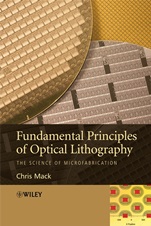
Fundamental Principles of Optical Lithography: The Science of Microfabrication
ISBN 9780470727300
Autor: Chris Mack
Wydawca: Wiley
Dostępność: 3-6 tygodni
Cena: 343,35 zł
Przed złożeniem zamówienia prosimy o kontakt mailowy celem potwierdzenia ceny.
ISBN13: |
9780470727300 |
ISBN10: |
0470727306 |
Autor: |
Chris Mack |
Oprawa: |
Paperback |
Rok Wydania: |
2007-11-16 |
Ilość stron: |
534 |
Wymiary: |
244x170 |
Tematy: |
PH |
The fabrication of an integrated circuit requires a variety of physical and chemical processes to be performed on a semiconductor substrate. In general, these processes fall into three categories: film deposition, patterning, and semiconductor doping. Films of both conductors and insulators are used to connect and isolate transistors and their components.
By creating structures of these various components millions of transistors can be built and wired together to form the complex circuitry of modern microelectronic devices. Fundamental to all of these processes is lithography, ie, the formation of three–dimensional relief images on the substrate for subsequent transfer of the pattern to the substrate.
This book presents a complete theoretical and practical treatment of the topic of lithography for both students and researchers. It comprises ten detailed chapters plus three appendices with problems provided at the end of each chapter.
Spis treści:
Preface.
1. Introduction to Semiconductor Lithography.
1.1 Basics of IC Fabrication.
1.2 Moore’s Law and the Semiconductor Industry.
1.3 Lithography Processing.
Problems.
2. Aerial Image Formation – The Basics.
2.1 Mathematical Description of Light.
2.2 Basic Imaging Theory.
2.3 Partial Coherence.
2.4 Some Imaging Examples.
Problems.
3. Aerial Image Formation – The Details.
3.1 Aberrations.
3.2 Pupil Filters and Lens Apodization.
3.3 Flare.
3.4 Defocus.
3.5 Imaging with Scanners Versus Steppers.
3.6 Vector Nature of Light.
3.7 Immersion Lithography.
3.8 Image Quality.
Problems.
4. Imaging in Resist: Standing Waves and Swing Curves.
4.1 Standing Waves.
4.2 Swing Curves.
4.3 Bottom Antirefl ection Coatings.
4.4 Top Antirefl ection Coatings.
4.5 Contrast Enhancement Layer.
4.6 Impact of the Phase of the Substrate Refl ectance.
4.7 Imaging in Resist.
4.8 Defi
ning Intensity.
Problems.
5. Conventional Resists: Exposure and Bake Chemistry.
5.1 Exposure.
5.2 Post–Apply Bake.
5.3 Post–exposure Bake Diffusion.
5.4 Detailed Bake Temperature Behavior.
5.5 Measuring the ABC Parameters.
Problems.
6. Chemically Amplifi ed Resists: Exposure and Bake Chemistry.
6.1 Exposure Reaction.
6.2 Chemical Amplifi cation.
6.3 Measuring Chemically Amplifi ed Resist Parameters.
6.4 Stochastic Modeling of Resist Chemistry.
Problems.
7. Photoresist Development.
7.1 Kinetics of Development.
7.2 The Development Contrast.
7.3 The Development Path.
7.4 Measuring Development Rates.
Problems.
8. Lithographic Control in Semiconductor Manufacturing.
8.1 Defi ning Lithographic Quality.
8.2 Critical Dimension Control.
8.3 How to Characterize Critical Dimension Variations.
8.4 Overlay Control.
8.5 The Process Window.
8.6 H–V Bias.
8.7 Mask Error Enhancement Factor (MEEF).
8.8 Line–End Shortening.
8.9 Critical Shape and Edge Placement Errors.
8.10 Pattern Collapse.
Problems.
9. Gradient–Based Lithographic Optimization: Using the Normalized Image Log–Slope.
9.1 Lithography as Information Transfer.
9.2 Aerial Image.
9.3 Image in Resist.
9.4 Exposure.
9.5 Post–exposure Bake.
9.6 Develop.
9.7 Resist Profi le Formation.
9.8 Line Edge Roughness.
9.9 Summary.
Problems.
10. Resolution Enhancement Technologies.
10.1 Resolution.
10.2 Optical Proximity Correction (OPC).
10.3 Off–Axis Illumination (OAI).
10.4 Phase–Shifting Masks (PSM).
10.5 Natural Resolutions.
Problems.
Appendix A. Glossary of Microlithographic Terms.
Appendix B. Curl, Divergence, Gradient, Laplacian.
Appendix C. The Dirac Delta Function.
Index.
Koszyk
Książek w koszyku: 0 szt.
Wartość zakupów: 0,00 zł
Informacje


Kontakt
Gambit
Centrum Oprogramowania
i Szkoleń Sp. z o.o.
Al. Pokoju 29b/22-24
31-564 Kraków
Siedziba Księgarni
ul. Kordylewskiego 1
31-542 Kraków
+48 12 410 5991
+48 12 410 5987
+48 12 410 5989
Subskrypcje
Administratorem danych osobowych jest firma Gambit COiS Sp. z o.o. Na podany adres będzie wysyłany wyłącznie biuletyn informacyjny.
Autoryzacja płatności

Informacje na temat autoryzacji płatności poprzez PayU.

© Copyright 2012: GAMBIT COiS Sp. z o.o. Wszelkie prawa zastrzeżone.
Projekt i wykonanie: Alchemia Studio Reklamy