


Wydawcy
Katalog tematyczny
- Archeologia (109)
- Ekonomia, finanse, business (13704)
- Filozofia (1445)
- Historia (3040)
- Języki i językoznawstwo (2356)
- Lifestyle, hobby i rozrywka (475)
- Medycyna (9704)
- Nauki humanistyczne (4)
- Nauki o Ziemi i środowisku (2638)
- Nauki ścisłe (20412)
- Nauki społeczne (8486)
- Nauki techniczne (13450)
- Budownictwo lądowe (1045)
- Chemia przemysłowa (2258)
- Elektronika i telekomunikacja (3287)
- Energetyka (1122)
- Inne nauki stosowane (363)
- Inżynieria biochemiczna (507)
- Inżynieria transportu (232)
- Mechanika i materiały (3316)
- Nauka o środowisku (321)
- Rolnictwo (507)
- Technika, ogólnie (475)
- Prawo (1696)
- Publikacje informacyjne i interdyscyplinarne (1288)
- Religia i wierzenia (917)
- Technika komputerowa (4067)
- Zdrowie, relacje międzyludzkie i rozwój osobisty (657)






Informacje szczegółowe o książce
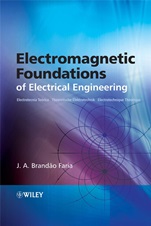
Electromagnetic Foundations of Electrical Engineering
ISBN 9780470727096
Autor: J. A. Brandão Faria
Wydawca: Wiley
Dostępność: 3-6 tygodni
Cena: 686,70 zł
Przed złożeniem zamówienia prosimy o kontakt mailowy celem potwierdzenia ceny.
ISBN13: |
9780470727096 |
ISBN10: |
0470727098 |
Autor: |
J. A. Brandão Faria |
Oprawa: |
Hardback |
Rok Wydania: |
2008-08-01 |
Ilość stron: |
420 |
Wymiary: |
253x176 |
Tematy: |
TJ |
The applications of electromagnetic phenomena within electrical engineering have been evolving and progressing at a fast pace. In contrast, the underlying principles have been stable for a long time and are not expected to undergo any changes. It is these electromagnetic field fundamentals that are the subject of discussion in this book with an emphasis on basic principles, concepts and governing laws that apply across the electrical engineering discipline.
Electromagnetic Foundations of Electrical Engineering begins with an explanation of Maxwell’s equations, from which the fundamental laws and principles governing the static and time–varying electric and magnetic fields are derived. Results for both slowly– and rapidly–varying electromagnetic field problems are discussed in detail.
Key aspects:Offers a project portfolio, with detailed solutions included on the companion website, which draws together aspects from various chapters so as to ensure comprehensive understanding of the fundamentals.Provides end–of–chapter homework problems with a focus on engineering applications.Progresses chapter by chapter to increasingly more challenging topics, allowing the reader to grasp the more simple phenomena and build upon these foundations.Enables the reader to attain a level of competence to subsequently progress to more advanced topics such as electrical machines, power system analysis, electromagnetic compatibility, microwaves and radiation.
This book is aimed at electrical engineering students and faculty staff in sub–disciplines as diverse as power and energy systems, circuit theory and telecommunications. It will also appeal to existing electrical engineering professionals with a need for a refresher course in electromagnetic foundations.
Spis treści:
PREFACE.
To the Electrical Engineer Practitioner.
To the Student.
To the Instructor.
ACKNOWLEDGE
MENTS.
PROJECT PORTFOLIO.
Analysis of a power delivery system.
Cylindrical type transmission lines.
DC current transducer.
Determination of the conductivity of a circular conducting disk.
Directional coupler analysis.
Ill–defined grounding problems.
Induction machine analysis.
Line matching technique using an exponential transmission–line section.
Linear variable differential transformer.
Magnetic actuator and sensor device.
Overhead–line protection by ground–wires.
Power line carrier communication.
Pseudo–balanced three–phase lines.
Screened high–voltage three–phase installation.
Shielded three–phase cable analysis.
Three–route microwave splitter.
Transmission–line system with balun transformer for even to odd–mode conversion.
Transmission–line system with transformer–stage matching.
Two–way loudspeaker analysis.
Variable reluctance transformer.
PART I: A BRIEF OVERVIEW.
INTRODUCTION.
CHAPTER 1: BASIC FIELD VECTORS.
1.1: The Electric and Magnetic Field Vectors.
1.2: Constitutive Relations.
1.3: Units and Notation.
1.4: Fundamental Concepts of Voltage and Current Intensity.
PART II: STATIONARY FIELD PHENOMENA.
INTRODUCTION.
CHAPTER 2: ELECTROSTATICS.
2.1 Fundamental Equations.
2.2 Gradient Electric Field, Electric Potential, Voltage, Kirchhoff’s Voltage Law.
2.3 Electric Charge, Electric Displacement Vector.
2.4 Dielectric Media, Permittivity, Polarization, Dielectric Strength.
2.5 Conductors in Electrostatic Equilibrium.
2.6 Application Example (Filament of charge).
2.7 Capacitor, Capacitance, Electric Energy.
2.8 Application Example (Two–wire transmission line).
2.9 Multiple Conductor Systems.
2.10 Application Example (Electric coupling in printed circuit boards).
2.11 Electric Forces and Torques.
2.12 Homewo
rk Proposed Problems.
CHAPTER 3: STATIONARY CURRENTS.
3.1 Fundamental Equations.
3.2 Conductivity, Current Density, Electric Circuits.
3.3 Current Intensity, Kirchhoff’s Current Law.
3.4 Resistor, Conductance, Resistance, Ohm′s Law.
3.5 Application Example (The potentiometer).
3.6 Application Example (The Wheatstone bridge).
3.7 Joule Losses, Generator Applied Field.
3.8 Generator Electromotive Force, Power Balance.
3.9 Homework Proposed Problems.
CHAPTER 4: MAGNETIC FIELD OF STATIONARY CURRENTS.
4.1 Fundamental Equations.
4.2 Ampère’s Law, Magnetomotive Force, Magnetic Voltage.
4.3 Magnetic Induction Field, Magnetic Induction Flux.
4.4 Application Example (Power line magnetic fields).
4.5 Magnetic Materials, Ferromagnetic Media, Saturation and Hysteresis.
4.6 Magnetic Circuits.
4.7 Application Example (Three–legged transformer).
4.8 Magnetic Reluctance.
4.9 Inductor, Inductance, Magnetic Flux Linkage, Magnetic Energy.
4.10 Application Example (Coaxial cable).
4.11 Hysteresis Losses.
4.12 Multiple Circuit Systems.
4.13 Magnetic Forces and Torques.
4.14 Application Example (U–shaped electromagnet).
4.15 Homework Proposed Problems.
PART III: SLOW TIME–VARYING FIELDS.
INTRODUCTION.
CHAPTER 5: MAGNETIC INDUCTION PHENOMENA.
5.1 Fundamental Equations.
5.2 Gradient and Induction Electric Fields, Potential Vector.
5.3 Revisiting the Voltage Concept.
5.4 Induction Law.
5.5 Application Example (Magnetic noise effects).
5.6 Voltages and Currents in Magnetically Multicoupled Systems.
5.7 Application Example (Magnetic coupling in printed circuit boards).
5.8 Eddy Currents.
5.9 Generalization of the Induction Law to Moving Circuit Systems.
5.10 Application Example (Electromechanical energy conversion).
5.11 DC Voltage Generation.
5.12 AC Voltage Generation.
5.13 Homework Proposed Problem
s.
CHAPTER 6: ELECTRIC INDUCTION PHENOMENA.
6.1 Fundamental Equations.
6.2 Displacement Current, Generalized Ampère’s Law.
6.3 Charge Continuity Equation.
6.4 Revisiting the Current Intensity Concept.
6.5 Application Example (Capacitor self–discharge).
6.6 Voltages and Currents in Electrically Multicoupled Systems.
6.7 Homework Proposed Problems.
CHAPTER 7: LUMPED PARAMETERS CIRCUIT ANALYSIS.
7.1 Introduction.
7.2 Steady–State Harmonic Regimes.
7.3 Transformer Analysis.
7.4 Transient Regimes.
7.5 Homework Proposed Problems.
PART IV: RAPID TIME–VARYING FIELDS.
INTRODUCTION.
CHAPTER 8: ELECTROMAGNETIC FIELD PHENOMENA.
8.1 Electromagnetic Waves.
8.2 Poynting’s Theorem, Poynting’s Vector, Power Flow.
8.3 Time–Harmonic Fields, Field Polarization, RMS Field Values.
8.4 Phasor–Domain Maxwell Equations, Material Media Constitutive Relations.
8.5 Application Example (Uniform plane waves).
8.6 Complex Poynting’s Vector.
8.7 Application Example (Skin effect).
8.8 Homework Proposed Problems.
CHAPTER 9: TRANSMISSION LINE ANALYSIS.
9.1 Introduction.
9.2 Time–Domain Transmission–Line Equations for Lossless Lines.
9.3 Application Example (Parallel–plate transmission line).
9.4 Frequency–Domain Transmission–Line Equations for Lossy Lines.
9.5 Frequency–Domain Transmission–Line Equations for Lossless Lines.
9.6 Application Example (Line matching techniques).
9.7 Multiconductor Transmission Lines.
9.8 Application Example (Even and odd modes).
9.9 Homework Proposed Problems.
APPENDICES.
Appendix 1: Formulas from Vector Analysis.
Appendix 2: Lorentz Transformation.
Appendix 3: Elements of Complex Algebra.
Appendix 4: Elements of Fourier Analysis.
BIBLIOGRAPHY.
INDEX.
Nota biograficzna:
J. A. Brandã
Koszyk
Książek w koszyku: 0 szt.
Wartość zakupów: 0,00 zł
Informacje


Kontakt
Gambit
Centrum Oprogramowania
i Szkoleń Sp. z o.o.
Al. Pokoju 29b/22-24
31-564 Kraków
Siedziba Księgarni
ul. Kordylewskiego 1
31-542 Kraków
+48 12 410 5991
+48 12 410 5987
+48 12 410 5989
Subskrypcje
Administratorem danych osobowych jest firma Gambit COiS Sp. z o.o. Na podany adres będzie wysyłany wyłącznie biuletyn informacyjny.
Autoryzacja płatności

Informacje na temat autoryzacji płatności poprzez PayU.

© Copyright 2012: GAMBIT COiS Sp. z o.o. Wszelkie prawa zastrzeżone.
Projekt i wykonanie: Alchemia Studio Reklamy