


Wydawcy
Katalog tematyczny
- Archeologia (109)
- Ekonomia, finanse, business (13704)
- Filozofia (1445)
- Historia (3040)
- Języki i językoznawstwo (2356)
- Lifestyle, hobby i rozrywka (475)
- Medycyna (9704)
- Nauki humanistyczne (4)
- Nauki o Ziemi i środowisku (2638)
- Nauki ścisłe (20412)
- Astronomia (294)
- Biologia (5119)
- Chemia (6540)
- Chemia analityczna (361)
- Chemia fizyczna (346)
- Chemia nieorganiczna (137)
- Chemia organiczna (535)
- Krystalografia (27)
- Minerologia (46)
- Fizyka (3309)
- Matematyka (4574)
- Nauki ścisłe, ogólnie (503)
- Nauki społeczne (8486)
- Nauki techniczne (13450)
- Prawo (1696)
- Publikacje informacyjne i interdyscyplinarne (1288)
- Religia i wierzenia (917)
- Technika komputerowa (4067)
- Zdrowie, relacje międzyludzkie i rozwój osobisty (657)





Informacje szczegółowe o książce
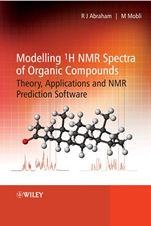
Modelling 1H NMR Spectra of Organic Compounds: Theory, Applications and NMR Prediction Software
ISBN 9780470723012
Autor: Raymond J. Abraham, Mehdi Mobli
Wydawca: Wiley
Dostępność: 3-6 tygodni
Cena: 596,40 zł
Przed złożeniem zamówienia prosimy o kontakt mailowy celem potwierdzenia ceny.
ISBN13: |
9780470723012 |
ISBN10: |
0470723017 |
Autor: |
Raymond J. Abraham, Mehdi Mobli |
Oprawa: |
Hardback |
Rok Wydania: |
2008-10-28 |
Ilość stron: |
392 |
Wymiary: |
258x170 |
Tematy: |
PN |
Provides a theoretical introduction to graduate scientists and industrial researchers towards the understanding of the assignment of 1H NMR spectraDiscusses, and includes on enclosed CD, one of the best, the fastest and most applicable pieces of NMR prediction software availableAllows students of organic chemistry to solve problems on 1H NMR with access to over 500 assigned spectra
Spis treści:
Preface.
Chapter 1: Introduction to 1H NMR.
1.1 Historical background.
1.2 Basic Theory.
1.3 The 1H chemical shift.
1.3.1.Nuclear shielding, reference compounds,.
1.4. 1H Substituent chemical shifts (SCS).
1.4.1. Two–bond effects (H.C.X), Shoolery’s rules,.
1.4.2. Three–bond effects (H.C.C.X).
1.4.3.1H SCS in olefins and aromatics.
1.5 Long range effects on 1H chemical shifts.
1.5.1. Steric (Van–der–Waals) shifts.
1.5.2. electric field and anisotropic shifts.
1.5.3. ã electron effects, aromatic ring currents.
1.5.4. Hydrogen bonding shifts.
1.6.Tables of 1H Chemical Shifts of Common Cyclic Systems.
Chapter 2: Interpretation of 1H NMR coupling patterns.
2.1 Fine Structure due to HH coupling.
2.2 The Analysis of NMR Spectra.
2.2.1. Nomenclature of the spin system, chemical and magnetic equivalence.
2.2.2. Two interacting nuclei, the AB spectrum.
2.2.3. Three interacting nuclei, the ABX spectrum.
2.2.4. Four interacting nuclei, the ABRX spectrum, the AA?XX? spectrum.
2.2.5. Iterative Computer Analysis, examples.
2.3. The Mechanism of Spin–Spin Coupling.
2.3.1. Geminal HH Couplings.
2.3.2. Vicinal HH Couplings, CH:CH couplings, CH.CH couplings.
2.3.3. Ab–initio calculations of couplings.
2.3.4. Long–range HH Couplings.
2.4. HF Couplings.
2.4.1. Geminal HF Couplings.
2.4.2. Vicinal HF Couplings, CH:CF couplings, CH.CF couplings.
2.4.3. Long–range HF Couplings.
Chapter 3:
Methods of Predicting 1H Chemical Shifts.
3.1. Quantum mechanical calculations of 1H Chemical shifts.
3.2. The Data Base Approach, the Hose code.
3.3. Semi–empirical calculations,.
3.4. Theory of the CHARGE program,.
3.4.1 Through Bond Effects.
3.4.2 1H Chemical Shifts in Substituted Methanes and Ethanes.
3.4.3 Through Space Effects, steric, electric field, magnetic anisotropy.
3.4.4Hydrogen Bonding Shifts, ab–initio calculations.
3.4.5 Aromatic Compounds, ring currents, ã–electron densities.
Chapter 4: Modelling 1H Chemical Shifts, Alkanes,Alkenes and Alkynes.
4.1. Alkanes.
4.1.1 H..H and C..H steric effects.
4.1.2 The methyl effect.
4.1.3 C.C Bond Anisotropy.
4.1.4 Observed vs Calculated Shifts.
a) Acyclic alkanes.
b) Cyclic Alkanes.
c) Methyl Cycloalkanes.
d) Androstane.
e) Chemical Shift contributions in Cyclohexane.
4.2 Alkenes.
4.2.1.C=C Bond Anisotropy and Shielding.
4.2.2 Observed vs Calculated Shifts.
a) Acyclic alkenes.
b) Monocyclic alkenes.
c) Aromatic alkenes.
d) Norbornenes and bicyclooctenes.
e) Pinenes.
f) Conclusions.
4.3.Alkynes.
4.3.1.CðC Bond Anisotropy and Shielding.
4.3.2 Observed vs Calculated Shifts.
4.3.3. Acetylene SCS.
4.3.4. Contributions to Acetylene SCS.
4.3.5. Napthyl and Phenanthryl acetylenes.
4.4. Summary.
Chapter 5: MODELLING 1H CHEMICAL SHIFTS, Aromatics.
5.1 Aromatic Hydrocarbons.
5.1.1. Ring currents, ã–electron density, steric effects.
5.1.2. Observed vs Calculated Shifts.
a) Condensed aromatics.
b) Cyclophanes.
c)Substituted Benzenes.
5.2. Heteroaromatics.
5.2.1. Theory and Application to Heteroaromatics.
5.2.2. Observed vs Calculated Shifts..
a) Furans, thiophenes and pyrroles.
b) Indoles,quinolines ans isoquinolines.
c) Diazabenzenes and azoles.
5.2.3. Ring current and ã–electron shifts.
5.3. Summary.
Chapter 6: MODELLING
1H CHEMICAL SHIFTS, Mono valent Substituents.
6.1. Flourocompounds.
6.1.1. Electric field theory.
6.1.2. Fluoroalkanes.
6.1.3. Fluoroalkenes.
6.2. Steric,Anisotropic and Electric Field Effects in Chloro,bromo and Iodo SCS.
6.2.1. Aromatic halides.
6.2.2. Alkyl halides.
6.2.3. Contributions to Halo SCS in cyclohexanes.
6.2.4. Steric Coefficients for Halogens.
6.3. Hydroxy Compounds.
6.3.1 Alcohols and diols.
6.3.2Phenols.
6.4. Amines.
6.4.1 Observed vs Calculated Shifts.
6.5. Cyanides.
6.5.1 Observed vs Calculated Shifts.
6.5.2. Cyano SCS.
6.6. Nitro Compounds.
6.6.1. Observed vs Calculated Shifts.
6.6.2.Conformational Analysis.
6.7. Summary.
Chapter 7: MODELLING 1H CHEMICAL SHIFTS, Divalent Substituents.
7.1. Aldehydes and Ketones.
7.1.1.Aliphatic aldehydes and ketones.
a) Observed vs Calculated shifts.
7.1.2. Aromatic aldehydes and ketones.
a). Keto–enol tautomerism in anthrone.
7.2. Esters.
7.2.1.Observed vs Calculated shifts.
7.3 Amides.
7.3.1.Aliphatic and cyclic amides.
7.3.2 Aromatic amides.
7.4. Ethers.
7.4.1.Oxygen SCS in ethers.
7.4.2.Observed vs Calculated Shifts.
7.5. Sulfoxides, sulfones, sulphites.
7.5.1.Observed vs Calculated Shifts.
7.6. Summary.
Chapter 8: 1H CHEMICAL SHIFTS AND STRUCTURAL CHEMISTRY.
8.1. Electronic Structure Calculations.
8.1.1. Basis sets.
8.2. Molecular Mechanics Calculations.
8.2.1. Conformer generation.
8.3. Molecular Geometries and 1H Chemical Shifts.
8.3.1. Methyl anthracene–9–carboxylate.
8.3.2. N–formyl aniline.
8.3.3. Benzosuberone.
8.4. Rate Processes and NMR Spectra.
8.4.1. Theory.
8.4.2. Amide rotation.
8.4.3. Proton exchange equilibria.
8.4.4. Rotation about single bonds, ring inversion processes.
8.5. Solvent Effects.
8.5.1. Non–polar compounds.
8.5.2. Polar Aprotic Compounds.
8.5.3. Protic Compounds.
8.5.4. Diols and P
olyhydroxy Compounds.
8.5.5. Chemical Shift.Contributions.
8.6. Summary.
Chapter 9: Strategies for 1H NMR prediction.
9.1. Calculating 1H NMR spectra.
9.1.1. Molecular Modelling, PCMODEL.
9.1.2. Calculating 1H chemical shifts and coupling constants, HNMRSPEC.
9.1.3. Displaying the calculated 1H spectrum, 1HPLOT.
9.1.4. Advanced use of HNMRSPEC—S.
9.1.5. Calculation/Iteration of 2nd order 1H spectra from specified δ’s and J’s. LAOCOON.
9.2. Automated spectral prediction, NMRPredict.
Appendix 1. The observed vs calculated 1H NMR chemical shifts of ca 1000 spectra.
Appendix 2. The observed vs calculated 1H NMR chemical shifts of 113 Substituted Benzenes.
Appendix 3. The observed vs calculated 1H NMR chemical shifts of 65 Substituted Pyridines.
Koszyk
Książek w koszyku: 0 szt.
Wartość zakupów: 0,00 zł
Informacje


Kontakt
Gambit
Centrum Oprogramowania
i Szkoleń Sp. z o.o.
Al. Pokoju 29b/22-24
31-564 Kraków
Siedziba Księgarni
ul. Kordylewskiego 1
31-542 Kraków
+48 12 410 5991
+48 12 410 5987
+48 12 410 5989
Subskrypcje
Administratorem danych osobowych jest firma Gambit COiS Sp. z o.o. Na podany adres będzie wysyłany wyłącznie biuletyn informacyjny.
Autoryzacja płatności

Informacje na temat autoryzacji płatności poprzez PayU.

© Copyright 2012: GAMBIT COiS Sp. z o.o. Wszelkie prawa zastrzeżone.
Projekt i wykonanie: Alchemia Studio Reklamy