


Wydawcy
Katalog tematyczny
- Archeologia (109)
- Ekonomia, finanse, business (13704)
- Filozofia (1445)
- Historia (3040)
- Języki i językoznawstwo (2356)
- Lifestyle, hobby i rozrywka (475)
- Medycyna (9704)
- Nauki humanistyczne (4)
- Nauki o Ziemi i środowisku (2638)
- Nauki ścisłe (20412)
- Astronomia (294)
- Biologia (5119)
- Chemia (6540)
- Chemia analityczna (361)
- Chemia fizyczna (346)
- Chemia nieorganiczna (137)
- Chemia organiczna (535)
- Krystalografia (27)
- Minerologia (46)
- Fizyka (3309)
- Matematyka (4574)
- Nauki ścisłe, ogólnie (503)
- Nauki społeczne (8486)
- Nauki techniczne (13450)
- Prawo (1696)
- Publikacje informacyjne i interdyscyplinarne (1288)
- Religia i wierzenia (917)
- Technika komputerowa (4067)
- Zdrowie, relacje międzyludzkie i rozwój osobisty (657)





Informacje szczegółowe o książce
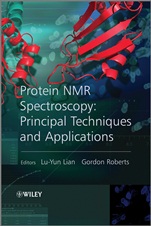
Protein NMR Spectroscopy: Practical Techniques and Applications
ISBN 9780470721933
Autor: Lu–Yun Lian, Gordon Roberts
Wydawca: Wiley
Dostępność: 3-6 tygodni
Cena: 496,65 zł
Przed złożeniem zamówienia prosimy o kontakt mailowy celem potwierdzenia ceny.
ISBN13: |
9780470721933 |
ISBN10: |
0470721936 |
Autor: |
Lu–Yun Lian, Gordon Roberts |
Oprawa: |
Hardback |
Rok Wydania: |
2011-07-22 |
Ilość stron: |
366 |
Wymiary: |
256x180 |
Tematy: |
PN |
Nuclear Magnetic Resonance (NMR) spectroscopy, a physical phenomenon based upon the magnetic properties of certain atomic nuclei, has found a wide range of applications in life sciences over recent decades. The dramatic advances in NMR techniques have led to corresponding advances in the ability of NMR to study structure, dynamics and interactions of biological macromolecules in solution under close to physiological conditions. This volume focuses on the use of NMR to study proteins.
NMR can be used to determine detailed three–dimensional structures of proteins in solution. Furthermore, it provides information about conformational or chemical exchange, internal mobility and dynamics at timescales varying from pcoseconds to seconds. It is the primary technique used to obtain information on intrinsically disordered (unfolded) proteins, since these proteins will not crystallize easily. NMR is also a very powerful method for the study of interactions of protein with other molecules, whether small molecules (including drugs), nuclear acids or other proteins.
This up–to–date volume covers NMR techiniques and their application to proteins, with a focus on practical details. This book will provide a newcomer to NMR with the practical guidance in order to carry out successful experiments with proteins and to analyze the resulting spectra. Those who are familiar with the chemical applications of NMR will also find is useful in understanding the special requirements of protien NMR.
Spis treści:
List of Contributors xiii
Introduction 1
Lu–Yun Lian and Gordon Roberts
References 4
1 Sample Preparation, Data Collection and Processing 5
Frederick W. Muskett
1.1 Introduction 5
1.2 Sample Preparation 5
1.3 Data Collection 11
1.4 Data Processing 17
2 Isotope Labelling 23
Mitsuhiro Takeda and Masatsune Kainosho
2.1 Introduction 23
2.2 Production Methods for Isotopical
ly Labelled Proteins 24
2.3 Uniform Isotope Labelling of Proteins 29
2.4 Selective Isotope Labelling of Proteins 32
2.5 Segmental Labelling 37
2.6 SAIL Methods 38
2.7 Concluding Remarks 45
3 Resonance Assignments 55
Lu–Yun Lian and Igor L. Barsukov
3.1 Introduction 55
3.2 Resonance Assignment of Unlabelled Proteins 56
3.3 15N–Edited Experiments 60
3.4 Triple Resonance 62
3.5 Side–Chain Assignments 77
4 Measurement of Structural Restraints 83
Geerten W. Vuister, Nico Tjandra, Yang Shen, Alex Grishaev and Stephan Grzesiek
4.1 Introduction 83
4.2 NOE–Based Distance Restraints 84
4.3 Dihedral Restraints Derived from J–Couplings 96
4.4 Hydrogen Bond Restraints 103
4.5 Orientational Restraints 107
4.6 Chemical Shift Structural Restraints 129
4.7 Solution Scattering Restraints 137
5 Calculation of Structures from NMR Restraints 159
Peter Guntert
5.1 Introduction 159
5.2 Historical Development 161
5.3 Structure Calculation Algorithms 164
5.4 Automated NOE Assignment 173
5.5 Nonclassical Approaches 178
5.6 Fully Automated Structure Analysis 181
6 Paramagnetic Tools in Protein NMR 193
Peter H.J. Keizers and Marcellus Ubbink
6.1 Introduction 193
6.2 Types of Restraints 194
6.3 What Metals to Use? 200
6.4 Paramagnetic Probes 203
6.5 Examples 209
6.6 Conclusions and Perspective 212
7 Structural and Dynamic Information on Ligand Binding 221
Gordon Roberts
7.1 Introduction 221
7.2 Fundamentals of Exchange Effects on NMR Spectra 222
7.3 Measurement of Equilibrium and Rate Constants 229
7.4 Detecting Binding – NMR Screening 238
7.5 Mechanistic Information 241
7.6 Structural Information 246
8 Macromolecular Complexes 269
Paul C. Driscoll
8.1 Introduction 269
8.2 Spectral Simplification through Differential Isotope Labell
ing 270
8.3 Basic NMR Characterisation of Complexes 273
8.4 3D Structure Determination of Macromolecular Protein–Ligand Complexes 277
8.5 Literature Examples 297
9 Studying Partially Folded and Intrinsically Disordered Proteins Using NMR Residual Dipolar Couplings 319
Malene Ringkjøbing Jensen, Valery Ozenne, Loic Salmon, Gabrielle Nodet, Phineus Markwick, Pau Bernado´ and Martin Blackledge
9.1 Introduction 319
9.2 Ensemble Descriptions of Unfolded Proteins 320
9.3 Experimental Techniques for the Characterisation of IDPs 320
9.4 NMR Spectroscopy of Intrinsically Disordered Proteins 321
9.5 Residual Dipolar Couplings 323
9.6 Conclusions 340
References 340
Index 347
Okładka tylna:
Nuclear Magnetic Resonance (NMR) spectroscopy, a physical phenomenon based upon the magnetic properties of certain atomic nuclei, has found a wide range of applications in life sciences over recent decades. The dramatic advances in NMR techniques have led to corresponding advances in the ability of NMR to study structure, dynamics and interactions of biological macromolecules in solution under close to physiological conditions. This volume focuses on the use of NMR to study proteins.
NMR can be used to determine detailed three–dimensional structures of proteins in solution. Furthermore, it provides information about conformational or chemical exchange, internal mobility and dynamics at timescales varying from pcoseconds to seconds. It is the primary technique used to obtain information on intrinsically disordered (unfolded) proteins, since these proteins will not crystallize easily. NMR is also a very powerful method for the study of interactions of protein with other molecules, whether small molecules (including drugs), nuclear acids or other proteins.
This up–to–date volume covers NMR techiniques and their application to proteins, with a focus on practical details. This book
will provide a newcomer to NMR with the practical guidance in order to carry out successful experiments with proteins and to analyze the resulting spectra. Those who are familiar with the chemical applications of NMR will also find is useful in understanding the special requirements of protien NMR.
Koszyk
Książek w koszyku: 0 szt.
Wartość zakupów: 0,00 zł
Informacje


Kontakt
Gambit
Centrum Oprogramowania
i Szkoleń Sp. z o.o.
Al. Pokoju 29b/22-24
31-564 Kraków
Siedziba Księgarni
ul. Kordylewskiego 1
31-542 Kraków
+48 12 410 5991
+48 12 410 5987
+48 12 410 5989
Subskrypcje
Administratorem danych osobowych jest firma Gambit COiS Sp. z o.o. Na podany adres będzie wysyłany wyłącznie biuletyn informacyjny.
Autoryzacja płatności

Informacje na temat autoryzacji płatności poprzez PayU.

© Copyright 2012: GAMBIT COiS Sp. z o.o. Wszelkie prawa zastrzeżone.
Projekt i wykonanie: Alchemia Studio Reklamy