


Wydawcy
Katalog tematyczny
- Archeologia (109)
- Ekonomia, finanse, business (13704)
- Filozofia (1445)
- Historia (3040)
- Języki i językoznawstwo (2356)
- Lifestyle, hobby i rozrywka (475)
- Medycyna (9704)
- Nauki humanistyczne (4)
- Nauki o Ziemi i środowisku (2638)
- Nauki ścisłe (20412)
- Astronomia (294)
- Biologia (5119)
- Chemia (6540)
- Chemia analityczna (361)
- Chemia fizyczna (346)
- Chemia nieorganiczna (137)
- Chemia organiczna (535)
- Krystalografia (27)
- Minerologia (46)
- Fizyka (3309)
- Matematyka (4574)
- Nauki ścisłe, ogólnie (503)
- Nauki społeczne (8486)
- Nauki techniczne (13450)
- Prawo (1696)
- Publikacje informacyjne i interdyscyplinarne (1288)
- Religia i wierzenia (917)
- Technika komputerowa (4067)
- Zdrowie, relacje międzyludzkie i rozwój osobisty (657)





Informacje szczegółowe o książce
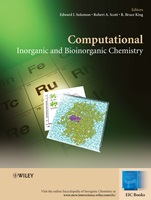
Computational Inorganic and Bioinorganic Chemistry
ISBN 9780470699973
Autor: Edward I. Solomon, Robert A. Scott, R. Bruce King
Wydawca: Wiley
Dostępność: 3-6 tygodni
Cena: 938,70 zł
Przed złożeniem zamówienia prosimy o kontakt mailowy celem potwierdzenia ceny.
ISBN13: |
9780470699973 |
ISBN10: |
0470699973 |
Autor: |
Edward I. Solomon, Robert A. Scott, R. Bruce King |
Oprawa: |
Hardback |
Rok Wydania: |
2009-09-18 |
Ilość stron: |
614 |
Wymiary: |
306x213 |
Tematy: |
PN |
Over the past several decades there have been major advances in our ability to computationally evaluate the electronic structure of inorganic molecules, particularly transition metal systems. This advancement is due to the Moore’s Law increase in computing power as well as the impact of density functional theory (DFT) and its implementation in commercial and freeware programs for quantum chemical calculations. Improved pure and hybrid density functionals are allowing DFT calculations with accuracy comparable to high–level Hartree–Fock treatments, and the results of these calculations can now be evaluated by experiment.
When calculations are correlated to, and supported by, experimental data they can provide fundamental insight into electronic structure and its contributions to physical properties and chemical reactivity. This interplay continues to expand and contributes to both improved value of experimental results and improved accuracy of computational predictions.
The purpose of this EIC Book is to provide state–of–the–art presentations of quantum mechanical and related methods and their applications, written by many of the leaders in the field. Part 1 of this volume focuses on methods, their background and implementation, and their use in describing bonding properties, energies, transition states and spectroscopic features. Part 2 focuses on applications in bioinorganic chemistry and Part 3 discusses inorganic chemistry, where electronic structure calculations have already had a major impact. This addition to the EIC Book series is of significant value to both experimentalists and theoreticians, and we anticipate that it will stimulate both further development of the methodology and its applications in the many interdisciplinary fields that comprise modern inorganic and bioinorganic chemistry.
Spis treści:
List of Contributors.
Series Preface.
Volume Preface.
Part 1: Methods.
Calculati
on of Bonding Properties (Gernot Frenking and Moritz von Hopffgarden).
Determining Transition States in Bioinorganic Reactions (Marcus Lundberg and Keiji Morokuma).
Quantum Mechanical/Molecular Mechanical (QM/MM) Methods and Applications in Bioinorganic Chemistry (Ulf Ryde).
Ab initio and Semiempirical Methods (Serge I. Gorelsky).
Spectroscopic Properties of Proten–Bound Cofactors: Calculation by Combined Quantum Mechanical/Molecular Mechanical (QM/MM) Approaches (Mahesh Sundararajan, Christoph Riplinger, Maylis Orio, Frank Wennmohs and Frank Neese).
Spectroscopic Properties Obtained from Time–Dependent Density Functional Theory (TD–DFT) (Jochen Autschbach).
Nuclear Magnetic Resonance (NMR) Parameters of Transition Metal Complexes: Methods and Applications (Martin Kaupp and Michael Bühl).
Calculation of Reduction Potential and pKa.
Quantum–Chemistry–Centered Normal Coordinate Analysis (QCC–NCA): Application of NCA for the Simulation of the Vibrational Spectra of Large Molecules (Nicolai Lehnert).
Molecular Mechanics in Bioinorganic Chemistry (Robert J. Deeth).
Multiconfigurational Quantum Mechanics (QM) for Heavy Element Compounds (Björn O. Roos).
Approximate Density Functionals: Which Should I Choose? (Dmitrij Rappoport, Nathan R. M. Crawford, Filipp Furche and Kieron Burke).
Spin Contamination in Inorganic Chemistry Calculations (Jason L. Sonnerberg, H. Bernhard Schlegel and Hrant P. Hratchian).
Gaussian Basis Sets for Quantum Mechanical (QM) Calculations (Kirk A. Peterson).
Part 2: Case Studies – Bioinorganic.
Modeling Metalloenzymes with Density Functional and Mixed Quantum Mechanical/Molecular Mechanical (QM/MM) Calculations: Progress and Challenges (Richard A. Friesner).
Broken Symmetry States of Iron–Sulfur Clusters (Louis Noodleman and David A. Case).
Water Oxidation by the Manganese Cluster in Photosynthesis (Per E. M. Siegbahn).
Natur
e of the Catecholate–Fe(III) Bond: High Affinity Binding and Substrate Activation in Bioinorganic Chemistry (Edward I. Solomon, Monita Y. M. Pau and Rosalie K. Hocking).
Computational Studies: B12 Cofactors and Their Interaction with Enzyme Active Sites (Thomas C. Brunold).
Reaction Coordinate of Pyranopterin Molybdenum Enzymes (Martin L. Kirk, Sushilla Knottenbelt and Abebe Habtegabre).
Electronic Structure Calculations: Dinitrogen Reduction in Nitrogenase and Synthetic Model Systems (Felix Tuczek).
Hydrogenases: Theoretical Investigations Towards Bioinspired H2 Production and Activation (Maurizio Bruschi, Giuseppe Zampella, Claudio Grego, Luca Bertini, Piercarlo Fantucci and Luca De Gioia).
Computational Studies: Cisplatin (Yogita Mantri and Mu–Hyun Baik).
Computational Methods: Modeling of Reactivity in Zn–Containing Enzymes (Jon I. Mujika, Adrian J. Mulholland and Jeremy N. Harvey).
Combined Density Functional Theory (DFT) and Electrostatics Study of the Proton Pumping Mechanism in Cytochrome c Oxidase (Jason Quenneville, Dragan M. Popović and Alexei A. Stuchebrukhov).
Computational Studies: Proton/Water Coupling to Metal in Biological Reaction Mechanisms (Y. Bu and R. I. Cukier).
Computational Studies: Chemical Evolution of Metal Sites (Kasper P. Jensen).
Part 3: Case Studies – Inorganic.
Electronic Structure Calculations: Transition Metal–NO Complexes (Abhik Ghosh, Jeanet Conradie and Kathrin H. Hopmann).
Structural Origins of Noninnocent Coordination Chemistry (Robert K. Szilagyi).
Electronic Structure of Metal–Metal Bonds (John E. McGrady).
Computational Methods: Transition Metal Clusters (Régis Gautier, Jean–François Halet and Jean–Yves Saillard).
Computational Methods: Heteropolyoxoanions (Josep M. Poblet and Xavier López).
Electronic Structure Calculations: Metal Carbonyls (Chantal Daniel).
Potential Energy
Surfaces for Metal–Assisted Chemical Reactions (Tiziana Marino, Maria del Carmen Michelini, Nino Russo, Emilia Sicilia and Marirosa Toscano).
Computational Methods: Lanthanides and Actinides (M. Dolg and X. Cao).
Spin–Orbit Coupling: Effects in Heavy Element Chemistry (Nikolas Kaltsoyannis).
Noble Gas Compounds: Reliable Computational Methods (David A. Dixon).
Computational Studies: Boranes (Oottikkal Shameema and Eluvathingal D. Jemmis).
Multiple Aromaticity, Multiple Antiaromaticity, and Conflicting Aromaticity in Inorganic Systems (Dmitry Yu. Zubarev and Aledander I. Boldyrev).
Theoretical Aspects of Main Group Multiple Bonded Systems (Ioan Silaghi–Dumitrescu, Petronela Petrar, Gabriela Nemes and R. Bruce King).
Index.
Okładka tylna:
Over the past several decades there have been major advances in our ability to computationally evaluate the electronic structure of inorganic molecules, particularly transition metal systems. This advancement is due to the Moore’s Law increase in computing power as well as the impact of density functional theory (DFT) and its implementation in commercial and freeware programs for quantum chemical calculations. Improved pure and hybrid density functionals are allowing DFT calculations with accuracy comparable to high–level Hartree–Fock treatments, and the results of these calculations can now be evaluated by experiment.
When calculations are correlated to, and supported by, experimental data they can provide fundamental insight into electronic structure and its contributions to physical properties and chemical reactivity. This interplay continues to expand and contributes to both improved value of experimental results and improved accuracy of computational predictions.
The purpose of this EIC Book is to provide state–of–the–art presentations of quantum mechanical and related methods and their applications, written by many of the
Koszyk
Książek w koszyku: 0 szt.
Wartość zakupów: 0,00 zł
Informacje


Kontakt
Gambit
Centrum Oprogramowania
i Szkoleń Sp. z o.o.
Al. Pokoju 29b/22-24
31-564 Kraków
Siedziba Księgarni
ul. Kordylewskiego 1
31-542 Kraków
+48 12 410 5991
+48 12 410 5987
+48 12 410 5989
Subskrypcje
Administratorem danych osobowych jest firma Gambit COiS Sp. z o.o. Na podany adres będzie wysyłany wyłącznie biuletyn informacyjny.
Autoryzacja płatności

Informacje na temat autoryzacji płatności poprzez PayU.

© Copyright 2012: GAMBIT COiS Sp. z o.o. Wszelkie prawa zastrzeżone.
Projekt i wykonanie: Alchemia Studio Reklamy