


Wydawcy
Katalog tematyczny
- Archeologia (109)
- Ekonomia, finanse, business (13704)
- Filozofia (1445)
- Historia (3040)
- Języki i językoznawstwo (2356)
- Lifestyle, hobby i rozrywka (475)
- Medycyna (9704)
- Nauki humanistyczne (4)
- Nauki o Ziemi i środowisku (2638)
- Nauki ścisłe (20412)
- Nauki społeczne (8486)
- Nauki techniczne (13450)
- Budownictwo lądowe (1045)
- Chemia przemysłowa (2258)
- Elektronika i telekomunikacja (3287)
- Energetyka (1122)
- Inne nauki stosowane (363)
- Inżynieria biochemiczna (507)
- Inżynieria transportu (232)
- Mechanika i materiały (3316)
- Nauka o środowisku (321)
- Rolnictwo (507)
- Technika, ogólnie (475)
- Prawo (1696)
- Publikacje informacyjne i interdyscyplinarne (1288)
- Religia i wierzenia (917)
- Technika komputerowa (4067)
- Zdrowie, relacje międzyludzkie i rozwój osobisty (657)





Informacje szczegółowe o książce
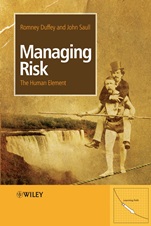
Managing Risk: The Human Element
ISBN 9780470699768
Autor: Romney Beecher Duffey, John Walton Saull
Wydawca: Wiley
Dostępność: 3-6 tygodni
Cena: 718,20 zł
Przed złożeniem zamówienia prosimy o kontakt mailowy celem potwierdzenia ceny.
ISBN13: |
9780470699768 |
ISBN10: |
0470699760 |
Autor: |
Romney Beecher Duffey, John Walton Saull |
Oprawa: |
Hardback |
Rok Wydania: |
2008-10-17 |
Ilość stron: |
568 |
Wymiary: |
246x173 |
Tematy: |
TGPQ |
The human element is the principle cause of incidents and accidents in all technology industries; hence it is evident that an understanding of the interaction between humans and technology is crucial to the effective management of risk. Despite this, no tested model that explicitly and quantitatively includes the human element in risk prediction is currently available.
Managing Risk: the Human Element combines descriptive and explanatory text with theoretical and mathematical analysis, offering important new concepts that can be used to improve the management of risk, trend analysis and prediction, and hence affect the accident rate in technological industries. It uses examples of major accidents to identify common causal factors, or “echoes”, and argues that the use of specific experience parameters for each particular industry is vital to achieving a minimum error rate as defined by mathematical prediction. New ideas for the perception, calculation and prediction of risk are introduced, and safety management is covered in depth, including for rare events and “unknown” outcomes
Discusses applications to multiple industries including nuclear, aviation, medical, shipping, chemical, industrial, railway, offshore oil and gas;Shows consistency between learning for large systems and technologies with the psychological models of learning from error correction at the personal level;Offers the expertise of key leading industry figures involved in safety work in the civil aviation and nuclear engineering industries;Incorporates numerous fascinating case studies of key technological accidents.
Managing Risk: the Human Element is an essential read for professional safety experts, human reliability experts and engineers in all technological industries, as well as risk analysts, corporate managers and statistical analysts. It is also of interest to professors, researchers and postgraduate students of reliab
ility and safety engineering, and to experts in human performance.
“…congratulations on what appears to be, at a high level of review, a significant contribution to the literature…I have found much to be admired in (your) research”
Mr. Joseph Fragola – Vice President of Valador Inc.
“The book is not only technically informative, but also attractive to all concerned readers and easy to be comprehended at various level of educational background. It is truly an excellent book ever written for the safety risk managers and analysis professionals in the engineering community, especially in the high reliability organizations…”
Dr Feng Hsu, Head of Risk Assessment and Management, NASA Goddard Space Flight Center
“I admire your courage in confronting your theoretical ideas with such diverse, ecologically valid data, and your success in capturing a major trend in them….I should add that I find all this quite inspiring . …The idea that you need to find the right measure of accumulated experience and not just routinely used calendar time makes so much sense that it comes as a shock to realize that this is a new idea”,
Professor Stellan Ohlsson, Professor of Psychology, University of Illinois at Chicago
Spis treści:
Contents
About the Authors
Preface
Acknowledgements
Defi nitions of Risk and Risk Management
Introduction: The Art of Prediction and the Creation of Order
Risk and Risk Management
Defi ning Risk
Managing Risk: Our Purpose, Plan and Goals
Recent Tragic Outcomes
Power Blackouts, Space Shuttle Losses, Concorde Crashes, Chernobyl, Three Mile Island and More . . .
How Events and Disasters Evolve in a Phased Development: The Human Element
Our Values at Risk: The Probable Improvement
Probably or Improbably Not
How this Book is Organised
References
Techni
cal Summary
Defi ning the Past Probability
Predicting Future Risk: Sampling from the Jar of Life
A Possible Future: Defi ning the Posterior Probability
The Engineers Have an Answer: Reliability
Drawing from the Jar of Life: The Hazard Function and Species Extinction
Experiencing Failure: Engineering and Human Risk and Reliability
Experience Space
Managing Safely: Creating Order out of Disorder Using Safety Management Systems
Describing the Indescribable: Top–Down and Bottom–Up
What an Observer will Observe and the Depth of our Experience
References
1 The Universal Learning Curve
Predicting Tragedies, Accidents and Failures: Using the Learning Hypothesis
The Learning Hypothesis: The Market Place of Life
Learning in HTSs: The Way a Human Learns
Evidence of Risk Reduction by Learning
Evidence of Learning from Experience: Case Studies
Evidence of Learning in Economics
Evidence of Learning in Engineering and Architecture: The Costs of Mistakes
Learning in Technology: the Economics of Reducing Costs
Evidence of Learning Skill and Risk Reduction in the Medical Profession: Practice Makes Almost Perfect
Learning in HTSs: The Recent Data Still Agrees
The Equations That Describe the Learning Curve
Zero Defects and Reality
Predicting Failures: The Human Bathtub
Experience Space: The Statistics of Managing Safety and of Observing Accidents
Predicting the Future Based on Past Experience: The Prior Ignorance
Future Events: the Way Forward Using Learning Probabilities
The Wisdom of Experience and Inevitability
The Last, First or Rare Event
Conclusions and Observations: Predicting Accidents
References
2 The Four Echoes
Power Blackouts, Space Shuttle Losses, Concorde Crashes, and the Chernobyl and Three Mile Island Accidents
The Combination of Events
The Problem Is the Human Element
The Four Echoes Share the Same Four Phases
The First Echo:
Blackout of the Power Grid
Management’s Role
The First Echo: Findings
Error State Elimination
The Second Echo: Columbia/Challenger
The Results of the Inquiry: Prior Knowledge
The Second Echo: The Four Phases
Management’s Responsibility
Error State Elimination
The Third Echo: Concorde Tires and SUVs
Tire Failures: the Prior Knowledge
The Third Echo: The Four Phases
Management’s Responsibility
Error State Elimination
The Fourth Echo: Chernobyl
The Chernobyl Accident: An Echo of Three Mile Island
The Consequences
Echoes of Three Mile Island
The Causes
Error State Elimination
The Fourth Echo: The Four Phases
Regulatory Environment and Practices
Case study: Regulation in Commercial Aviation
a) Regulations Development
b) Compliance Standards
c) Accident Investigation
Addressing Human Error
Management Responsibilities
Designing to Reduce Risk and the Role of Standards
Conclusion and Echoes: Predicting the Unpredictable
References
3 Predicting Rocket Risks and Refi nery Explosions: Near Misses, Shuttles, Safety and Anti–Missile Defence Systems Effectiveness
Learning from Near Misses and Prior Knowledge
Problems in Quantifying Risk: Predicting the Risk for the Next Shuttle Mission
Estimating a Possible Range of Likelihoods
Learning from Experience: Maturity Models for Future Space Mission Risk
Technology versus Technology
Missiles Risks over London: The German Doodlebug
Launching Missile Risk
The Number of Tests Required
Estimating the Risk of a Successful Attack and How Many Missiles We Must Fire
Uncertainty in the Risk of Failing to Intercept
What Risk Is There of a Missile Getting Through: Missing the Missile
Predicting the Risk of Industrial Accidents: The Texas City Refinery Explosion
From Lagging to Leading: Safety Analysis and Safety Culture
Missing Near Misses
What these Risk Est
Koszyk
Książek w koszyku: 0 szt.
Wartość zakupów: 0,00 zł
Informacje


Kontakt
Gambit
Centrum Oprogramowania
i Szkoleń Sp. z o.o.
Al. Pokoju 29b/22-24
31-564 Kraków
Siedziba Księgarni
ul. Kordylewskiego 1
31-542 Kraków
+48 12 410 5991
+48 12 410 5987
+48 12 410 5989
Subskrypcje
Administratorem danych osobowych jest firma Gambit COiS Sp. z o.o. Na podany adres będzie wysyłany wyłącznie biuletyn informacyjny.
Autoryzacja płatności

Informacje na temat autoryzacji płatności poprzez PayU.

© Copyright 2012: GAMBIT COiS Sp. z o.o. Wszelkie prawa zastrzeżone.
Projekt i wykonanie: Alchemia Studio Reklamy