


Wydawcy
Katalog tematyczny
- Archeologia (109)
- Ekonomia, finanse, business (13704)
- Filozofia (1445)
- Historia (3040)
- Języki i językoznawstwo (2356)
- Lifestyle, hobby i rozrywka (475)
- Medycyna (9704)
- Nauki humanistyczne (4)
- Nauki o Ziemi i środowisku (2638)
- Nauki ścisłe (20412)
- Astronomia (294)
- Biologia (5119)
- Chemia (6540)
- Fizyka (3309)
- Elektryczność i magnetyzm (90)
- Fizyka atomowa i molekularna (110)
- Fizyka cząstek elementarnych (36)
- Fizyka jądra atomowego (36)
- Fizyka kwantowa (210)
- Fizyka matematyczna (121)
- Fizyka relatywistyczna (36)
- Fizyka statystyczna (51)
- Fizyka stosowana (498)
- Mechanika klasyczna (186)
- Optyka i światło (133)
- Stany materii (202)
- Matematyka (4574)
- Nauki ścisłe, ogólnie (503)
- Nauki społeczne (8486)
- Nauki techniczne (13450)
- Prawo (1696)
- Publikacje informacyjne i interdyscyplinarne (1288)
- Religia i wierzenia (917)
- Technika komputerowa (4067)
- Zdrowie, relacje międzyludzkie i rozwój osobisty (657)





Informacje szczegółowe o książce
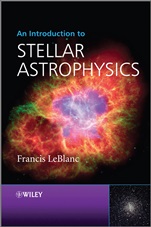
An Introduction to Stellar Astrophysics
ISBN 9780470699577
Autor: Francis LeBlanc
Wydawca: Wiley
Dostępność: 3-6 tygodni
Cena: 769,65 zł
Przed złożeniem zamówienia prosimy o kontakt mailowy celem potwierdzenia ceny.
ISBN13: |
9780470699577 |
ISBN10: |
0470699574 |
Autor: |
Francis LeBlanc |
Oprawa: |
Hardback |
Rok Wydania: |
2010-04-09 |
Ilość stron: |
352 |
Wymiary: |
252x165 |
Tematy: |
PH |
An Introduction to Stellar Astrophysics aspires to provide the reader with an intermediate knowledge on stars whilst focusing mostly on the explanation of the functioning of stars by using basic physical concepts and observational results.
The book is divided into seven chapters, featuring both core and optional content:Basic conceptsStellar FormationRadiative Transfer in StarsStellar AtmospheresStellar InteriorsNucleosynthesis and Stellar Evolution andChemically Peculiar Stars and Diffusion.
Student–friendly features include:Detailed examples to help the reader better grasp the most important conceptsA list of exercises is given at the end of each chapter and answers to a selection of these are presented.Brief recalls of the most important physical concepts needed to properly understand stars.A summary for each chapterOptional and advanced sections are included which may be skipped without interfering with the flow of the core content.
This book is designed to cover the most important aspects of stellar astrophysics inside a one semester (or half–year) course and as such is relevant for advanced undergraduate students following a first course on stellar astrophysics, in physics or astronomy programs. It will also serve as a basic reference for a full–year course as well as for researchers working in related fields.
Spis treści:
Preface
Acknowledgments
Chapter 1: Basics Concepts
1.1 Introduction
1.2 The electromagnetic spectrum
1.3 Blackbody radiation
1.4 Luminosity, effective temperature, flux and magnitudes
1.5 Boltzmann and Saha equations
1.6 Spectral classification of stars
1.7 The Hertzsprung–Russell diagram
Chapter 2: Stellar Formation
2.1 Introduction
2.2 Hydrostatic equilibrium
2.3 The virial theorem
2.4 The Jeans criteria
2.5 Free–fall times†
2.6 PreR
11;main–sequence evolution†
Chapter 3: Radiative Transfer in Stars
3.1 Introduction
3.2 Radiative opacities
3.3 Specific intensity and radiative moments
3.4 Radiative transfer equation
3.5 Local thermodynamic equilibrium
3.6 Solution of the radiative transfer equation
3.7 Radiative equilibrium
3.8 Radiative transfer at large optical depths
3.9 Rosseland and other mean opacities
3.10 Schwarzschild–Milne equations††
3.11 Demonstration of the radiative transfer equation†
3.12 Radiative acceleration of matter and radiative pressure†
Chapter 4: Stellar Atmospheres
4.1 Introduction
4.2 The grey atmosphere
4.3 Line opacities and broadening
4.4 Equivalent width and formation of atomic lines
4.5 Atmospheric modelling
Chapter 5: Stellar Interiors
5.1 Introduction
5.2 Equations of stellar structure
5.3 Energy transport in stars
5.4 Polytropic models
5.5 Structure of the Sun
5.6 Equation of state
5.7 Variable stars and asteroseismology
Chapter 6: Nucleosynthesis and Stellar Evolution
6.1 Introduction
6.2 Generalities concerning nuclear fusion
6.3 Models of the nucleus†
6.4 Basic physics of nuclear fusion
6.5 Main–sequence burning
6.6 Helium burning phase
6.7 Advanced nuclear burning
6.8 Evolutionary tracks in the H.–R. diagram
6.9 Stellar clusters
6.10 Stellar remnants
6.11 Novae and supernovae†
6.12 Heavy element nucleosynthesis: s, r and p processes†
6.13 Nuclear reaction cross–sections and rates††
Chapter 7: Chemically Peculiar Stars and Diffusion†
7.1 Introduction
7.2 Chemically peculiar stars
7.3 Diffusion theory††
7.4 Radiative accelerations††
7.5 Other transport processes††
Answers to selected exercises
Appendix A: Physical constants
Appendix B: Units in the c.g.s. and S.I. systems
Appendix C: Astronomical constants
Appendix D: Ionization energies (in eV) for the first five stages of ionization for the most important elements
Appendix E: Solar abundances for the most important elements
Appendix F: Atomic masses
Appendix G: Physical parameters for main–sequence stars
Appendix H: Periodic table of the elements
References
Bibliography
Index
Okładka tylna:
An Introduction to Stellar Astrophysics aspires to provide the reader with an intermediate knowledge on stars whilst focusing mostly on the explanation of the functioning of stars by using basic physical concepts and observational results.
The book is divided into seven chapters, featuring both core and optional content:Basic conceptsStellar FormationRadiative Transfer in StarsStellar AtmospheresStellar InteriorsNucleosynthesis and Stellar Evolution andChemically Peculiar Stars and Diffusion.
Student–friendly features include:Detailed examples to help the reader better grasp the most important conceptsA list of exercises is given at the end of each chapter and answers to a selection of these are presented.Brief recalls of the most important physical concepts needed to properly understand stars.A summary for each chapterOptional and advanced sections are included which may be skipped without interfering with the flow of the core content.
This book is designed to cover the most important aspects of stellar astrophysics inside a one semester (or half–year) course and as such is relevant for advanced undergraduate students following a first course on stellar astrophysics, in physics or astronomy programs. It will also serve as a basic reference for a full–year course as well as for researchers working in related fiel
ds.
Koszyk
Książek w koszyku: 0 szt.
Wartość zakupów: 0,00 zł
Informacje


Kontakt
Gambit
Centrum Oprogramowania
i Szkoleń Sp. z o.o.
Al. Pokoju 29b/22-24
31-564 Kraków
Siedziba Księgarni
ul. Kordylewskiego 1
31-542 Kraków
+48 12 410 5991
+48 12 410 5987
+48 12 410 5989
Subskrypcje
Administratorem danych osobowych jest firma Gambit COiS Sp. z o.o. Na podany adres będzie wysyłany wyłącznie biuletyn informacyjny.
Autoryzacja płatności

Informacje na temat autoryzacji płatności poprzez PayU.

© Copyright 2012: GAMBIT COiS Sp. z o.o. Wszelkie prawa zastrzeżone.
Projekt i wykonanie: Alchemia Studio Reklamy