


Wydawcy
Katalog tematyczny
- Archeologia (109)
- Ekonomia, finanse, business (13704)
- Filozofia (1445)
- Historia (3040)
- Języki i językoznawstwo (2356)
- Lifestyle, hobby i rozrywka (475)
- Medycyna (9704)
- Chirurgia (272)
- Inne gałęzie medycyny (1871)
- Medycyna kliniczna (4187)
- Choroby wewnętrzne (514)
- Dermatologia (51)
- Diagnostyka medyczna (3)
- Endokrynologia (144)
- Gastroenterologia (27)
- Geriatria (50)
- Ginekologia i położnictwo (134)
- Hematologia (46)
- Hepatologia (10)
- Kardiologia (71)
- Laryngologia (12)
- Nefrologia (10)
- Neurologia (500)
- Oftalmologia (50)
- Pediatria (33)
- Pulmunologia (32)
- Reumatologia (14)
- Terapia genowa (1)
- Układ mięśniowo-szkieletowy (1)
- Urologia (14)
- Medycyna niekonwencjonalna (14)
- Medycyna przedkliniczna (269)
- Medycyna, ogólnie (1740)
- Medyczne służby pomocnicze (745)
- Studia medyczne (16)
- Weterynaria (548)
- Nauki humanistyczne (4)
- Nauki o Ziemi i środowisku (2638)
- Nauki ścisłe (20412)
- Nauki społeczne (8486)
- Nauki techniczne (13450)
- Prawo (1696)
- Publikacje informacyjne i interdyscyplinarne (1288)
- Religia i wierzenia (917)
- Technika komputerowa (4067)
- Zdrowie, relacje międzyludzkie i rozwój osobisty (657)





Informacje szczegółowe o książce
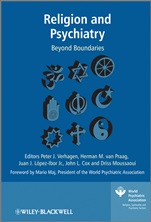
Religion and Psychiatry: Beyond Boundaries
ISBN 9780470694718
Autor: Peter Verhagen, Herman M. Van Praag, Juan José López–Ibor, John Cox, Driss Moussaoui
Wydawca: Wiley
Dostępność: 3-6 tygodni
Cena: 945,00 zł
Przed złożeniem zamówienia prosimy o kontakt mailowy celem potwierdzenia ceny.
ISBN13: |
9780470694718 |
ISBN10: |
0470694718 |
Autor: |
Peter Verhagen, Herman M. Van Praag, Juan José López–Ibor, John Cox, Driss Moussaoui |
Oprawa: |
Hardback |
Rok Wydania: |
2009-12-29 |
Ilość stron: |
680 |
Wymiary: |
248x174 |
Tematy: |
MJ |
Religion (and spirituality) is very much alive and shapes the cultural values and aspirations of psychiatrist and patient alike, as does the choice of not identifying with a particular faith. Patients bring their beliefs and convictions into the doctor–patient relationship. The challenge for mental health professionals, whatever their own world view, is to develop and refine their vocabularies such that they truly understand what is communicated to them by their patients. Religion and Psychiatry provides psychiatrists with a framework for this understanding and highlights the importance of religion and spirituality in mental well–being.
This book aims to inform and explain, as well as to be thought provoking and even controversial. Patiently and thoroughly, the authors consider why and how, when and where religion (and spirituality) are at stake in the life of psychiatric patients. The interface between psychiatry and religion is explored at different levels, varying from daily clinical practice to conceptual fieldwork. The book covers phenomenology, epidemiology, research data, explanatory models and theories. It also reviews the development of DSM V and its awareness of the importance of religion and spirituality in mental health.
What can religious traditions learn from each other to assist the patient? Religion and Psychiatry discusses this, as well as the neurological basis of religious experiences. It describes training programmes that successfully incorporate aspects of religion and demonstrates how different religious and spiritual traditions can be brought together to improve psychiatric training and daily practice.Describes the relationship of the main world religions with psychiatryConsiders training, policy and service deliveryProvides powerful support for more effective partnerships between psychiatry and religion in day to day clinical care
This is the first time that so many psychiatrists, psychologists and theologians from all parts of the world and from so many different religious and spiritual backgrounds have worked together to produce a book like this one. In that sense, it truly is a World Psychiatric Association publication.
Religion and Psychiatry is recommended reading for residents in psychiatry, postgraduates in theology, psychology and psychology of religion, researchers in psychiatric epidemiology and trans–cultural psychiatry, as well as professionals in theology, psychiatry and psychology of religion.
Spis treści:
List of Contributors
Foreword
Preface
General Introduction: Religion and Science
Peter J. Verhagen
PART 1 PROLEGOMENA (FIRST ISSUES): HISTORY, PHILOSOPHY, SCIENCE AND CULTURE
Introduction
1.1 Evil in Historical Perspective: At the Intersection of Religion and Psychiatry
Michael H. Stone
1.2 Linguistic Analysis and Values–Based Practice: One Way of Getting Started with Some Kinds of Philosophical Problems at the Interface Between Psychiatry and Religion
Bill (K.W.M.) Fulford
1.3 Science and Transcendence in Psychopathology; Lessons from Existentialism
Juan J. López–Ibor Jr. & María Inés López–Ibor Alcocer
1.4 Psychiatry of the Whole Person – Contribution of Spirituality in form of Mystic (Sufi) Thinking
Ahmad Mohit
PART 2 MAIN ISSUES: THE INTERFACE BETWEEN PSYCHIATRY, MENTAL HEALTH AND MAJOR RELIGIOUS TRADITIONS
Introduction 87
2.1 Judaism and Psychiatry
Ayala Uri, Noa Navot & Alan Apter
2.2 Christianity and Psychiatry
John R. Peteet
2.3 Religion and Mental Health in Islam
Ahmed Okasha
2.4 Psychiatry and African Religion
Frank G. Njenga, Anna Nguithi & Sam G. Gatere
2.5 Hinduism
and Mental Health
R. Srinivasa Murthy
2.6 Buddhism and Psychotherapy in Japan
Naotaka Shinfuku & Kenji Kitanishi
2.7 Psychiatry and Theravada Buddhism
Pichet Udomratn
PART 3 CORE ISSUES: RELIGION AND PSYCHOPATHOLOGY
Introduction 209
3.1 Religious Experience and Psychopathology
Juan J. López–Ibor Jr. & María Inés López–Ibor Alcocer
3.2 God’s Champions and Adversaries: About the Borders between Normal and Abnormal Religiosity
Herman M. van Praag
3.3 Religion and Psychopathology: Psychosis and Depression
Andrew C. P. Sims
3.4 Obsessive Compulsive Disorder and Religion: A Reconnaissance
Harold J. G. M. van Megen, Dianne A. den Boer–Wolters & Peter J. Verhagen
3.5 Religion and Psychoanalysis: Past and Present
Allan M. Josephson, Armand Nicholi Jr. & Allan Tasman
3.6 On the Psychology of Religious Fundamentalism
John, Lord Alderdice
3.7 Measurement at the Interface of Psychiatry and Religion:
Issues and Existing Measures
Peter C. Hill & Carissa Dwiwardani
PART 4 RESEARCH ISSUES
Introduction
4.1 Religion and Mental Health: What Do You Mean When You Say ‘Religion’? What Do You Mean When You Say ‘Mental Health’?
Charles H. Hackney
4.2 A Moment of Anger, a Lifetime of Favor: Image of God, Personality, and Orthodox Religiosity
Elisabeth H.M. Eurelings–Bontekoe & Hanneke Schaap–Jonker
4.3 The Relationship Between an Orthodox Protestant Upbringing and Current Orthodox Protestant Adherence, DSM–IV Axis II B Cluster Personality Disorders and Structural Borderline Personality Organization
Elisabeth H.M. Eurelings–Bontekoe & Patrick Luyten
4.4 When Religion Goes Awry: Religious Risk Factors for Poorer Health and Well–Being
Hisham
Abu Raiya, Kenneth I. Pargament & Gina Magyar–Russell
4.5 Religious Practice and Mental Health: a Moroccan Experience
Driss Moussaoui & Nadia Kadri
4.6 Religious and Spiritual Considerations in Psychiatric Diagnosis: Considerations for the DSM–V
David Lukoff, C. Robert Cloninger, Marc Galanter, David M. Gellerman, Linda Glickman, Harold G. Koenig, Francis G. Lu, William E. Narrow, John R. Peteet, Samuel B. Thielman & C. Paul Yang
PART 5 INTERDISCIPLINARY ISSUES: PSYCHOTHERAPY, PASTORAL CARE AND MEANING GIVING
Introduction
5.1 Gods of the Horizon: The Therapist’s and the Patient’s Religious Representations and the Inevitability of Countertransference
Moshe Halevi Spero
5.2 Assumptions About Pastoral Care, Spirituality and Mental Health
Peter J. Verhagen & Adamantios G. Avgoustidis
5.3 Coming to Terms with Loss in Schizophrenia – The Search for Meaning
Hanneke (J.K.) Muthert
PART 6 CONTROVERSIAL ISSUES: RELIGION AND THE BRAIN
Introduction
6.1 The Limits of Scientific Understanding and their Relevance for the Role of Religion in Psychiatry
Robert H. Belmaker
6.2 Seat of the Divine: A Biological ‘Proof of God’s Existence’?
Herman M. van Praag
6.3 Neuro–Theology: Demasqué of Religions
Dick F. Swaab & Wilma T.P. Verweij
PART 7 TRAINING ISSUES: RESIDENCY TRAINING AND CONTINUOUS EDUCATION
Introduction
7.1 Religion and the Training of Psychotherapists
Allan M. Josephson, John R. Peteet & Allan Tasman
7.2 Multicultural Education and Training in Religion and Spirituality
Peter J. Verhagen & John L. Cox
Epilogue: Proposal for a World Psychiatric Association Consensus or Position Statement on Spirituality and Religion in Psychiatry
Peter J. Verhagen & Christopher C.H. CookNotes on Contributors
Index of Names
Index of Subjects
Nota biograficzna:
Peter J. Verhagen is a graduate of the School of Medicine (1983) and the School of Theology (1988) of the University of Utrecht, the Netherlands. In 1988 he was registered as a psychiatrist. He is a practicing psychiatrist and theologian, group psychotherapist and supervisor (2002) of the Dutch Association for Group Dynamics and Group Psychotherapy. He is Director of the Program for the Treatment of Personality Disorders, Meerkanten GGz Ermelo/Harderwijk. He is also co–founder and present chair of the WPA Section on Religion, Spirituality and Psychiatry, founded in 2003, and Secretary of the Dutch Foundation for Psychiatry and Religion. He is lead editor of the Dutch journal, ′Psyche & Geloof′ (Psyche & Faith).
Herman M. van Praag is Professor Emeritus of the Dutch Universities of Groningen, Utrecht, Maastricht, and the Albert Einstein College of Medicine, New York, USA. He established the first department of biological psychiatry in Europe (Groningen) and became the first European Professor of Biological Psychiatry in 1968. He is well known for his extensive research on the biological determinants of depression and depressive symptoms for which he was decorated many times. He chaired the WPA Section on Religion, Spirituality and Psychiatry.
Juan J. López–Ibor, Jr is Professor and Chairman of Psychiatry and Director of the Institute for Psychiatry and Mental Health of the San Carlos Hospital of the Complutense University in Madrid. He is also Director of the World Health Organization Collaborating Center for Research and Training in Mental Health, Spain, and Fellow of the Royal National Academy of Medicine of Spain, Corresponding Fellow of the Royal Academy of Medicine of Zaragoza, and Honorary Fellow of the Spanish Medical Chirurgical Academy. He has been Secretary Gene
ral, President–Elect and President of the World Psychiatric Association. He is author, alone or in collaboration, of 53 books and of 219 chapters in monographs by other authors. He has published more than 330 papers in scientific journals and has presented more than 1,500 papers and communications in scientific meetings.
John L. Cox is Professor Emeritus at Keele University and Visiting Professor at the Institute of Psychiatry, London. During his period as President and Dean of the Royal College of Psychiatrists, he encouraged greater emphasis on international mental health, and the bridging of arts and science. He is the Immediate Past Secretary General of the World Psychiatric Association. He has a longstanding interest in the relationship between religion, spirituality and mental health, and was the lead editor of a book based on the work of Paul Tournier. He co–authored Modern Management of Perinatal Mental Disorder, and has published widely in perinatal mental health and transcultural psychiatry.
Driss Moussaoui is the Founder and the Chairman of the Ibn Rushd University Psychiatric Centre in Casablanca, Morocco, a WHO Collaborating Centre in Mental Health since 1992. He is the President–Elect of the World Association of Social Psychiatry and a member of the French Academy of Medicine. He is the Vice–Chair of the World Psychiatric Association Section on Spirituality, Religion and Psychiatry. Driss Moussaoui has published (or edited) 10 books and hundreds of papers in international journals.
Okładka tylna:
Religion (and spirituality) is very much alive and shapes the cultural values and aspirations of psychiatrist and patient alike, as does the choice of not identifying with a particular faith. Patients bring their beliefs and convictions into the doctor–patient relationship. The challenge for mental health professionals, whatever their own world view, is to develop and
refine their vocabularies such that they truly understand what is communicated to them by their patients. Religion and Psychiatry provides psychiatrists with a framework for this understanding and highlights the importance of religion and spirituality in mental well–being.
This book aims to inform and explain, as well as to be thought provoking and even controversial. Patiently and thoroughly, the authors consider why and how, when and where religion (and spirituality) are at stake in the life of psychiatric patients. The interface between psychiatry and religion is explored at different levels, varying from daily clinical practice to conceptual fieldwork. The book covers phenomenology, epidemiology, research data, explanatory models and theories. It also reviews the development of DSM V and its awareness of the importance of religion and spirituality in mental health.
What can religious traditions learn from each other to assist the patient? Religion and Psychiatry discusses this, as well as the neurological basis of religious experiences. It describes training programmes that successfully incorporate aspects of religion and demonstrates how different religious and spiritual traditions can be brought together to improve psychiatric training and daily practice.Describes the relationship of the main world religions with psychiatryConsiders training, policy and service deliveryProvides powerful support for more effective partnerships between psychiatry and religion in day to day clinical care
This is the first time that so many psychiatrists, psychologists and theologians from all parts of the world and from so many different religious and spiritual backgrounds have worked together to produce a book like this one. In that sense, it truly is a World Psychiatric Association publication.
Religion and Psychiatry is recommended reading for residents in psyc
hiatry, postgraduates in theology, psychology and psychology of religion, researchers in psychiatric epidemiology and trans–cultural psychiatry, as well as professionals in theology, psychiatry and psychology of religion.
Koszyk
Książek w koszyku: 0 szt.
Wartość zakupów: 0,00 zł
Informacje


Kontakt
Gambit
Centrum Oprogramowania
i Szkoleń Sp. z o.o.
Al. Pokoju 29b/22-24
31-564 Kraków
Siedziba Księgarni
ul. Kordylewskiego 1
31-542 Kraków
+48 12 410 5991
+48 12 410 5987
+48 12 410 5989
Subskrypcje
Administratorem danych osobowych jest firma Gambit COiS Sp. z o.o. Na podany adres będzie wysyłany wyłącznie biuletyn informacyjny.
Autoryzacja płatności

Informacje na temat autoryzacji płatności poprzez PayU.

© Copyright 2012: GAMBIT COiS Sp. z o.o. Wszelkie prawa zastrzeżone.
Projekt i wykonanie: Alchemia Studio Reklamy