


Wydawcy
Katalog tematyczny
- Archeologia (109)
- Ekonomia, finanse, business (13704)
- Filozofia (1445)
- Historia (3040)
- Języki i językoznawstwo (2356)
- Lifestyle, hobby i rozrywka (475)
- Medycyna (9704)
- Nauki humanistyczne (4)
- Nauki o Ziemi i środowisku (2638)
- Nauki ścisłe (20412)
- Nauki społeczne (8486)
- Edukacja (229)
- Kryminologia, opieka spełeczna (284)
- Obronność (10)
- Polityka (1389)
- Psychologia (777)
- Socjologia (410)
- Społeczeństwo i kultura (187)
- Nauki techniczne (13450)
- Prawo (1696)
- Publikacje informacyjne i interdyscyplinarne (1288)
- Religia i wierzenia (917)
- Technika komputerowa (4067)
- Zdrowie, relacje międzyludzkie i rozwój osobisty (657)





Informacje szczegółowe o książce
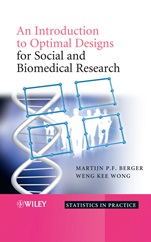
An Introduction to Optimal Designs for Social and Biomedical Research
ISBN 9780470694503
Autor: Martijn P.F. Berger, Weng–Kee Wong
Wydawca: Wiley
Dostępność: 3-6 tygodni
Cena: 411,60 zł
Przed złożeniem zamówienia prosimy o kontakt mailowy celem potwierdzenia ceny.
ISBN13: |
9780470694503 |
ISBN10: |
0470694505 |
Autor: |
Martijn P.F. Berger, Weng–Kee Wong |
Oprawa: |
Hardback |
Rok Wydania: |
2009-05-28 |
Ilość stron: |
346 |
Wymiary: |
241x162 |
Tematy: |
JC |
The increasing cost of research means that scientists are in more urgent need of optimal design theory to increase the efficiency of parameter estimators and the statistical power of their tests.
The objectives of a good design are to provide interpretable and accurate inference at minimal costs. Optimal design theory can help to identify a design with maximum power and maximum information for a statistical model and, at the same time, enable researchers to check on the model assumptions.
This Book:
Introduces optimal experimental design in an accessible format.Provides guidelines for practitioners to increase the efficiency of their designs, and demonstrates how optimal designs can reduce a study’s costs.Discusses the merits of optimal designs and compares them with commonly used designs.Takes the reader from simple linear regression models to advanced designs for multiple linear regression and nonlinear models in a systematic manner.Illustrates design techniques with practical examples from social and biomedical research to enhance the reader’s understanding.
Researchers and students studying social, behavioural and biomedical sciences will find this book useful for understanding design issues and in putting optimal design ideas to practice.
Spis treści:
Preface.
Acknowledgements.
1 Introduction to designs.
1.1 Introduction.
1.2 Stages of the research process.
1.3 Research design.
1.4 Types of research designs.
1.5 Requirements for a ‘good’ design.
1.6 Ethical aspects of design choice.
1.7 Exact versus approximate designs.
1.8 Examples.
1.9 Summary.
2 Designs for simple linear regression.
2.1 Design problem for a linear model.
2.2 Designs for radiation–dosage example.
2.3 Relative efficiency and sample size.
2.4 Simultaneous inference.
2.5 Optimality criteria.
2.6 Relative efficiency.2.7 Matrix formulation of designs for linear regression.
2.8 Summary.
3 Designs for multiple linear regression analysis.
3.1 Design problem for multiple linear regression.
3.2 Designs for vocabulary–growth study.
3.3 Relative efficiency and sample size.
3.4 Simultaneous inference.
3.5 Optimality criteria for a subset of parameters.
3.6 Relative efficiency.
3.7 Designs for polynomial regression model.
3.8 The Poggendorff and Ponzo illusion study.
3.9 Uncertainty about best fitting regression models.
3.10 Matrix notation of designs for multiple regression models.
3.11 Summary.
4 Designs for analysis of variance models.
4.1 A typical design problem for an analysis of variance model.
4.2 Estimation of parameters and efficiency.
4.3 Simultaneous inference and optimality criteria.
4.4 Designs for groups under stress study.
4.5 Specific hypotheses and contrasts.
4.6 Designs for the composite faces study.
4.7 Balanced designs versus unbalanced designs.
4.8 Matrix notation for Groups under Stress study.
4.9 Summary.
5 Designs for logistic regression models.
5.1 Design problem for logistic regression.
5.2 The design.
5.3 The logistic regression model.
5.4 Approaches to deal with local optimality.
5.5 Designs for calibration of item parameters in item response theory models.
5.6 Matrix formulation of designs for logistic regression.
5.7 Summary.
6 Designs for multilevel models.
6.1 Design problem for multilevel models.
6.2 The multilevel regression model.
6.3 Cluster versus subject randomization.
6.4 Cost function.
6.5 Example: Nursing home study.
6.6 Optimal design and power.
6.7 Design effect in multilevel surveys.
6.8 Matrix formulation of the multilevel model .
6.9 Summary.
7 Longitudinal designs for repeated measurement models.
7.1 Design problem for repeated measurements.
7.2 The design.
7.3 Ana
lysis techniques for repeated measures.
7.4 The linear mixed effects model for repeated measurement data.
7.5 Variance–covariance structures.
7.6 Estimation of parameters and efficiency.
7.7 Bone mineral density example.
7.8 Cost function.
7.9 D–optimal designs for linear mixed effects models with autocorrelated errors.
7.10 Miscellanea.
7. 11 Matrix formulation of the linear mixed effects model.
7. 12 Summary.
8 Two–treatment crossover designs.
8.1 Design problem for crossover studies.
8.2 The design.
8.3 Confounding treatment effects with nuisance effects.
8.4 The linear model for crossover designs.
8.5 Estimation of parameters and efficiency.
8.6 Cost and efficiency of the crossover design.
8.7 Optimal crossover designs for two treatments.
8.8 Matrix formulation of the mixed model for crossover designs.
8.9 Summary.
9 Alternative optimal designs for linear models.
9.1 Introduction.
9.2 Information matrix.
9.3 DA– or Ds–optimal designs.
9.4 Extrapolation optimal design.
9.5 L–optimal designs.
9.6 Bayesian optimal designs.
9.7 Minimax optimal design.
9.8 Multiple–objective optimal designs.
9.9 Summary.
10 Optimal designs for nonlinear models.
10.1 Introduction.
10.2 Linear models versus nonlinear models.
10.3 Design issues for nonlinear models.
10.4 Alternative optimal designs with examples.
10.5 Bayesian optimal designs.
10.6 Minimax optimal design.
10.7 Multiple–objective optimal designs.
10.8 Optimal design for model discrimination.
10.9 Summary.
11 Resources for the construction of optimal designs.
11.1 Introduction.
11.2 Sequential construction of optimal designs.
11.3 Exchange of design points.
11.4 Other algorithms.
11.5 Optimal design software.
11.6 A web site for finding optimal designs.
11.7 Summary.
References.
Autho
r Index.
Subject Index.
Okładka tylna:
The increasing cost of research means that scientists are in more urgent need of optimal design theory to increase the efficiency of parameter estimators and the statistical power of their tests.
The objectives of a good design are to provide interpretable and accurate inference at minimal costs. Optimal design theory can help to identify a design with maximum power and maximum information for a statistical model and, at the same time, enable researchers to check on the model assumptions.
This Book:
Introduces optimal experimental design in an accessible format.Provides guidelines for practitioners to increase the efficiency of their designs, and demonstrates how optimal designs can reduce a study’s costs.Discusses the merits of optimal designs and compares them with commonly used designs.Takes the reader from simple linear regression models to advanced designs for multiple linear regression and nonlinear models in a systematic manner.Illustrates design techniques with practical examples from social and biomedical research to enhance the reader’s understanding.
Researchers and students studying social, behavioural and biomedical sciences will find this book useful for understanding design issues and in putting optimal design ideas to practice.
Koszyk
Książek w koszyku: 0 szt.
Wartość zakupów: 0,00 zł
Informacje


Kontakt
Gambit
Centrum Oprogramowania
i Szkoleń Sp. z o.o.
Al. Pokoju 29b/22-24
31-564 Kraków
Siedziba Księgarni
ul. Kordylewskiego 1
31-542 Kraków
+48 12 410 5991
+48 12 410 5987
+48 12 410 5989
Subskrypcje
Administratorem danych osobowych jest firma Gambit COiS Sp. z o.o. Na podany adres będzie wysyłany wyłącznie biuletyn informacyjny.
Autoryzacja płatności

Informacje na temat autoryzacji płatności poprzez PayU.

© Copyright 2012: GAMBIT COiS Sp. z o.o. Wszelkie prawa zastrzeżone.
Projekt i wykonanie: Alchemia Studio Reklamy