


Wydawcy
Katalog tematyczny
- Archeologia (109)
- Ekonomia, finanse, business (13704)
- Filozofia (1445)
- Historia (3040)
- Języki i językoznawstwo (2356)
- Lifestyle, hobby i rozrywka (475)
- Medycyna (9704)
- Nauki humanistyczne (4)
- Nauki o Ziemi i środowisku (2638)
- Nauki ścisłe (20412)
- Nauki społeczne (8486)
- Nauki techniczne (13450)
- Prawo (1696)
- Publikacje informacyjne i interdyscyplinarne (1288)
- Religia i wierzenia (917)
- Technika komputerowa (4067)
- Zdrowie, relacje międzyludzkie i rozwój osobisty (657)





Informacje szczegółowe o książce
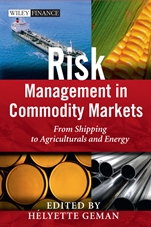
Risk Management in Commodity Markets: From Shipping to Agriculturals and Energy
ISBN 9780470694251
Autor: Helyette Geman
Wydawca: Wiley
Dostępność: 3-6 tygodni
Cena: 476,70 zł
Przed złożeniem zamówienia prosimy o kontakt mailowy celem potwierdzenia ceny.
ISBN13: |
9780470694251 |
ISBN10: |
0470694254 |
Autor: |
Helyette Geman |
Oprawa: |
Hardback |
Rok Wydania: |
2008-11-14 |
Ilość stron: |
320 |
Wymiary: |
244x168 |
Tematy: |
KF |
Today commodities represent the fastest growing markets worldwide. Historically misunderstood, generally understudied and undervalued, certainly under–represented in the literature, commodities are suddenly receiving the attention they deserve.
Bringing together some of the best authors in their fields, this book focuses on the risk management issues associated with both soft and hard commodities: energy, weather, agriculturals, metals and shipping. Taking the reader through every part of the commodities markets, the authors discuss the intricacies of modelling spot and forward prices, as well as the design of new Futures markets. The book also looks at the use of options and other derivative contract forms for hedging purposes, as well as supply management in commodity markets. It looks at the implications of climate policy and climate research and analyzes the various freight derivatives markets and products used to manage shipping and freight risk in a global commodity world.
Spis treści:
Preface.
About the Editor.
About the Contributors.
1. Structural Models of Commodity Prices (Craig Pirrong).
1.1 Introduction.
1.2 A Commodity Taxonomy.
1.3 Fundamental Models for Storable Commodities.
1.4 Non–Storable Commodities.
1.5 Summary.
1.6 References.
2. Forward Curve Modelling in Commodity Markets (Svetlana Borovkova, Universiteit Amsterdam, and Helyette Geman).
2.1 Introduction.
2.2 Forward Curve Models for Non–Seasonal Commodities.
2.3 The Seasonal Forward Curve Model and its Extensions.
2.4 Principal Component Analysis of a Forward Curve.
2.5 Forward Curve Indicators.
2.6 Conclusions.
2.7 References.
3. Integrating Physical and Financial Risk Management in Supply Management (Paul R. Kleindorfer).
3.1 Introduction.
3.2 A Primer On Previous Supply Management Contracting Literature.
3.3 A Moddeling Framework and a Simple Illus
trative Case.
3.4 Recent Contributions to the Optimal Contracting Literature.
3.5 Some Open Research Questions and Implications for Practice.
3.6 References.
4. The Design of New Derivative Markets (Giovanni Barone–Adesi).
4.1 Introduction.
4.2 Determinants of Success of New Derivative Markets.
4.3 Price Discovery.
4.4 Trading, Clearing and Margining.
4.5 Market Integrity.
4.6 Market Recovery.
4.7 Market Oversight.
4.8 Case Studies.
4.9 Conclusion.
4.10 References.
5 Risk Premia of Electricity Futures: A Dynamic Equilibrium Model (Wolfgang Bühler, University of Mannheim, and Jens Müller–Merbach).
5.1 Introduction.
5.2 The Dynamic Equilibrium Model.
5.3 Comparative Statics.
5.4 Empirical Study.
5.5 Conclusion.
5.6 References.
6. Measuring Correlation Risk for Energy Derivatives (Roza Galeeva, Jiri Hoogland and Alexander Eydeland).
6.1 Introduction.
6.2 Correlation.
6.3 Perturbing the Correlation Matrix.
6.4 Correlation VaR.
6.5 Some Examples.
6.6 Discussion and Conclusions.
6.7 References.
7. Precaution and a Dismal Theorem: Implications for Climate Policy and Climate Research (Gary W. Yohe, Wesleyan University and Richard S. J. Tol).
7.1 Introduction.
7.2 A New Source of Concern: Weitzman’s Dismal Theorem.
7.3 Implications of the "Dismal Theorem".
7.4 Some Concluding Remarks.
7.5 References.
8. Incentives for Investing in Renewables (Falbo Paolo, Felletti Daniele and Stefani Silvana).
8.1 Introduction and Background.
8.2 Subsidies for Energy.
8.3 The Model.
8.4 Statistical Estimations.
8.5 Risk Analysis.
8.6 Conclusions.
8.7 References.
9. Hedging the Risk of an Energy Futures Portfolio (Carol Alexander).
9.1 Mapping Portfolios to Constant Maturity Futures.
9.2 The Portfolio and its Key Risk Factors.
9.3 Identifying the Key Risk Factors.
9.4 Hedgin
g the Portfolio Risk.
9.5 Conclusions.
9.6 References.
10. Spark Spread Options when Commodity Prices are Represented as Time Changed Processes (Elisa Luciano).
10.1 Spark Spread Options.
10.2 Time Change in a Nutshell.
10.3 Time Change and Commodity Prices.
10.4 An Application to PJM Electricity and NYMEX Natural Gas.
10.5 Conclusions and Further Research.
10.6 Appendix A: Modelling Specification in the Multivariate Case.
10.7 Appendix B: Alternative Modelling Specifications in the Univariate Case.
10.8 References.
11. Freight Derivatives and Risk Management: A Review (Manolis G. Kavussanos and Ilias D. Visvikis).
11.1 Introduction.
11.2 Forward Freight Agreements.
11.3 Freight Futures.
11.4 "Hybrid" (Cleared) FFAs.
11.5 Freight Options.
11.6 Empirical Research on Freight Derivatives.
11.7 Conclusion.
11.8 References.
12. Mean–Reversion and Structural Breaks in Crude Oil, Copper, and Shipping (H. Geman and S. Ohana).
12.1 Introduction.
12.2 Fundamentals of Copper, Crude Oil, and Shipping.
12.3 Defining Mean–Reversion.
12.4 Dataset and Unit Root Tests.
12.5 Conclusion.
12.6 References.
13. Managing Agricultural Price Risk in Developing Countries (Julie Dana and Christopher L. Gilbert).
13.1 The Liberalization Context.
13.2 Incidence of Risk Exposure.
13.3 Instruments and Problems.
13.4 Price Risk Management in the Developing Country Supply Chain.
13.5 Concluding Comments.
13.6 References.
14. Gaining Exposure to Emerging Markets in Institutional Portfolios: The Role of Commodities (George A. Martin and Richard Spurgin).
14.1 Introduction.
14.2 Asset Markets and Economic Growth.
14.3 Are Emerging Markets Equity Markets and Commodity Markets Integrated?
14.4 Implications for the Investment Policy of Institutional Investors.
14.5 Conclusion.
14.6 References.
15. Case Studies and Risk Management
in Commodity Derivatives Trading (Hilary Till).
15.1 Introduction.
15.2 Institutional Risk Management.
15.3 Proprietary–Trading Risk Management.
15.4 Hedge Fund Risk Management.
15.5 Fund–of–Hedge–Funds Diversification.
15.6 Market Risk Management.
15.7 Conclusion.
15.8 References.
Index.
Nota biograficzna:
HELYETTE GEMAN is a Professor of Finance at Birkbeck, University of London and ESSEC Graduate Business School. She is a graduate of l’École Normale Supérieure in Mathematics, holds a Masters degree in Theoretical Physics and a PhD in Mathematics from the University Pierre et Marie Curie and a PhD in Finance from the University Panthéon Sorbonne.
Professor Geman has been a scientific advisor to major financial institutions and energy and mining companies for the last 18 years, covering the spectrum of interest rates, catastrophic risk, oil, natural gas, electricity and metals. She was previously the head of Research and Development at Caisse des Dépôts. Professor Geman was the first president of the Bachelier Finance Society and has published more than 95 papers in top international finance Journals including the Journal of Finance, Journal of Financial Economics, Mathematical Finance. She is a Member of Honour of the French Society of Actuaries. Professor Geman′s research includes interest rates and catastrophic insurance, asset price and commodity forward curve modelling, hedge funds and alternative investments, as well as exotic option pricing for which she won the first prize of the Merrill Lynch Awards in 1994. Her work on catastrophic options and CAT bonds and book Insurance and Weather Derivatives (1998) received the AFIR (actuarial approach to financial risk) prize. Prof Geman was named in 2004 in the Hall of Fame of Energy Risk and received in July 2008 the ISA medal for Sciences of the Alma Mater University of Bologna for the
Koszyk
Książek w koszyku: 0 szt.
Wartość zakupów: 0,00 zł
Informacje


Kontakt
Gambit
Centrum Oprogramowania
i Szkoleń Sp. z o.o.
Al. Pokoju 29b/22-24
31-564 Kraków
Siedziba Księgarni
ul. Kordylewskiego 1
31-542 Kraków
+48 12 410 5991
+48 12 410 5987
+48 12 410 5989
Subskrypcje
Administratorem danych osobowych jest firma Gambit COiS Sp. z o.o. Na podany adres będzie wysyłany wyłącznie biuletyn informacyjny.
Autoryzacja płatności

Informacje na temat autoryzacji płatności poprzez PayU.

© Copyright 2012: GAMBIT COiS Sp. z o.o. Wszelkie prawa zastrzeżone.
Projekt i wykonanie: Alchemia Studio Reklamy