


Wydawcy
Katalog tematyczny
- Archeologia (109)
- Ekonomia, finanse, business (13704)
- Filozofia (1445)
- Historia (3040)
- Języki i językoznawstwo (2356)
- Lifestyle, hobby i rozrywka (475)
- Medycyna (9704)
- Nauki humanistyczne (4)
- Nauki o Ziemi i środowisku (2638)
- Nauki ścisłe (20412)
- Nauki społeczne (8486)
- Nauki techniczne (13450)
- Budownictwo lądowe (1045)
- Chemia przemysłowa (2258)
- Elektronika i telekomunikacja (3287)
- Energetyka (1122)
- Inne nauki stosowane (363)
- Inżynieria biochemiczna (507)
- Inżynieria transportu (232)
- Mechanika i materiały (3316)
- Nauka o środowisku (321)
- Rolnictwo (507)
- Technika, ogólnie (475)
- Prawo (1696)
- Publikacje informacyjne i interdyscyplinarne (1288)
- Religia i wierzenia (917)
- Technika komputerowa (4067)
- Zdrowie, relacje międzyludzkie i rozwój osobisty (657)





Informacje szczegółowe o książce
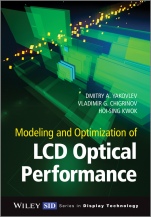
Modeling and Optimization of LCD Optical Performance
ISBN 9780470689141
Autor: Dmitry A. Yakovlev, Vladimir G. Chigrinov, Hoi–Sing Kwok
Wydawca: Wiley
Dostępność: 3-6 tygodni
Cena: 514,50 zł
Przed złożeniem zamówienia prosimy o kontakt mailowy celem potwierdzenia ceny.
ISBN13: |
9780470689141 |
ISBN10: |
0470689145 |
Autor: |
Dmitry A. Yakovlev, Vladimir G. Chigrinov, Hoi–Sing Kwok |
Oprawa: |
Hardback |
Rok Wydania: |
2015-03-20 |
Ilość stron: |
584 |
Wymiary: |
250x171 |
Tematy: |
TG |
Focussing on polarization matrix optics in many forms, this book includes coverage of a wide range of methods which have been applied to LCD modeling, ranging from the simple Jones matrix method to elaborate and high accuracy algorithms suitable for off–axis optics. Researchers and scientists are constantly striving for improved performance, faster response times, wide viewing angles, improved colour in liquid crystal display development, and with this comes the need to model LCD devices effectively. The authors have significant experience in dealing with the problems related to the practical application of liquid crystals, in particular their optical performance. Key features: Explores analytical solutions and approximations to important cases in the matrix treatment of different LC layer configurations, and the application of these results to improve the computational method Provides the analysis of accuracies of the different approaches discussed in the book Explains the development of the Eigenwave Jones matrix method which offers a path to improved accuracy compared to Jones matrix and extended Jones matrix formalisms, while achieving significant improvement in computational speed and versatility compared to full 4x4 matrix methods Includes a companion website hosting the authors′ program library LMOPTICS (FORTRAN 90), a collection of routines for calculating the optical characteristics of stratified media, the use of which allows for the easy implementation of the methods described in this book. The website also contains a set of sample programs (source codes) using LMOPTICS, which exemplify the application of these methods in different situations.
Preface 1 Polarization of monochromatic waves. Background of the Jones matrix methods. The Jones calculus 1.1 Homogeneous waves in isotropic media 1.1.1 Waves 1.1.2 Polarization. Jones vectors 1.1.3 Coordinate transformation rules for Jones vectors. Orthogonal polarizations. Decomposition of a wave into two orthogonally polarized waves 1.2 Interface optics for isotropic media 1.2.1 Fresnel′s formulas. Snell′s law 1.2.2 Reflection and transmission Jones matrices for a plane interface between isotropic media 1.3 Wave propagation in anisotropic media 1.3.1 Wave equations 1.3.2 Waves in a uniaxial layer 1.3.3 A simple birefringent layer. Principal axes of a simple birefringent layer 1.3.4 Transmission Jones matrices of a simple birefringent layer at normal incidence 1.3.5 Linear retarders 1.3.6 Jones matrices of absorbing polarizers 1.4 Jones calculus 1.4.1 Basic principles of the Jones calculus 1.4.2 Three useful theorems for transmissive systems 1.4.3 Reciprocity relations. Jones′s reversibility theorem 1.4.4 Theorem of polarization reversibility for systems without diattenuation 1.4.5 Particular variants of application of the Jones calculus. Cartesian Jones vectors for wave fields in anisotropic media 2 The Jones calculus: Solutions for ideal twisted structures and their applications in LCD optics 2.1 Jones matrix and eigenmodes of a liquid crystal layer with an ideal twisted structure 2.2 LCD optics and Gooch–Tarry formulas 2.3 Interactive simulation 2.4 Parameter space 3 Optical equivalence theorem 3.1 General optical equivalence theorem 3.2 Optical equivalence for a twisted nematic liquid crystal cell 3.3 Polarization conserving modes 3.4 Application to nematic bistable LCDs 3.5 Application to reflective displays 3.6 Measurement of characteristic parameters of an LC cell 4 Electrooptical modes. Practical examples of LCD modeling and optimization 4.1 Optimization of LCD performance in various electrooptical modes 4.1.1 Electrically Controlled Birefringence 4.1.2 Twist effect 4.1.3 Supertwist effect 4.1.4 Optimization of optical performance of reflective LCDs 4.2 Transflective LCDs 4.2.1 Dual Mode Single Cell Gap approach 4.2.2 Single Mode Single Cell Gap approach 4.3 Total Internal Reflection Mode 4.4 Ferroelectric Liquid Crystal Displays 4.4.1 Basic physical properties 4.4.2 Electrooptic effects in FLC cells 4.5 Birefringent Color Generation in Dichromatic Reflective FLCDs 5 Necessary mathematics. Radiometric terms. Conventions. Various Stokes and Jones vectors 5.1 Some definitions and relations from matrix algebra 5.1.1 General definitions 5.1.2 Some important properties of matrix products 5.1.3 Unitary matrices. Unimodular unitary 2´2 matrices. STU matrices 5.1.4 Norms of vectors and matrices 5.1.5 Kronecker product of matrices 5.1.6 Approximations 5.2 Some radiometric quantities. Conventions 5.3 Stokes vectors of plane waves and collimated beams propagating in isotropic nonabsorbing media 5.4 Jones vectors 5.4.1 Fitted–to–electric–field Jones vectors and fitted–to–transverse–component–of–electric–field Jones vectors 5.4.2 Fitted–to–irradiance Jones vectors 5.4.3 Conventional Jones vectors 6 Simple models and representations for solving the optimization and inverse optical problems. Real optics of LC cells and useful approximations 6.1 Polarization transfer factor of an optical system 6.2 Optics of LC cells in terms of the polarization transport coefficients 6.2.1 Polarization–dependent losses, and depolarization, unpolarized transmittance 6.2.2 Rotations 6.2.3 Symmetry of sample 6.3 Retroreflection geometry 6.4 Applications of the polarization transport coefficients in the optimization of LC devices 6.5 Evaluation of the ultimate characteristics of an LCD that can be attained by fitting the compensation system. Modulation efficiency of LC layers 7 Some physical models and mathematical algorithms used in modeling the optical performance of LCDs 7.1 Physical models of the light – layered system interaction used in modeling the optical behavior of LC devices. Plane–wave approximations. Transfer channel approach 7.2 Transfer matrix technique and adding technique 7.2.1 Transfer matrix technique 7.2.2 Adding technique 7.3 Optical models of some elements of LCDs 8 Modeling methods based on the rigorous theory of the interaction of a plane monochromatic wave with an ideal stratified medium. Eigenwave (EW) methods. EW Jones matrix method 8.1 General properties of electromagnetic field induced by a plane monochromatic wave within a linear stratified media 8.1.1 Maxwell′s equations and constitutive relations 8.1.2 Plane waves 8.1.3 Field geometry 8.2 Transmission and reflection operators of fragments (TR–units) of stratified medium and their calculation 8.2.1 EW Jones vector. EW Jones matrices. Transmission and reflection operators 8.2.2 Calculation of overall transmission and overall reflection operators for layered systems by using transfer matrices 8.3 Berreman′s method 8.3.1 Transfer matrices 8.3.2 Transfer matrix of a homogeneous layer 8.3.3 Transfer matrix of a smoothly inhomogeneous layer. Staircase approximation 8.3.4 Coordinate systems 8.4 Simplifications, useful relations and advanced techniques 8.4.1 Orthogonality relations and other useful relations for eigenwave bases 8.4.2 Simple general formulas for transmission operators for interfaces 8.4.3 Calculation of transmission and reflection operators of layered systems by using the adding technique 8.5 Transmissivities and reflectivities 8.6 Mathematical properties of transfer matrices and 2´2 transmission and reflection matrices of lossless media and reciprocal media 8.6.1 Properties of matrix operators for nonabsorbing regions 8.6.2 Properties of matrix operators for reciprocal regions 8.7 Calculation of EW 4´4 transfer matrices for LC layers 8.8 Transformation of the elements of EW Jones vectors and EW Jones matrices under changes of eigenwave bases 8.8.1 Coordinates of the EW Jones vector of a wave field in different eigenwave bases 8.8.2 EW Jones operators in different eigenwave bases 9 Specification of eigenwave bases in isotropic, uniaxial, and biaxial media 9.1 General aspects of the eigenwave basis specification. Implementation topics 9.2 Isotropic media 9.3 Uniaxial media 9.4 Biaxial media 10 Efficient methods for calculating the optical characteristics of layered systems for quasimonochromatic incident light. Main routines of LMOPTICS library 10.1 EW Stokes vectors and EW Mueller matrices 10.2 Calculation of the EW Mueller matrices of the overall transmission and reflection of a system consisting of "thin" and "thick" layers 10.3 Main routines of LMOPTICS 10.3.1 Routines for computing 4´4 transfer matrices and EW Jones matrices 10.3.2 Routines for computing EW Mueller matrices 10.3.3 Other useful routines 11 Calculation of the transmission characteristics of inhomogeneous liquid crystal layers by using the classical Jones calculus and the EW Jones matrix method 11.1 Application of Jones matrix methods to modeling the optics of inhomogeneous LC layers 11.1.1 Calculation of a transmission Jones matrix of an LC layer by using the classical Jones calculus 11.1.2 Extended Jones matrix methods 11.2 NBR approximation. Basic differential equations 11.3 NBR approximation. Numerical methods 11.3.1 Approximating multilayer method 11.3.2 Discretization method 11.3.3 Power series method 11.4 NBR approximation. Analytical solutions 11.4.1 Twisted strictures 11.4.2 Non–twisted structures 11.4.3 NBR approximation and the geometrical optics approximation. Adiabatic and quasiadiabatic approximations. 11.5 Estimation of the maximum error of calculated values of the LCD panel transmittance caused by errors in used values of the transmission matrix of the LC layer 12 Some approximate representations in EW Jones matrix method and their application for solving optimization and inverse problems for LCDs 12.1 Theory of STUM approximation 12.2 Exact and approximate expressions for transmission operators of interfaces at normal incidence 12.3 Polarization Jones matrix of an inhomogeneous nonabsorbing anisotropic layer with negligible bulk reflection at normal incidence. Simple representations of the polarization matrices of LC layers at normal incidence 12.4 Immersion model of the polarization–converting system of an LCD 12.5 Determining the configurational and optical parameters of LC layers with a twisted structure: Spectral fitting method 12.5.1 How to bring together the experiment and unitary approximation 12.5.2 Parameterization and solving the inverse problem 12.5.3 Appendix to section 12.5 12.6 Development of compensation systems for enhancement of viewing angle characteristics of LCDs 13 A few words about modeling of fine–structure LCDs and the direct ray approximation 13.1 Virtual microscope 13.2 Directional illumination and diffuse illumination Appendix A A.1 Introductory remarks A.2 Fast LCD A.3 Color LCD A.4 Transflective LCD A.5 Switchable viewing angle LCD A.6 Optimal E–paper configurations A.7 Color filter optimization Appendix B B.1 Conservation law for energy flux B.2 Lorentz′s lemma B.3 Non–exponential waves B.4 To the power series method (section 11.3.3) B.5 One of ways to obtain the explicit expressions for transmission Jones matrices of an ideal twisted LC layer
Koszyk
Książek w koszyku: 0 szt.
Wartość zakupów: 0,00 zł
Informacje


Kontakt
Gambit
Centrum Oprogramowania
i Szkoleń Sp. z o.o.
Al. Pokoju 29b/22-24
31-564 Kraków
Siedziba Księgarni
ul. Kordylewskiego 1
31-542 Kraków
+48 12 410 5991
+48 12 410 5987
+48 12 410 5989
Subskrypcje
Administratorem danych osobowych jest firma Gambit COiS Sp. z o.o. Na podany adres będzie wysyłany wyłącznie biuletyn informacyjny.
Autoryzacja płatności

Informacje na temat autoryzacji płatności poprzez PayU.

© Copyright 2012: GAMBIT COiS Sp. z o.o. Wszelkie prawa zastrzeżone.
Projekt i wykonanie: Alchemia Studio Reklamy