


Wydawcy
Katalog tematyczny
- Archeologia (109)
- Ekonomia, finanse, business (13704)
- Filozofia (1445)
- Historia (3040)
- Języki i językoznawstwo (2356)
- Lifestyle, hobby i rozrywka (475)
- Medycyna (9704)
- Nauki humanistyczne (4)
- Nauki o Ziemi i środowisku (2638)
- Nauki ścisłe (20412)
- Nauki społeczne (8486)
- Nauki techniczne (13450)
- Budownictwo lądowe (1045)
- Chemia przemysłowa (2258)
- Elektronika i telekomunikacja (3287)
- Energetyka (1122)
- Inne nauki stosowane (363)
- Inżynieria biochemiczna (507)
- Inżynieria transportu (232)
- Mechanika i materiały (3316)
- Nauka o środowisku (321)
- Rolnictwo (507)
- Technika, ogólnie (475)
- Prawo (1696)
- Publikacje informacyjne i interdyscyplinarne (1288)
- Religia i wierzenia (917)
- Technika komputerowa (4067)
- Zdrowie, relacje międzyludzkie i rozwój osobisty (657)





Informacje szczegółowe o książce
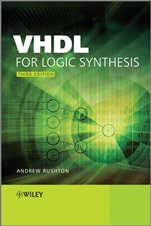
VHDL for Logic Synthesis
ISBN 9780470688472
Autor: Andrew Rushton
Wydawca: Wiley
Dostępność: 3-6 tygodni
Cena: 385,35 zł
Przed złożeniem zamówienia prosimy o kontakt mailowy celem potwierdzenia ceny.
ISBN13: |
9780470688472 |
ISBN10: |
0470688475 |
Autor: |
Andrew Rushton |
Oprawa: |
Hardback |
Rok Wydania: |
2011-04-18 |
Numer Wydania: |
3rd Edition |
Ilość stron: |
484 |
Wymiary: |
251x176 |
Tematy: |
TJ |
Making VHDL a simple and easy–to–use hardware description language
Many engineers encountering VHDL (very high speed integrated circuits hardware description language) for the first time can feel overwhelmed by it. This book bridges the gap between the VHDL language and the hardware that results from logic synthesis with clear organisation, progressing from the basics of combinational logic, types, and operators; through special structures such as tristate buses, register banks and memories, to advanced themes such as developing your own packages, writing test benches and using the full range of synthesis types.
This third edition has been substantially rewritten to include the new VHDL–2008 features that enable synthesis of fixed–point and floating–point hardware. Extensively updated throughout to reflect modern logic synthesis usage, it also contains a complete case study to demonstrate the updated features.
Features to this edition include:
• a common VHDL subset which will work across a range of different synthesis systems, targeting a very wide range of technologies
• a design style that results in long design lifetimes, maximum design reuse and easy technology retargeting
• a new chapter on a large scale design example based on a digital filter from design objective and design process, to testing strategy and test benches
• a chapter on writing test benches, with everything needed to implement a test–based design strategy
• extensive coverage of data path design, including integer, fixed–point and floating–point arithmetic, logic circuits, shifters, tristate buses, RAMs, ROMs, state machines, and decoders
Focused specifically on logic synthesis, this book is for professional hardware engineers using VHDL for logic synthesis, and digital systems designers new to VHDL but familiar with digital systems. It offers all the knowl
edge and tools needed to use VHDL for logic synthesis. Organised in themed chapters and with a comprehensive index, this complete reference will also benefit postgraduate students following courses on microelectronics or VLSI/ semiconductors and digital design.
Spis treści:
Preface.
List of Figures.
List of Tables.
1 Introduction.
1.1 The VHDL Design Cycle.
1.2 The Origins of VHDL.
1.3 The Standardisation Process.
1.4 Unification of VHDL Standards.
1.5 Portability.
2 Register–Transfer Level Design.
2.1 The RTL Design Stages.
2.2 Example Circuit.
2.3 Identify the Data Operations.
2.4 Determine the Data Precision.
2.5 Choose Resources to Provide.
2.6 Allocate Operations to Resources.
2.7 Design the Controller.
2.8 Design the Reset Mechanism.
2.9 VHDL Description of the RTL Design.
2.10 Synthesis Results.
3 Combinational Logic.
3.1 Design Units.
3.2 Entities and Architectures.
3.3 Simulation Model.
3.4 Synthesis Templates.
3.5 Signals and Ports.
3.6 Initial Values.
3.7 Simple Signal Assignments.
3.8 Conditional Signal Assignments.
3.9 Selected Signal Assignment.
3.10 Worked Example.
4 Basic Types.
4.1 Synthesisable Types.
4.2 Standard Types.
4.3 Standard Operators.
4.4 Type Bit.
4.5 Type Boolean.
4.6 Integer Types.
4.7 Enumeration Types.
4.8 Multi–Valued Logic Types.
4.9 Records.
4.10 Arrays.
4.11 Aggregates, Strings and Bit–Strings.
4.12 Attributes.
4.13 More on Selected Signal Assignments.
5 Operators.
5.1 The Standard Operators.
5.2 Operator Precedence.
5.3 Boolean Operators.
5.4 Comparison Operators.
5.5 Shifting Operators.
5.6 Arithmetic Operators.
5.7 Concatenation Operator.
6 Synthesis Types.
6.1 Synthesis Type System.
6.2 Making the Packages Visible.
6.3 Logic Types – Std—Logic̵
2;1164.
6.4 Numeric Types – Numeric—Std.
6.5 Fixed–Point Types – Fixed—Pkg.
6.6 Floating–Point Types – Float—Pkg.
6.7 Type Conversions.
6.8 Constant Values.
6.9 Mixing Types in Expressions.
6.10 Top–Level Interface.
7 Std—Logic—Arith.
7.1 The Std—Logic—Arith Package.
7.2 Contents of Std—Logic—Arith.
7.3 Type Conversions.
7.4 Constant Values.
7.5 Mixing Types in Expressions.
8 Sequential VHDL.
8.1 Processes.
8.2 Signal Assignments.
8.3 Variables.
8.4 If Statements.
8.5 Case Statements.
8.6 Latch Inference.
8.7 Loops.
8.8 Worked Example.
9 Registers.
9.1 Basic D–Type Register.
9.2 Simulation Model.
9.3 Synthesis Model.
9.4 Register Templates.
9.5 Register Types.
9.6 Clock Types.
9.7 Clock Gating.
9.8 Data Gating.
9.9 Asynchronous Reset.
9.10 Synchronous Reset.
9.11 Registered Variables.
9.12 Initial Values.
10 Hierarchy.
10.1 The Role of Components.
10.2 Indirect Binding.
10.3 Direct Binding.
10.4 Component Packages.
10.5 Parameterised Components.
10.6 Generate Statements.
10.7 Worked Examples.
11 Subprograms.
11.1 The Role of Subprograms.
11.2 Functions.
11.3 Operators.
11.4 Type Conversions.
11.5 Procedures.
11.6 Declaring Subprograms.
11.7 Worked Example.
12 Special Structures.
12.1 Tristates.
12.2 Finite State Machines.
12.3 RAMs and Register Banks.
12.4 Decoders and ROMs.
13 Test Benches.
13.1 Test Benches.
13.2 Combinational Test Bench.
13.3 Verifying Responses.
13.4 Clocks and Resets.
13.5 Other Standard Types.
13.6 Don′t Care Outputs.
13.7 Printing Response Values.
13.8 Using TextIO to Read Data Files.
13.9 Reading Standard Types.
13.10 TextIO Error Handling.
13.11 TextIO for Synthesis Types.
13.12 TextIO fo
r User–Defined Types.
13.13 Worked Example.
14 Libraries.
14.1 The Library.
14.2 Library Names.
14.3 Library Work.
14.4 Standard Libraries.
14.5 Organising Your Files.
14.6 Incremental Compilation.
15 Case Study.
15.1 Specification.
15.2 System–Level Design.
15.3 RTL Design.
15.4 Trial Synthesis.
15.5 Testing the Design.
15.6 Floating–Point Version.
15.7 Final Synthesis.
15.8 Generic Version.
15.9 Conclusions.
A Package Listings.
A.1 Package Standard.
A.2 Package Standard—Additions.
A.3 Package Std—Logic—1164.
A.4 Package Std—Logic—1164—Additions.
A.5 Package Numeric—Std.
A.6 Package Numeric—Std—Additions.
A.7 Package Fixed—Float—Types.
A.8 Package Fixed—Pkg.
A.9 Package Float—Pkg.
A.10 Package TextIO.
A.11 Package Standard—Textio—Additions.
A.12 Package Std—Logic—Arith.
A.13 Package Math—Real.
B Syntax Reference.
B.1 Keywords.
B.2 Design Units.
B.3 Concurrent Statements.
B.4 Sequential Statements.
B.5 Expressions.
B.6 Declarations.
References.
Index.
Okładka tylna:
Making VHDL a simple and easy–to–use hardware description language
Many engineers encountering VHDL (very high speed integrated circuits hardware description language) for the first time can feel overwhelmed by it. This book bridges the gap between the VHDL language and the hardware that results from logic synthesis with clear organisation, progressing from the basics of combinational logic, types, and operators; through special structures such as tristate buses, register banks and memories, to advanced themes such as developing your own packages, writing test benches and using the full range of synthesis types.
This third edition has been substantially rewritten to inclu
de the new VHDL–2008 features that enable synthesis of fixed–point and floating–point hardware. Extensively updated throughout to reflect modern logic synthesis usage, it also contains a complete case study to demonstrate the updated features.
Features to this edition include:
• a common VHDL subset which will work across a range of different synthesis systems, targeting a very wide range of technologies
• a design style that results in long design lifetimes, maximum design reuse and easy technology retargeting
• a new chapter on a large scale design example based on a digital filter from design objective and design process, to testing strategy and test benches
• a chapter on writing test benches, with everything needed to implement a test–based design strategy
• extensive coverage of data path design, including integer, fixed–point and floating–point arithmetic, logic circuits, shifters, tristate buses, RAMs, ROMs, state machines, and decoders
Focused specifically on logic synthesis, this book is for professional hardware engineers using VHDL for logic synthesis, and digital systems designers new to VHDL but familiar with digital systems. It offers all the knowledge and tools needed to use VHDL for logic synthesis. Organised in themed chapters and with a comprehensive index, this complete reference will also benefit postgraduate students following courses on microelectronics or VLSI/ semiconductors and digital design.
Koszyk
Książek w koszyku: 0 szt.
Wartość zakupów: 0,00 zł
Informacje


Kontakt
Gambit
Centrum Oprogramowania
i Szkoleń Sp. z o.o.
Al. Pokoju 29b/22-24
31-564 Kraków
Siedziba Księgarni
ul. Kordylewskiego 1
31-542 Kraków
+48 12 410 5991
+48 12 410 5987
+48 12 410 5989
Subskrypcje
Administratorem danych osobowych jest firma Gambit COiS Sp. z o.o. Na podany adres będzie wysyłany wyłącznie biuletyn informacyjny.
Autoryzacja płatności

Informacje na temat autoryzacji płatności poprzez PayU.

© Copyright 2012: GAMBIT COiS Sp. z o.o. Wszelkie prawa zastrzeżone.
Projekt i wykonanie: Alchemia Studio Reklamy