


Wydawcy
Katalog tematyczny
- Archeologia (109)
- Ekonomia, finanse, business (13704)
- Filozofia (1445)
- Historia (3040)
- Języki i językoznawstwo (2356)
- Lifestyle, hobby i rozrywka (475)
- Medycyna (9704)
- Nauki humanistyczne (4)
- Nauki o Ziemi i środowisku (2638)
- Nauki ścisłe (20412)
- Nauki społeczne (8486)
- Nauki techniczne (13450)
- Budownictwo lądowe (1045)
- Chemia przemysłowa (2258)
- Elektronika i telekomunikacja (3287)
- Energetyka (1122)
- Inne nauki stosowane (363)
- Inżynieria biochemiczna (507)
- Inżynieria transportu (232)
- Mechanika i materiały (3316)
- Nauka o środowisku (321)
- Rolnictwo (507)
- Technika, ogólnie (475)
- Prawo (1696)
- Publikacje informacyjne i interdyscyplinarne (1288)
- Religia i wierzenia (917)
- Technika komputerowa (4067)
- Zdrowie, relacje międzyludzkie i rozwój osobisty (657)





Informacje szczegółowe o książce
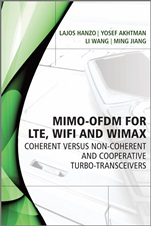
MIMO–OFDM for LTE, WiFi and WiMAX: Coherent versus Non–coherent and Cooperative Turbo Transceivers
ISBN 9780470686690
Autor: Lajos Hanzo, Yosef Akhtman, Li Wang, Ming Jiang
Wydawca: Wiley
Dostępność: 3-6 tygodni
Cena: 780,15 zł
Przed złożeniem zamówienia prosimy o kontakt mailowy celem potwierdzenia ceny.
ISBN13: |
9780470686690 |
ISBN10: |
0470686693 |
Autor: |
Lajos Hanzo, Yosef Akhtman, Li Wang, Ming Jiang |
Oprawa: |
Hardback |
Rok Wydania: |
2010-10-15 |
Ilość stron: |
692 |
Wymiary: |
283x171 |
Tematy: |
TJ |
MIMO–OFDM for LTE, WIFI and WIMAX: Coherent versus Non–Coherent and Cooperative
Turbo–Transceivers provides an up–to–date portrayal of wireless transmission based on OFDM techniques augmented with Space–Time Block Codes (STBCs) and Spatial–Division Multiple Access (SDMA). The volume also offers an in–depth treatment of cutting–edge Cooperative Communications.
This monograph collates the latest techniques in a number of specific design areas of turbo–detected MIMO–OFDM wireless systems. As a result a wide range of topical subjects are examined, including channel coding and multiuser detection (MUD), with a special emphasis on optimum maximum–likelihood (ML) MUDs, reduced–complexity genetic algorithm aided near–ML MUDs and sphere detection. The benefits of spreading codes as well as joint iterative channel and data estimation are only a few of the radical new features of the book.
Also considered are the benefits of turbo and LDPC channel coding, the entire suite of known joint coding and modulation schemes, space–time coding as well as SDM/SDMA MIMOs within the context of various application examples. The book systematically converts the lessons of Shannon s information theory into design principles applicable to practical wireless systems; the depth of discussions increases towards the end of the book.
Discusses many state–of–the–art topics important to today s wireless communications engineers. Includes numerous complete system design examples for the industrial practitioner. Offers a detailed portrayal of sphere detection. Based on over twenty years of research into OFDM in the context of various applications, subsequently presenting comprehensive bibliographies.About the Authors.
OtherWiley and IEEE Press Books on Related Topics.
Acknowledgments.
Preface.
List of Symbols.
1 Introduction to OFDM and MIMO–OFDM.
1.1 OFDM History.
1.2 OFDM Schematic.
1.3 Channel Estimation for Multicarrier.
1.5 Signal Detection in MIMO–OFDM Systems.
1.6 Iterative Signal Processing for SDM–OFDM.
1.7 System Model.
1.8 SDM–OFDM System Model.
1.9 Novel Aspects and Outline of the Book.
1.10 Chapter Summary.
2 OFDM Standards.
2.1 Wi–Fi.
2.2 3GPP Long–Term Evolution.
2.3 WiMAX Evolution.
2.4 Chapter Summary.
I Coherently Detected SDMA–OFDM Systems.
3 Channel Coding Assisted STBC–OFDM Systems.
3.1 Introduction.
3.2 Space–Time Block Codes.
3.3 Channel Coded Space–Time Block Codes.
3.4 Channel Coding Aided Space–Time Block Coded OFDM.
3.5 Chapter Summary.
4 Coded Modulation Assisted Multi–User SDMA–OFDM Using Frequency–Domain Spreading.
4.1 Introduction.
4.2 System Model.
4.3 Simulation Results.
4.4 Chapter Summary.
5 Hybrid Multi–User Detection for SDMA–OFDM Systems.
5.1 Introduction.
5.2 Genetical Algorithm Assisted Multi–User Detection.
5.3 Enhanced GA–based Multi–User Detection.
5.4 Chapter Summary.
6 DS–Spreading and Slow Subcarrier–Hopping Aided Multi–User SDMA–OFDM Systems.
6.1 Conventional SDMA–OFDM Systems.
6.2 Introduction to Hybrid SDMA–OFDM.
6.3 Subband–Hopping Versus Subcarrier–Hopping.
6.4 System Architecture.
6.5 Simulation Results.
6.6 Complexity Issues.
6.7 Conclusions.
6.8 Chapter Summary.
7 Channel Estimation for OFDM and MC–CDMA.
7.1 Pilot–Assisted Channel Estimation.
7.2 Decision Directed Channel Estimation.
7.3 A Posteriori FD–CTF Estimation.
7.4 A Posteriori CIR Estimation.
7.5 Parametric FS–CIR Estimation.
7.6 Time–Domain A Priori CIR Tap Prediction.
7.7 PASTD Aided DDCE.
7.8 Channel Estimation for MIMO–OFDM.
8 Iterative Joint Channel Estimation and MUD for SDMA–OFDM Systems.
8.1 Introduction.
8.2 System Overview.
8.3 GA–assisted Iterative Joint Channel Estimation and MUD.
8.4 Simulation Results.
8.5 Conclusions.
8.6 Chapter Summary.
II Coherent versus Non–Coherent and Cooperative OFDM Systems List of Symbols in Part II.
9 Reduced–Complexity Sphere Detection for Uncoded SDMA–OFDM Systems.
9.1 Introduction.
9.2 Principle of Sphere Detection.
9.3 Complexity–Reduction Schemes for SD.
9.4 Comparison of the Depth–First, K–Best and OHRSA Detectors.
9.5 Chapter Conclusions.
10 Reduced–Complexity Iterative Sphere Detection for Channel Coded SDMA–OFDM Systems.
10.1 Introduction.
10.2 Channel Coded Iterative Center–Shifting SD.
10.3 Apriori–LLR–Threshold–Assisted Low–Complexity SD.
10.4 Unity–Rate–Code–Aided Three–Stage Iterative Receiver Employing SD.
10.5 Chapter Conclusions.
11 Sphere Packing Modulated STBC–OFDM and its Sphere Detection.
11.1 Introduction.
11.2 Orthogonal Transmit Diversity Design with Sphere Packing Modulation.
11.3 Sphere Detection Design for Sphere Packing Modulation.
11.4 Chapter Conclusions.
12 Multiple–Symbol Differential Sphere Detection for Cooperative OFDM.
12.1 Introduction.
12.2 Principle of Single–Path Multiple–Symbol Differential Sphere Detection.
12.3 Multi–Path MSDSD Design for Cooperative Communication.
12.4 Chapter Conclusions.
13 Resource Allocation for the DifferentiallyModulated Cooperative Uplink.
13.1 Introduction.
13.2 Performance Analysis of the Cooperation–Aided Uplink.
13.3 Cooperating–User–Selection for the Uplink.
13.4 Joint CPS and CUS for the Differential Cooperative Cellular Uplink Using APC.
13.5 Chapter Conclusions.
14 The Near–Capacity DifferentiallyModulated Cooperative Cellular Uplink.
14.1 Introduction.
14.2 Channel Capacity of Non–coherent Detectors.
14.3 Soft–Input Soft–OutputMSDSD.
14.4 Approaching the Capacity of the Differentially Modulated Cooperative Cellular Uplink .
14.5 Chapter Conclusions.
III Coherent SDM–OFDM Systems.
15 Multi–Stream Detection for SDM–OFDM Systems.
15.1 SDM/V–BLAST OFDM Architecture.
15.2 Linear Detection Methods.
15.3 Non–Linear SDM Detection Methods.
15.4 Performance Enhancement Using Space–Frequency Interleaving.
15.5 Performance Comparison and Discussion.
15.6 Conclusions.
16 Approximate Log–MAP SDM–OFDM Multi–Stream Detection.
16.1 Optimized Hierarchy Reduced Search Algorithm–Aided SDM Detection.
17 Iterative Channel Estimation and Multi–Stream Detection for SDM–OFDM.
17.1 Iterative Signal Processing.
17.2 Turbo Forward Error Correction Coding.
17.3 Iterative Detection Decoding.
17.4 Iterative Channel Estimation Detection Decoding.
18 Summary, Conclusions and Future Research.
18.1 Summary of the Results.
18.2 Suggestions for Future Research.
A Appendix to Chapter 5.
A.1 A Brief Introduction to Genetic Algorithms.
A.2 Normalization of the Mutation–Induced Transition Probability.
Glossary.
Bibliography.
Subject Index.
Author Index.
Dr Lajos Hanzo, School of Electronics and Computer Science, University of Southampton
Lajos is Professor of Wireless multimedia communications in the School of Electronics and Computer Science. He has over 30 years experience in communications and has held various academic posts in Hungary, Germany and the UK. He has been a member of the academic staff at Southampton University since 1986 where he currently holds the Chair in Telecommunications. Professor Hanzo has published 12 titles with Wiley/IEEE and has published about 700 research papers.
Dr Yosef (Jos) Akhtman, School of Electronics and Computer Science, University of Southampton
Jos Akhtman is currently working as a Senior Research Assistant in the Communications Group, ECS. His major subject of interest is optimization algorithms for advanced multi–antenna multi–carrier communication systems. Specifically, iterative channel estimation, detection, space–time processing and turbo transceiver architecture. From 2000 to 2002 he was working as a Research Engineer in VYYO Ltd., Jerusalem, Israel and has co–authored numerous journal articles and book chapters.
Dr Ming Jiang Advanced Technology, Standards and Regulation (ATSR) of Samsung Electronics Research Institute (SERI), UK
Since April 2006, Dr. Jiang has been with Advanced Technology, Standards and Regulation (ATSR) of Samsung Electronics Research Institute (SERI), working on the European FP6 WINNER project as well as on internal projects related to advanced wireless communication systems. From 2002 to 2005, he was involved in the Core 3 research project of the Mobile Virtual Centre of Excellence (VCE), UK on air–interface algorithms designed for MIMO OFDM systems. His research interests include multi–user detection, channel estimation, space–time processing, heuristic and adaptive optimization, frequency–hopping and MIMO OFDM and OFDMA systems. Dr. Jiang has co–authored one IEEE Press book chapter and several IEE/IEEE journal and conference papers.
"This book provides a comprehensive and up–to–date portrayal of wireless transmission based on OFDM techniques augmented with Space–Time Block Codes (STBCs) and Spatial–Division Multiple Access (SDMA) . . . the book also includes an extensive bibliography, as well as both subject and author indexes. (Annotation ©2011 Book News Inc. Portland, OR)." (Booknews, 1 April 2011)
"The book systematically converts the lessons of Shannon′s information theory into design principles applicable to practical wireless systems; the depth of discussions increases towards the end of the book.". (4G Wireless Evolution , 26 January 2011)
Koszyk
Książek w koszyku: 0 szt.
Wartość zakupów: 0,00 zł
Informacje


Kontakt
Gambit
Centrum Oprogramowania
i Szkoleń Sp. z o.o.
Al. Pokoju 29b/22-24
31-564 Kraków
Siedziba Księgarni
ul. Kordylewskiego 1
31-542 Kraków
+48 12 410 5991
+48 12 410 5987
+48 12 410 5989
Subskrypcje
Administratorem danych osobowych jest firma Gambit COiS Sp. z o.o. Na podany adres będzie wysyłany wyłącznie biuletyn informacyjny.
Autoryzacja płatności

Informacje na temat autoryzacji płatności poprzez PayU.

© Copyright 2012: GAMBIT COiS Sp. z o.o. Wszelkie prawa zastrzeżone.
Projekt i wykonanie: Alchemia Studio Reklamy