


Wydawcy
Katalog tematyczny
- Archeologia (109)
- Ekonomia, finanse, business (13704)
- Filozofia (1445)
- Historia (3040)
- Języki i językoznawstwo (2356)
- Lifestyle, hobby i rozrywka (475)
- Medycyna (9704)
- Nauki humanistyczne (4)
- Nauki o Ziemi i środowisku (2638)
- Nauki ścisłe (20412)
- Nauki społeczne (8486)
- Nauki techniczne (13450)
- Budownictwo lądowe (1045)
- Chemia przemysłowa (2258)
- Elektronika i telekomunikacja (3287)
- Energetyka (1122)
- Inne nauki stosowane (363)
- Inżynieria biochemiczna (507)
- Inżynieria transportu (232)
- Mechanika i materiały (3316)
- Nauka o środowisku (321)
- Rolnictwo (507)
- Technika, ogólnie (475)
- Prawo (1696)
- Publikacje informacyjne i interdyscyplinarne (1288)
- Religia i wierzenia (917)
- Technika komputerowa (4067)
- Zdrowie, relacje międzyludzkie i rozwój osobisty (657)





Informacje szczegółowe o książce
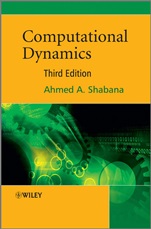
Computational Dynamics
ISBN 9780470686157
Autor: Ahmed A. Shabana
Wydawca: Wiley
Dostępność: 3-6 tygodni
Cena: 718,20 zł
Przed złożeniem zamówienia prosimy o kontakt mailowy celem potwierdzenia ceny.
ISBN13: |
9780470686157 |
ISBN10: |
0470686154 |
Autor: |
Ahmed A. Shabana |
Oprawa: |
Hardback |
Rok Wydania: |
2010-01-12 |
Numer Wydania: |
3rd Edition |
Ilość stron: |
542 |
Wymiary: |
252x176 |
Tematy: |
TG |
Computational Dynamics, 3rd edition , thoroughly revised and updated, provides logical coverage of both theory and numerical computation techniques for practical applications.
The author introduces students to this advanced topic covering the concepts, definitions and techniques used in multi–body system dynamics including essential coverage of kinematics and dynamics of motion in three dimensions. He uses analytical tools including Lagrangian and Hamiltonian methods as well as Newton–Euler Equations.
An educational version of multibody computer code is now included in this new edition www.wiley.com/go/shabana that can be used for instruction and demonstration of the theories and formulations presented in the book, and a new chapter is included to explain the use of this code in solving practical engineering problems.
Most books treat the subject of dynamics from an analytical point of view, focusing on the techniques for analyzing the problems presented. This book is exceptional in that it covers the practical computational methods used to solve "real–world" problems. This makes it of particular interest not only for senior/ graduate courses in mechanical and aerospace engineering, but also to professional engineers.Modern and focused treatment of the mathematical techniques, physical theories and application of rigid body mechanics that emphasizes the fundamentals of the subject, stresses the importance of computational methods and offers a wide variety of examples.Each chapter features simple examples that show the main ideas and procedures, as well as straightforward problem sets that facilitate learning and help readers build problem–solving skills.
Spis treści:
PREFACE.
1 INTRODUCTION.
1.1 Computational Dynamics.
1.2 Motion and Constraints.
1.3 Degrees of Freedom.
1.4 Kinematic Analysis.
1.5 Force Analysis.
1.6 Dynamic Equations and Their Diff
erent Forms.
1.7 Forward and Inverse Dynamics.
1.8 Planar and Spatial Dynamics.
1.9 Computer and Numerical Methods.
1.10 Organization, Scope, and Notations of the Book.
2 LINEAR ALGEBRA.
2.1 Matrices.
2.2 Matrix Operations.
2.3 Vectors.
2.4 Three–Dimensional Vectors.
2.5 Solution of Algebraic Equations.
2.6 Triangular Factorization.
∗2.7 QR Decomposition.
∗2.8 Singular Value Decomposition.
Problems.
3 KINEMATICS.
3.1 Kinematics of Rigid Bodies.
3.2 Velocity Equations.
3.3 Acceleration Equations.
3.4 Kinematics of a Point Moving on a Rigid Body.
3.5 Constrained Kinematics.
3.6 Classical Kinematic Approach.
3.7 Computational Kinematic Approach.
3.8 Formulation of the Driving Constraints.
3.9 Formulation of the Joint Constraints.
3.10 Computational Methods in Kinematics.
3.11 Computer Implementation.
3.12 Kinematic Modeling and Analysis.
3.13 Concluding Remarks.
Problems.
4 FORMS OF THE DYNAMIC EQUATIONS.
4.1 D’Alembert’s Principle.
4.2 D’Alembert’s Principle and Newton–Euler Equations.
4.3 Constrained Dynamics.
4.4 Augmented Formulation.
4.5 Lagrange Multipliers.
4.6 Elimination of the Dependent Accelerations.
4.7 Embedding Technique.
4.8 Amalgamated Formulation.
4.9 Open–Chain Systems.
4.10 Closed–Chain Systems.
4.11 Concluding Remarks.
Problems.
5 VIRTUAL WORK AND LAGRANGIAN DYNAMICS.
5.1 Virtual Displacements.
5.2 Kinematic Constraints and Coordinate Partitioning.
5.3 Virtual Work.
5.4 Examples of Force Elements.
5.5 Workless Constraints.
5.6 Principle of Virtual Work in Statics.
5.7 Principle of Virtual Work in Dynamics.
5.8 Lagrange’s Equation.
5.9 Gibbs–Appel Equation.
∗5.10 Hamiltonian Formulation.
5.11 Relationship between Virtual Work and Gaussian Elimination.
Problems.
6 CONSTRA
INED DYNAMICS.
6.1 Generalized Inertia.
6.2 Mass Matrix and Centrifugal Forces.
6.3 Equations of Motion.
6.4 System of Rigid Bodies.
6.5 Elimination of the Constraint Forces.
6.6 Lagrange Multipliers.
6.7 Constrained Dynamic Equations.
6.8 Joint Reaction Forces.
6.9 Elimination of Lagrange Multipliers.
6.10 State Space Representation.
6.11 Numerical Integration.
6.12 Algorithm and Sparse Matrix Implementation.
6.13 Differential and Algebraic Equations.
∗6.14 Inverse Dynamics.
∗6.15 Static Analysis.
Problems.
7 SPATIAL DYNAMICS.
7.1 General Displacement.
7.2 Finite Rotations.
7.3 Euler Angles.
7.4 Velocity and Acceleration.
7.5 Generalized Coordinates.
7.6 Generalized Inertia Forces.
7.7 Generalized Applied Forces.
7.8 Dynamic Equations of Motion.
7.9 Constrained Dynamics.
7.10 Formulation of the Joint Constraints.
7.11 Newton–Euler Equations.
7.12 D’Alembert’s Principle.
7.13 Linear and Angular Momentum.
7.14 Recursive Methods.
Problems.
8 SPECIAL TOPICS IN DYNAMICS.
8.1 Gyroscopes and Euler Angles.
8.2 Rodriguez Formula.
8.3 Euler Parameters.
8.4 Rodriguez Parameters.
8.5 Quaternions.
8.6 Rigid Body Contact.
8.7 Stability and Eigenvalue Analysis.
Problems.
9 MULTIBODY SYSTEM COMPUTER CODES.
9.1 Introduction to SAMS/2000.
9.2 Code Structure.
9.3 System Identification and Data Structure.
9.4 Installing the Code and Theoretical Background.
9.5 SAMS/2000 Setup.
9.6 Use of the Code.
9.7 Body Data.
9.8 Constraint Data.
9.9 Performing Simulations.
9.10 Batch Jobs.
9.11 Graphics Control.
9.12 Animation Capabilities.
9.13 General Use of the Input Data Panels.
9.14 Spatial Analysis.
9.15 Special Modules and Features of the Code.
REFERENCES.
INDEX.
Okładka tylna:
Computational Dynamics, 3rd edition , thor
oughly revised and updated, provides logical coverage of both theory and numerical computation techniques for practical applications.
The author introduces students to this advanced topic covering the concepts, definitions and techniques used in multi–body system dynamics including essential coverage of kinematics and dynamics of motion in three dimensions. He uses analytical tools including Lagrangian and Hamiltonian methods as well as Newton–Euler Equations.
An educational version of multibody computer code is now included in this new edition www.wiley.com/go/shabana that can be used for instruction and demonstration of the theories and formulations presented in the book, and a new chapter is included to explain the use of this code in solving practical engineering problems.
Most books treat the subject of dynamics from an analytical point of view, focusing on the techniques for analyzing the problems presented. This book is exceptional in that it covers the practical computational methods used to solve "real–world" problems. This makes it of particular interest not only for senior/ graduate courses in mechanical and aerospace engineering, but also to professional engineers.Modern and focused treatment of the mathematical techniques, physical theories and application of rigid body mechanics that emphasizes the fundamentals of the subject, stresses the importance of computational methods and offers a wide variety of examples.Each chapter features simple examples that show the main ideas and procedures, as well as straightforward problem sets that facilitate learning and help readers build problem–solving skills.
Koszyk
Książek w koszyku: 0 szt.
Wartość zakupów: 0,00 zł
Informacje


Kontakt
Gambit
Centrum Oprogramowania
i Szkoleń Sp. z o.o.
Al. Pokoju 29b/22-24
31-564 Kraków
Siedziba Księgarni
ul. Kordylewskiego 1
31-542 Kraków
+48 12 410 5991
+48 12 410 5987
+48 12 410 5989
Subskrypcje
Administratorem danych osobowych jest firma Gambit COiS Sp. z o.o. Na podany adres będzie wysyłany wyłącznie biuletyn informacyjny.
Autoryzacja płatności

Informacje na temat autoryzacji płatności poprzez PayU.

© Copyright 2012: GAMBIT COiS Sp. z o.o. Wszelkie prawa zastrzeżone.
Projekt i wykonanie: Alchemia Studio Reklamy