


Wydawcy
Katalog tematyczny
- Archeologia (109)
- Ekonomia, finanse, business (13704)
- Filozofia (1445)
- Historia (3040)
- Języki i językoznawstwo (2356)
- Lifestyle, hobby i rozrywka (475)
- Medycyna (9704)
- Nauki humanistyczne (4)
- Nauki o Ziemi i środowisku (2638)
- Nauki ścisłe (20412)
- Nauki społeczne (8486)
- Nauki techniczne (13450)
- Prawo (1696)
- Publikacje informacyjne i interdyscyplinarne (1288)
- Religia i wierzenia (917)
- Technika komputerowa (4067)
- Zdrowie, relacje międzyludzkie i rozwój osobisty (657)





Informacje szczegółowe o książce
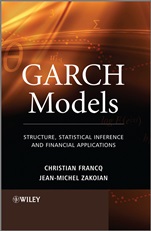
GARCH Models: Structure, Statistical Inference and Financial Applications
ISBN 9780470683910
Autor: Christian Francq, Jean–Michel Zakoian
Wydawca: Wiley
Dostępność: 3-6 tygodni
Cena: 454,65 zł
Przed złożeniem zamówienia prosimy o kontakt mailowy celem potwierdzenia ceny.
ISBN13: |
9780470683910 |
ISBN10: |
0470683910 |
Autor: |
Christian Francq, Jean–Michel Zakoian |
Oprawa: |
Hardback |
Rok Wydania: |
2010-07-16 |
Ilość stron: |
504 |
Wymiary: |
249x179 |
Tematy: |
KC |
This book provides a comprehensive and systematic approach to understanding GARCH time series models and their applications whilst presenting the most advanced results concerning the theory and practical aspects of GARCH. The probability structure of standard GARCH models is studied in detail as well as statistical inference such as identification, estimation and tests. The book also provides coverage of several extensions such as asymmetric and multivariate models and looks at financial applications.
Key features:Provides up–to–date coverage of the current research in the probability, statistics and econometric theory of GARCH models.Numerous illustrations and applications to real financial series are provided.Supporting website featuring R codes, Fortran programs and data sets.Presents a large collection of problems and exercises.
This authoritative, state–of–the–art reference is ideal for graduate students, researchers and practitioners in business and finance seeking to broaden their skills of understanding of econometric time series models.
Spis treści:
Preface
Notations
1 Classical Time Series Models and Financial Series
1.1 Stationary Processes . . . . . . . . . . . . . . . . . . . . . . . . . .
1.2 ARMA and ARIMA Models . . . . . . . . . . . . . . . . . . . . . .
1.3 Financial Series . . . . . . . . . . . . . . . . . . . . . . . . . . . . .
1.4 Random Variance Models . . . . . . . . . . . . . . . . . . . . . . .
1.5 Bibliographical Notes . . . . . . . . . . . . . . . . . . . . . . . . . .
1.6 Exercises . . . . . . . . . . . . . . . . . . . . . . . . . . . . . . . . .
I Univariate GARCH Models
2 GARCH(p, q) Processes
2.1 Definitions and Representations . . . . . . . . . . . . . . . . . . . .
2.2 Stationarity Study . . . . . . . . . . . . . . . . . . . . . . . . . . .
2.2.1 The GARCH(1,1
) Case . . . . . . . . . . . . . . . . . . . . .
2.2.2 The General Case . . . . . . . . . . . . . . . . . . . . . . . .
2.3 ARCH(∞) Representation∗ . . . . . . . . . . . . . . . . . . . . . .
2.3.1 Existence Conditions . . . . . . . . . . . . . . . . . . . . . .
2.3.2 ARCH(∞) Representation of a GARCH . . . . . . . . . . .
2.3.3 Long–Memory ARCH . . . . . . . . . . . . . . . . . . . . . .
2.4 Properties of the Marginal Distribution . . . . . . . . . . . . . . . .
2.4.1 Even–Order Moments . . . . . . . . . . . . . . . . . . . . . .
2.4.2 Kurtosis . . . . . . . . . . . . . . . . . . . . . . . . . . . . .
2.5 Autocovariances of the Squares of a GARCH . . . . . . . . . . . . .
2.5.1 Positivity of the Autocovariances . . . . . . . . . . . . . . .
2.5.2 The Autocovariances Do not Always Decrease . . . . . . . .
2.5.3 Explicit Computation of the Autocovariances of the Squares
2.6 Theoretical Predictions . . . . . . . . . . . . . . . . . . . . . . . . .
2.7 Bibliographical Notes . . . . . . . . . . . . . . . . . . . . . . . . . .
2.8 Exercices . . . . . . . . . . . . . . . . . . . . . . . . . . . . . . . . .
3 Mixing∗
3.1 Markov Chains with Continuous State Space . . . . . . . . . . . . .
3.2 Mixing Properties of GARCH Processes . . . . . . . . . . . . . . .
3.3 Bibliographical Notes . . . . . . . . . . . . . . . . . . . . . . . . . .
3.4 Exercises . . . . . . . . . . . . . . . . . . . . . . . . . . . . . . . . .
4 Temporal Aggregation and Weak GARCH Models
4.1 Temporal Aggregation of GARCH Processes . . . . . . . . . . . . .
4.1.1 Non Temporal Aggregation of Strong Models . . . . . . . . .
4.1.2 Non Aggregation in the Class of the Semi–Strong GARCH .
4.2 Weak GARCH . . . . . . . . . . . . . . . . . . . . . . . . . . . . .
4.3 Aggregation of Strong GARCH Processes in the Weak GARCH Class
4.4 Bibliographical Notes . . . . . . . . .
. . . . . . . . . . . . . . . . .
4.5 Exercices . . . . . . . . . . . . . . . . . . . . . . . . . . . . . . . . .
II Statistical Inference
5 Identification
5.1 Autocorrelation Check for White Noise . . . . . . . . . . . . . . . .
5.1.1 Empirical Autocorrelations of a GARCH . . . . . . . . . . .
5.1.2 Portmanteau Tests . . . . . . . . . . . . . . . . . . . . . . .
5.1.3 Sample Partial Autocorrelations (SPAC) of a GARCH . . .
5.1.4 Numerical Illustrations . . . . . . . . . . . . . . . . . . . . .
5.2 Identifying the ARMA Orders . . . . . . . . . . . . . . . . . . . . .
5.2.1 Sample Autocorrelations of an ARMA–GARCH . . . . . . .
5.2.2 Case of a Non Symmetric Noise . . . . . . . . . . . . . . . .
5.2.3 Identifying the Orders (P,Q) . . . . . . . . . . . . . . . . .
5.3 Identifying the GARCH Orders . . . . . . . . . . . . . . . . . . . .
5.3.1 Corner Method in the GARCH Case . . . . . . . . . . . . .
5.3.2 Applications . . . . . . . . . . . . . . . . . . . . . . . . . . .
5.4 LM Test for Conditional Homoscedasticity . . . . . . . . . . . . . .
5.4.1 General Form of the LM Test . . . . . . . . . . . . . . . . .
5.4.2 LM Test for Conditional Homoscedasticity . . . . . . . . . .
5.5 Application to Real Series . . . . . . . . . . . . . . . . . . . . . . .
5.6 Bibliographical Notes . . . . . . . . . . . . . . . . . . . . . . . . . .
5.7 Exercises . . . . . . . . . . . . . . . . . . . . . . . . . . . . . . . . .
6 LS Estimator of ARCH
6.1 Estimation of ARCH(q) Models by OLS . . . . . . . . . . . . . . .
6.2 QLS Estimation of ARCH(q) Models . . . . . . . . . . . . . . . . .
6.3 Estimation by Constrained OLS . . . . . . . . . . . . . . . . . . . .
6.3.1 Properties of the Constrained OLS Estimator . . . . . . . .
6.3.2 Computation of the Constrained OLS Estimator . . . . . . .
6.4 Bibliographical Notes . . . . . . . . . . . . . . . . . . . . . . . . . .
6.5 Exercises
. . . . . . . . . . . . . . . . . . . . . . . . . . . . . . . . .
7 Estimating GARCH by QML
7.1 Conditional Quasi–Likelihood . . . . . . . . . . . . . . . . . . . . .
7.1.1 Asymptotic Properties of the QML Estimator . . . . . . . .
7.1.2 The ARCH(1) Case . . . . . . . . . . . . . . . . . . . . . . .
7.1.3 The Non Stationary Case . . . . . . . . . . . . . . . . . . .
7.2 ARMA–GARCH QML Estimation . . . . . . . . . . . . . . . . . . .
7.3 Application to Real Data . . . . . . . . . . . . . . . . . . . . . . . .
7.4 Proofs of the Asymptotic Results∗ . . . . . . . . . . . . . . . . . . .
7.5 Bibliographical Notes . . . . . . . . . . . . . . . . . . . . . . . . . .
7.6 Exercises . . . . . . . . . . . . . . . . . . . . . . . . . . . . . . . . .
8 Tests Based on the Likelihood
8.1 Test of the Second Order Stationarity Assumption . . . . . . . . . .
8.2 Asymptotic Distribution of the QML when θ0 Is at the Boundary .
8.2.1 Computation of the Asymptotic Distribution . . . . . . . . .
8.3 Significance of the GARCH Coefficients . . . . . . . . . . . . . . . .
8.3.1 Presentation of the Main Tests . . . . . . . . . . . . . . . .
8.3.2 Modification of the Standard Tests . . . . . . . . . . . . . .
8.3.3 Test for the Nullity of One Coefficient . . . . . . . . . . . .
8.3.4 Conditional Homoscedasticity Tests with ARCH Models . .
8.3.5 Asymptotic Comparison of the Tests . . . . . . . . . . . . .
8.4 Diagnostic Checking with Portmanteau Tests . . . . . . . . . . . . .
8.5 Application: Is the GARCH(1,1) Model Over–Represented? . . . . .
8.6 Proof of the Main Results∗ . . . . . . . . . . . . . . . . . . . . . . .
8.7 Bibliographical Notes . . . . . . . . . . . . . . . . . . . . . . . . . .
8.8 Exercises . . . . . . . . . . . . . . . . . . . . . . . . . . . . . . . . .
9 Optimal Inference and Alternatives to the QMLE∗
9.1 Maximum Likelihoo
d Estimator . . . . . . . . . . . . . . . . . . . .
9.1.1 Asymptotic Behavior . . . . . . . . . . . . . . . . . . . . . .
9.1.2 One Step Efficient Estimator . . . . . . . . . . . . . . . . . .
9.1.3 Semiparametric Models and Adaptive Estimators . . . . . .
9.1.4 Local Asymptotic Normality (LAN) . . . . . . . . . . . . . .
9.2 MLE with Misspecified Density . . . . . . . . . . . . . . . . . . . .
9.2.1 Condition for the Convergence of ˆθn,h to θ0 . . . . . . . . . .
9.2.2 Reparameterization Implying the Convergence of ˆθn,h to θ0 .
9.2.3 Choice of the Instrumental Density h . . . . . . . . . . . . .
9.2.4 Asymptotic Distribution of ˆθn,h . . . . . . . . . . . . . . . .
9.3 Alternative Estimation Method . . . . . . . . . . . . . . . . . . . .
9.3.1 Weighted LSE for the ARMA Parameters . . . . . . . . . .
9.3.2 Self–Weighted QMLE . . . . . . . . . . . . . . . . . . . . . .
9.3.3 Lp Estimators . . . . . . . . . . . . . . . . . . . . . . . . .
9.3.4 Estimators of the Least Absolute Values . . . . . . . . . . .
9.3.5 Whittle Estimator . . . . . . . . . . . . . . . . . . . . . . .
9.4 Bibliographical Notes . . . . . . . . . . . . . . . . . . . . . . . . . .
9.5 Exercises . . . . . . . . . . . . . . . . . . . . . . . . . . . . . . . . .
III Extensions and Applications
10 Asymmetries
10.1 Exponential GARCH Model (EGARCH) . . . . . . . . . . . . . . .
10.2 Threshold GARCH Model (TGARCH) . . . . . . . . . . . . . . . .
10.3 Asymmetric Power GARCH Model . . . . . . . . . . . . . . . . . .
10.4 Other Asymmetric GARCH Models . . . . . . . . . . . . . . . . . .
10.5 GARCH with Contemporaneous Asymmetry . . . . . . . . . . . . .
10.6 Empirical Comparisons . . . . . . . . . . . . . . . . . . . . . . . . .
10.7 Bibliographical Notes . . . . . . . . . . . . . . . . . . . . . . . . . .
10.8 Exercises . . . . . . . . . . . . . . . . . . . . . . . .
. . . . . . . . .
11 Multivariate GARCH
11.1 Multivariate Stationary Processes . . . . . . . . . . . . . . . . . . .
11.2 Multivariate GARCH Models . . . . . . . . . . . . . . . . . . . . .
11.2.1 Diagonal Model . . . . . . . . . . . . . . . . . . . . . . . . .
11.2.2 VEC–GARCH Model . . . . . . . . . . . . . . . . . . . . . .
11.2.3 Constant Conditional Correlations (CCC) Models . . . . . .
11.2.4 Dynamic Conditional Correlations (DCC) models . . . . . .
11.2.5 BEKK–GARCH Model . . . . . . . . . . . . . . . . . . . . .
11.2.6 Factor GARCH models . . . . . . . . . . . . . . . . . . . . .
11.3 Stationarity . . . . . . . . . . . . . . . . . . . . . . . . . . . . . . .
11.3.1 Stationarity of VEC and BEKK Models . . . . . . . . . . .
11.3.2 Stationarity of the CCC Model . . . . . . . . . . . . . . . .
11.4 Estimation of the CCC model . . . . . . . . . . . . . . . . . . . . .
11.4.1 Identifiability Conditions . . . . . . . . . . . . . . . . . . . .
11.4.2 Asymptotic Properties of the QML Estimator of the CCCGARCH
11.4.3 Proof of the Asymptotic Properties of the QML . . . . . . .
11.5 Bibliographical notes . . . . . . . . . . . . . . . . . . . . . . . . . .
11.6 Exercises . . . . . . . . . . . . . . . . . . . . . . . . . . . . . . . . .
12 Financial Applications
12.1 Relation between GARCH and Continuous–Time Models . . . . . .
12.1.1 Some Properties of Stochastic Differential Equations . . . .
12.1.2 Convergence of Markov Chains to Diffusions . . . . . . . . .
12.2 Option Pricing . . . . . . . . . . . . . . . . . . . . . . . . . . . . .
12.2.1 Derivatives, Options . . . . . . . . . . . . . . . . . . . . . .
12.2.2 The Black–Scholes Approach . . . . . . . . . . . . . . . . . .
12.2.3 Historic Volatility and Implied Volatilities . . . . . . . . . .
12.2.4 Option Pricing when the Underlying Process Is a GARCH .
12.3 Value at Risk (VaR) and Other Risks
Measures . . . . . . . . . . .
12.3.1 VaR . . . . . . . . . . . . . . . . . . . . . . . . . . . . . . .
12.3.2 Other Risk Measures . . . . . . . . . . . . . . . . . . . . . .
12.3.3 Estimation Methods . . . . . . . . . . . . . . . . . . . . . .
12.4 Bibliographical Notes . . . . . . . . . . . . . . . . . . . . . . . . . .
12.5 Exercices . . . . . . . . . . . . . . . . . . . . . . . . . . . . . . . . .
IV Annexes
A Ergodicity, Martingale, Mixing
A.1 Ergodicity . . . . . . . . . . . . . . . . . . . . . . . . . . . . . . . .
A.2 Martingale Increments . . . . . . . . . . . . . . . . . . . . . . . . .
A.3 Mixing . . . . . . . . . . . . . . . . . . . . . . . . . . . . . . . . . .
A.3.1 α–Mixing and β–Mixing Coefficients . . . . . . . . . . . . . .
A.3.2 Covariance Inequality . . . . . . . . . . . . . . . . . . . . . .
A.3.3 Central Limit Theorem . . . . . . . . . . . . . . . . . . . . .
B Autocorrelation
B.1 Partial Autocorrelation . . . . . . . . . . . . . . . . . . . . . . . . .B.2 Generalized
C Solution to the Exercises
D Problems
D.1 Problem 1 . . . . . . . . . . . . . . . . . . . . . . . . . . . . . . . .
D.2 Problem 2 . . . . . . . . . . . . . . . . . . . . . . . . . . . . . . . .
D.3 Problem 3 . . . . . . . . . . . . . . . . . . . . . . . . . . . . . . . .
D.4 Problem 4 . . . . . . . . . . . . . . . . . . . . . . . . . . . . . . . .
D.5 Problem 5 . . . . . . . . . . . . . . . . . . . . . . . . . . . . . . . .
D.6 Problem 6 . . . . . . . . . . . . . . . . . . . . . . . . . . . . . . . .
D.7 Problem 7 . . . . . . . . . . . . . . . . . . . . . . . . . . . . . . . .
D.8 Problem 8 . . . . . . . . . . . . . . . . . . . . . . . . . . . . . . . .
D.9 Problem 9 . . . . . . . . . . . . . . . . . . . . . . . . . . . . . . . .
References
Index
Okładka tylna:
This book provides a comprehens
ive and systematic approach to understanding GARCH time series models and their applications whilst presenting the most advanced results concerning the theory and practical aspects of GARCH. The probability structure of standard GARCH models is studied in detail as well as statistical inference such as identification, estimation and tests. The book also provides coverage of several extensions such as asymmetric and multivariate models and looks at financial applications.
Key features:Provides up–to–date coverage of the current research in the probability, statistics and econometric theory of GARCH models.Numerous illustrations and applications to real financial series are provided.Supporting website featuring R codes, Fortran programs and data sets.Presents a large collection of problems and exercises.
This authoritative, state–of–the–art reference is ideal for graduate students, researchers and practitioners in business and finance seeking to broaden their skills of understanding of econometric time series models.
Koszyk
Książek w koszyku: 0 szt.
Wartość zakupów: 0,00 zł
Informacje


Kontakt
Gambit
Centrum Oprogramowania
i Szkoleń Sp. z o.o.
Al. Pokoju 29b/22-24
31-564 Kraków
Siedziba Księgarni
ul. Kordylewskiego 1
31-542 Kraków
+48 12 410 5991
+48 12 410 5987
+48 12 410 5989
Subskrypcje
Administratorem danych osobowych jest firma Gambit COiS Sp. z o.o. Na podany adres będzie wysyłany wyłącznie biuletyn informacyjny.
Autoryzacja płatności

Informacje na temat autoryzacji płatności poprzez PayU.

© Copyright 2012: GAMBIT COiS Sp. z o.o. Wszelkie prawa zastrzeżone.
Projekt i wykonanie: Alchemia Studio Reklamy