


Wydawcy
Katalog tematyczny
- Archeologia (109)
- Ekonomia, finanse, business (13704)
- Filozofia (1445)
- Historia (3040)
- Języki i językoznawstwo (2356)
- Lifestyle, hobby i rozrywka (475)
- Medycyna (9704)
- Nauki humanistyczne (4)
- Nauki o Ziemi i środowisku (2638)
- Nauki ścisłe (20412)
- Nauki społeczne (8486)
- Nauki techniczne (13450)
- Prawo (1696)
- Publikacje informacyjne i interdyscyplinarne (1288)
- Religia i wierzenia (917)
- Technika komputerowa (4067)
- Zdrowie, relacje międzyludzkie i rozwój osobisty (657)





Informacje szczegółowe o książce
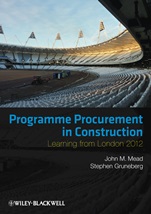
Programme Procurement in Construction: Learning from London 2012
ISBN 9780470674734
Autor: John Mead, Stephen Gruneberg
Wydawca: Wiley
Dostępność: 3-6 tygodni
Cena: 330,75 zł
Przed złożeniem zamówienia prosimy o kontakt mailowy celem potwierdzenia ceny.
ISBN13: |
9780470674734 |
ISBN10: |
0470674733 |
Autor: |
John Mead, Stephen Gruneberg |
Oprawa: |
Paperback |
Rok Wydania: |
2013-04-26 |
Ilość stron: |
238 |
Wymiary: |
241x171 |
Tematy: |
KM |
‘This book … adds to the impressive ‘legacy’ of learning which is still emerging from the successful delivery of the London 2012 construction programme. The authors combine the reforming zeal of a champion for change, who was there every step of the way, with academic rigour, and the result is delivered with impressive passion and commitment to the topic … All spenders and suppliers need to read this, to understand how conventional understandings of procurement fall so dramatically short when applied to high value–high risk acquisitions, which invariably is what large construction projects represent.’––Don Ward, Chief Executive, Constructing Excellence, UK Successful construction is often attributed to one or more aspects of the delivery process from good planning, design and clever engineering to efficient project management and quality construction. Before any of these disciplines can begin, they all require some form of procurement to select the team or supply chain to meet a client’s or a project’s specific requirements. The concept of PSE – Purchase and Supplier Engineering – originated in the procurement of the construction and infrastructure required to stage the 30th Olympiad in London during 2012. At the time of writing PSE has successfully delivered almost £25bn of public procurement meeting client and project requirements and without legal challenge. The construction of the venues and infrastructure needed to stage London 2012 was such a resounding success that it boosted not only the reputation of the UK construction industry but also the confidence of the UK population in the country’s ability to organise, build and run a major international event. Its success has been lauded as something from which clients and industry could learn. The ODA has established a comprehensive and informative body of evidence as part of a Learning Legacy. While the ODA is well aware of the many elements of the procurement and supply chain management, the complete end to end concept of how the Olympic supply chain procurements were managed has until now not been captured. For example, how does one buy the stage for an Olympic Games? How does one manage the details of thousands of contracts and the many firms of contractors, subcontractors and material suppliers and ensure that no one organisation adversely affects any other to the detriment of the programme? How are a client’s requirements beyond those of the capital asset realised as part of the investment? How does one measure programme exposure, or manage performance? How does one measure capacity and the ability of firms to cope with the work and manage the risks involved? Programme Procurement in Construction: Learning from London 2012 covers the planning and preparation of a programme’s procurement processes from understanding and developing the client’s requirements, to monitoring performance based on the benchmarks contractors set out in their own tender submissions. The emphasis is on a close attention to detail to avoid surprises, while keeping a focus on the total programme. Purchase and Supplier Engineering provides an overview of managing the interest of firms in participating and the resulting capacity and workloads of all suppliers, including the main contractors and the critical subcontractors and material suppliers. Offering techniques, tips and lessons learnt from the implementation of PSE on London 2012 and Crossrail, this book is aimed at public and private sector clients, developers, senior management and those businesses and professionals involved in undertaking the procurement, supply chain management and delivery of multiple construction projects or complex major construction programmes.
About the authors xi List of fi gures and tables xiii Forewords from Sir John Armitt CBE, Howard Shiplee CBE, Martin Rowark and Professor Geoffrey E. Petts xv Preface xix List of acronyms xxvii 1. Purchase and Supplier Engineering and the London 2012 Olympics 1 Introduction 3 The concept of Purchase and Supplier Engineering 4 Programme organisation – an Olympic case study 8 Procurement organisation structure – the Olympic Delivery Authority 11 Roles and responsibilities 11 Projects and programmes 13 Concluding remarks 14 Reference 15 2. A framework for understanding markets in construction 17 Introduction 18 Managing the supply market 19 The client and construction 23 Projects, programmes and construction dynamics 25 The client and the supply chain 27 Defi ning the supply chain 28 Outsourcing and subcontracting 31 Understanding and managing confl ict in construction 34 Concluding remarks 39 References 40 3. The client’s values and the balanced scorecard 43 Introduction 44 Developing a framework for measuring performance 46 All from a project vision 47 Performance measurement 50 Using balanced scorecards to communicate values and measure performance 53 Developing a balanced scorecard 56 Measures including key performance indicators 58 Construction KPI measures of economic sustainability 58 Social sustainability: Respect for people KPI measures 59 Environmental sustainability: Environmental KPI measures 59 Creating appropriate KPIs from a project vision and scorecard 62 Concluding remarks 63 References 64 4. Packaging and contracting strategies 65 Introduction 66 What, why and how to buy 68 Packaging strategy 70 Gestalt theory 73 Programme clusters 75 Programme application 78 Contracting strategy 79 Forms of contract used in the 2012 Olympics procurement 79 Classifi cation of contracts 82 Concluding remarks 85 References 88 5. Common component and commodity strategies 89 Introduction 90 The benefi ts of a common component strategy 91 Factors infl uencing the procurement of common components 93 Market leverage 93 Supply chain security 95 Future maintenance and operations 95 Design effi ciencies 96 Developing a common component strategy 96 Stage 1: Performance criteria 97 Stage 2: Assessment of benefi ts of implementing a common component strategy 98 Stage 3: The benefi ts of a common component purchasing strategy 99 The common component procurement strategy 100 Concluding remarks 102 References 102 6. Engaging with suppliers: How to attract suppliers and increase interest and awareness 103 Introduction 105 Gathering market intelligence 107 Supplier dialogue 109 One–way supplier dialogue – Supply chain events 110 One–way supplier dialogue – Industry days 110 One way supplier dialogue – One–to–one meetings 111 One–way supplier dialogue – Meet the buyer events 112 One–way supplier dialogue – Meet the contractor events 113 One–way supplier dialogue – Supplier guide 114 One–way supplier dialogue – Business opportunities website 115 One–way supplier dialogue – Opportunity slides 117 Two–way supplier dialogue – Supplier registration and pre–assessment questionnaires 117 Two–way supplier dialogue – Market soundings 120 Concluding remarks 125 Reference 126 7. eSourcing and process codifi cation: Standardising programme procurements 127 Introduction 128 The guiding principles of a robust procurement process 129 Standardising procurement documentation 130 Security of the procurement system 131 Evaluation of tenders 132 The application of electronic tools in the procurement process 133 eSourcing 134 eEvaluation 139 Aspects of managing systematic procurement processes 141 Standard processes 141 Schools of excellence 142 Governance 143 Assurance 144 Training 145 The milestones of procurement reporting 146 Standardisation and codifi cation of the procurement process 147 Stage gate 1 – Agreeing the procurement strategy 148 Stage gate 2 – Tender documentation completion 148 Stage gate 3 – Tender list agreement 149 Stage gate 4 – The tender report 149 Procurement reporting 151 Concluding remarks 151 References 154 8. Managing supply chain involvement across a programme 155 Introduction 156 Supplier relationship management 157 Remaining in contact with all fi rms who tender for work 159 Supply chain mapping 162 Concluding remarks 167 Reference 168 9. Due diligence and the management of capacity 169 Introduction 170 Modelling supplier utilisation 170 Monitoring the fi nancial strength of suppliers 180 Sub–tier supplier engineering 182 Identifying critical suppliers 185 Concluding remarks 189 References 191 10. Performance management 193 Introduction 195 The Purchase and Supplier Engineering model and programme management 195 Purchase and Supplier Engineering and the programme management office 197 Performance management within Purchase and Supplier Engineering 197 Analysis 198 Control 199 Performance improvement through Purchase and Supplier Engineering 200 Benchmarking 201 Concluding remarks 201 Index 205
Koszyk
Książek w koszyku: 0 szt.
Wartość zakupów: 0,00 zł
Informacje


Kontakt
Gambit
Centrum Oprogramowania
i Szkoleń Sp. z o.o.
Al. Pokoju 29b/22-24
31-564 Kraków
Siedziba Księgarni
ul. Kordylewskiego 1
31-542 Kraków
+48 12 410 5991
+48 12 410 5987
+48 12 410 5989
Subskrypcje
Administratorem danych osobowych jest firma Gambit COiS Sp. z o.o. Na podany adres będzie wysyłany wyłącznie biuletyn informacyjny.
Autoryzacja płatności

Informacje na temat autoryzacji płatności poprzez PayU.

© Copyright 2012: GAMBIT COiS Sp. z o.o. Wszelkie prawa zastrzeżone.
Projekt i wykonanie: Alchemia Studio Reklamy