


Wydawcy
Katalog tematyczny
- Archeologia (109)
- Ekonomia, finanse, business (13704)
- Filozofia (1445)
- Historia (3040)
- Języki i językoznawstwo (2356)
- Lifestyle, hobby i rozrywka (475)
- Medycyna (9704)
- Nauki humanistyczne (4)
- Nauki o Ziemi i środowisku (2638)
- Nauki ścisłe (20412)
- Nauki społeczne (8486)
- Nauki techniczne (13450)
- Budownictwo lądowe (1045)
- Chemia przemysłowa (2258)
- Elektronika i telekomunikacja (3287)
- Energetyka (1122)
- Inne nauki stosowane (363)
- Inżynieria dźwięku (22)
- Materiały wybuchowe (3)
- Optyka stosowana (106)
- Przestrzeń kosmiczna (22)
- Technika morska (44)
- Technologia górnicza (9)
- Inżynieria biochemiczna (507)
- Inżynieria transportu (232)
- Mechanika i materiały (3316)
- Nauka o środowisku (321)
- Rolnictwo (507)
- Technika, ogólnie (475)
- Prawo (1696)
- Publikacje informacyjne i interdyscyplinarne (1288)
- Religia i wierzenia (917)
- Technika komputerowa (4067)
- Zdrowie, relacje międzyludzkie i rozwój osobisty (657)





Informacje szczegółowe o książce
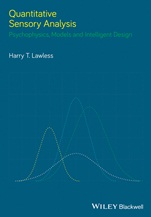
Quantitative Sensory Analysis: Psychophysics, Models and Intelligent Design
ISBN 9780470673461
Autor: Harry T. Lawless
Wydawca: Wiley
Dostępność: 3-6 tygodni
Cena: 791,70 zł
Przed złożeniem zamówienia prosimy o kontakt mailowy celem potwierdzenia ceny.
ISBN13: |
9780470673461 |
ISBN10: |
047067346X |
Autor: |
Harry T. Lawless |
Oprawa: |
Hardback |
Rok Wydania: |
2013-09-13 |
Ilość stron: |
416 |
Wymiary: |
252x178 |
Tematy: |
TT |
Quantitative Sensory Analysis Harry T. Lawless This book offers an advanced, quantitative approach to sensory science problems. Mainstream sensory evaluation, as practiced in the foods and consumer products industries, is often primarily concerned with day–to–day tests of pairs of products. Although such testing is often necessary, one can lose sight of the underlying models and theory for product discrimination and quantitative description upon which our test procedures and statistical methods are based. Sensory evaluation procedures have their roots in classical psychophysics and statistical methods. Quantitative Sensory Analysis provides a basis for models underpinning sensory testing for the advanced student and sensory scientist. Topics that lend themselves to quantitative analysis such as the theory behind scaling, shelf life modeling and threshold estimation are treated. The book is not designed as a guide to data analysis and sensory statistics alone, but treats quantitative modeling in a broader view. It attempts to gather together all the quantitative models for sensory phenomena and sensory data in one work. Rather than focus simply on data handling issues, the book will have a psychological emphasis, for example, examining why experimental designs that use panelists as their own controls are often more powerful for finding product differences. About the author Dr Harry T. Lawless is Professor Emeritus at the Department of Food Science, Cornell University, Ithaca, New York, USA. His research focuses on perception of taste, smell and texture in foods and model systems as well as applied research in sensory testing methods and psychological factors affecting sensory judgments. He supervised the department’s sensory testing facility and was a consultant to student and faculty projects involving sensory evaluation of foods. Dr Lawless is the author of the widely adopted textbook Sensory Evaluation of Foods , Principles and Practices , with Professor Hildegarde Heymann of the University of California, Davis. He has also served on the editorial boards of Chemical Senses, Chemosensory Perception, Food Quality and Preference, Journal of the Science of Food and Agriculture, and the Journal of Sensory Studies. Also available from Wiley Product Innovation Toolbox: A Field Guide to Consumer Understanding and Research Jacqueline H. Beckley, MBA, Dulce Paredes, Kannapon Lopetcharat / ISBN: 978–0–8138–2397–3 Sensory and Consumer Research in Food Product Design and Development, 2nd Edition Howard R. Moskowitz, Jacqueline H. Beckley and Anna V. A. Resurreccion / ISBN: 978–0–8138–1366–0 Sensory Evaluation: A Practical Handbook Sarah Kemp, Tracey Hollowood and Joanne Hort / ISBN: 978–1–4051–6210–4
Preface x 1 Psychophysics I: Introduction and Thresholds 1 1.1 Introduction and Terminology 1 1.2 Absolute Sensitivity 4 1.3 Methods for Measuring Absolute Thresholds 8 1.4 Differential Sensitivity 13 1.5 A Look Ahead: Fechner’s Contribution 17 Appendix 1.A: Relationship of Proportions, Areas Under the Normal Distribution, and Z–Scores 18 Appendix 1.B: Worked Example: Fitting a Logistic Function to Threshold Data 20 References 22 2 Psychophysics II: Scaling and Psychophysical Functions 24 2.1 Introduction 24 2.2 History: Cramer, Bernoulli, Weber, and Fechner 26 2.3 Partition Scales and Categories 27 2.4 Magnitude Estimation and the Power Law 28 2.5 Cross–Modality Matching; Attempts at Validation 32 2.6 Two–Stage Models and Judgment Processes 35 2.7 Empirical Versus Theory–Based Functions 39 2.8 Hybrid Scales and Indirect Scales: A Look Ahead 40 2.9 Summary and Conclusions 41 Appendix 2.A: Decibels and Sones 42 Appendix 2.B: Worked Example: Transformations Applied to Non–Modulus Magnitude Estimation Data 44 References 45 3 Basics of Signal Detection Theory 47 3.1 Introduction 48 3.2 The Yes/No Experiment 49 3.3 Connecting the Design to Theory 52 3.4 The ROC Curve 57 3.5 ROC Curves from Rating Scales; the R–Index 62 3.6 Conclusions and Implications for Sensory Testing 67 Appendix 3.A: Table of p and Z 68 Appendix 3.B: Test for the Significance of Differences Between d′ Values 69 References 69 4 Thurstonian Models for Discrimination and Preference 71 4.1 The Simple Paired–Choice Model 71 4.2 Extension into n–AFC: The Byer and Abrams “Paradox” 78 4.3 A Breakthrough: Power Analysis and Sample Size Determination 80 4.4 Tau Versus Beta Criteria: The Same–Different Test 84 4.5 Extension to Preference and Nonforced Preference 89 4.6 Limitations and Issues in Thurstonian Modeling 90 4.7 Summary and Conclusions 94 Appendix 4.A: The Bradley–Terry–Luce Model: An Alternative to Thurstone 95 Appendix 4.B: Tables for delta Values from Proportion Correct 96 References 97 5 Progress in Discrimination Testing 99 5.1 Introduction 99 5.2 Metrics for Degree of Difference 104 5.3 Replication in Choice Tests 108 5.4 Current Variations 110 5.5 Summary and Conclusions 118 Appendix 5.A: Psychometric Function for the Dual Pair Test, Power Equations, and Sample Size 119 Appendix 5.B: Fun with g 120 References 121 6 Similarity and Equivalence Testing 124 6.1 Introduction: Issues in Type II Error 124 6.2 Commonsense Approaches to Equivalence 126 6.3 Allowable Differences and Effect Size 133 6.4 Further Significance Testing 138 6.5 Summary and Conclusions 140 References 141 7 Progress in Scaling 143 7.1 Introduction 143 7.2 Labeled Magnitude Scales for Intensity 147 7.3 Adjustable and Relative Scales 153 7.4 Explicit Anchoring 155 7.5 Post Hoc Adjustments 158 7.6 Summary and Conclusions 161 Appendix 7.A: Examples of Individual Rescaling for Magnitude Estimation 162 References 164 8 Progress in Affective Testing: Preference/Choice and Hedonic Scaling 167 8.1 Introduction 167 8.2 Preference Testing Options 168 8.3 Replication 173 8.4 Alternative Models: Ferris k–visit, Dirichlet multinomial 176 8.5 Affective Scales 181 8.6 Ranking and Partial Ranking 185 8.7 Conclusions 188 Appendix 8.A: Proof that the McNemar Test is Equivalent to the Binomial Approximation Z–Test (AKA Sign Test) 188 References 190 9 Using Subjects as Their Own Controls 194 Part I: Designs using Parametric Statistics 195 9.1 Introduction to Part I 195 9.2 Dependent Versus Independent t–Tests 198 9.3 Within–Subjects ANOVA (“Repeated Measures”) 203 9.4 Issues 206 Part II: Nonparametric Statistics 208 9.5 Introduction to Part II 208 9.6 Applications of the McNemar Test: A–not–A and Same–Different Methods 209 9.7 Examples of the Stuart–Maxwell 212 9.8 Further Extensions of the Stuart Test Comparisons 218 9.9 Summary and Conclusions 220 Appendix 9.A: R code for the Stuart Test 221 References 222 10 Frequency Counts and Check–All–That–Apply (CATA) 224 10.1 Frequency Count Data: Situations — Open Ends, CATA 224 10.2 Simple Data Handling 227 10.3 Repeated or Within–Subjects Designs 228 10.4 Multivariate Analyses 230 10.5 Difference from Ideal and Penalty Analysis 231 10.6 Frequency Counts in Advertising Claims 235 10.7 Conclusions 236 Appendix 10.A: Proof Showing Equivalence of Binomial Approximation Z–Test and c2 Test for Differences of Proportions 237 References 239 11 Time–Intensity Modeling 240 11.1 Introduction: Goals and Applications 240 11.2 Parameters Versus Average Curves 245 11.3 Other Methods and Analyses 250 11.4 Summary and Conclusions 254 References 254 12 Product Stability and Shelf–Life Measurement 257 12.1 Introduction 257 12.2 Strategies, Measurements, and Choices 258 12.3 Study Designs 261 12.4 Hazard Functions and Failure Distributions 261 12.5 Reaction Rates and Kinetic Modeling 267 12.6 Summary and Conclusions 271 References 272 13 Product Optimization, Just–About–Right (Jar ) Scales, and Ideal Profiling 273 13.1 Introduction 273 13.2 Basic Equations, Designed Experiments, and Response Surfaces 276 13.3 Just–About–Right Scales 279 13.4 Ideal Profiling 285 13.5 Summary and Conclusions 292 References 294 14 Perceptual Mapping, Multivariate Tools, and Graph Theory 297 14.1 Introduction 297 14.2 Common Multivariate Methods 299 14.3 Shortcuts for Data Collection: Sorting and Projective Mapping 308 14.4 Preference Mapping Revisited 309 14.5 Cautions and Concerns 311 14.6 Introduction to Graph Theory 314 References 319 15 Segmentation 323 15.1 Introduction 323 15.2 Case Studies 326 15.3 Cluster Analysis 330 15.4 Other Analyses and Methods 336 15.5 Women, Fire, and Dangerous Things 337 References 338 16 An Introduction to Bayesian Analysis 340 16.1 Some Binomial–Based Examples 340 16.2 General Bayesian Models 347 16.3 Bayesian Inference Using Beta Distributions for Preference Tests 349 16.4 Proportions of Discriminators 352 16.5 Modeling Forced–Choice Discrimination Tests 353 16.6 Replicated Discrimination Tests 355 16.7 Bayesian Networks 356 16.8 Conclusions 359 References 360 Appendix A: Overview of Sensory Evaluation 361 A.1 Introduction 361 A.2 Discrimination and Simple Difference Tests 363 A.3 Descriptive Analysis 367 A.4 Affective Tests 372 A.5 Summary and Conclusions 375 References 375 Appendix B: Overview of Experimental Design 377 B.1 General Considerations 377 B.2 Factorial Designs 379 B.3 Fractional Factorials and Screening 380 B.4 Central Composite and Box–Behnken Designs 383 B.5 Mixture Designs 385 B.6 Summary and Conclusions 385 References 386 Appendix C: Glossary 387 Index 398
Dr Harry T. Lawless is Professor Emeritus at the Department of Food Science, Cornell University, Ithaca, New York, USA.
Koszyk
Książek w koszyku: 0 szt.
Wartość zakupów: 0,00 zł
Informacje


Kontakt
Gambit
Centrum Oprogramowania
i Szkoleń Sp. z o.o.
Al. Pokoju 29b/22-24
31-564 Kraków
Siedziba Księgarni
ul. Kordylewskiego 1
31-542 Kraków
+48 12 410 5991
+48 12 410 5987
+48 12 410 5989
Subskrypcje
Administratorem danych osobowych jest firma Gambit COiS Sp. z o.o. Na podany adres będzie wysyłany wyłącznie biuletyn informacyjny.
Autoryzacja płatności

Informacje na temat autoryzacji płatności poprzez PayU.

© Copyright 2012: GAMBIT COiS Sp. z o.o. Wszelkie prawa zastrzeżone.
Projekt i wykonanie: Alchemia Studio Reklamy