


Wydawcy
Katalog tematyczny
- Archeologia (109)
- Ekonomia, finanse, business (13704)
- Filozofia (1445)
- Historia (3040)
- Języki i językoznawstwo (2356)
- Lifestyle, hobby i rozrywka (475)
- Medycyna (9704)
- Nauki humanistyczne (4)
- Nauki o Ziemi i środowisku (2638)
- Nauki ścisłe (20412)
- Nauki społeczne (8486)
- Nauki techniczne (13450)
- Prawo (1696)
- Publikacje informacyjne i interdyscyplinarne (1288)
- Religia i wierzenia (917)
- Technika komputerowa (4067)
- Zdrowie, relacje międzyludzkie i rozwój osobisty (657)





Informacje szczegółowe o książce
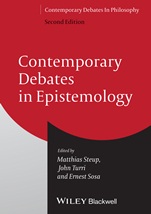
Contemporary Debates in Epistemology
ISBN 9780470672099
Autor: Matthias Steup, John Turri, Ernest Sosa
Wydawca: Wiley
Dostępność: 3-6 tygodni
Cena: 224,70 zł
Przed złożeniem zamówienia prosimy o kontakt mailowy celem potwierdzenia ceny.
ISBN13: |
9780470672099 |
ISBN10: |
0470672099 |
Autor: |
Matthias Steup, John Turri, Ernest Sosa |
Oprawa: |
Paperback |
Rok Wydania: |
2013-08-23 |
Numer Wydania: |
2nd Edition |
Ilość stron: |
398 |
Wymiary: |
244x170 |
Tematy: |
HP |
Building on the reputation of the first edition, this fully revised and updated volume expands the original content by including fourteen newly commissioned essays, presenting perspectives on differing sides of the most vibrant current debates in epistemology: Is knowledge contextual? Can skepticism be refuted? Can beliefs be justified through coherence alone? The expanded content evinces the central truth of philosophy as a discipline: that progress comes only through argumentation, dialectic, and debate. In common with the other volumes in the Contemporary Debates in Philosophy series, this new edition combines expert editing and judiciously commissioned material, adopting the series format which pairs up two essays espousing opposing views on a particular topic or theme in epistemology. The head–to–head chapters offer forceful advocacy of some of today’s most compelling philosophical stances as well as a brilliant opportunity for philosophy students to weigh the arguments and engage in comparative analysis of epistemological concepts that are constantly changing and developing.
Notes on Contributors viii Preface to the Second Edition xiii Preface to the First Edition xiv 1 Should Knowledge Come First? 1 Knowledge First Timothy Williamson 1 What Is Knowledge–first Epistemology? Trent Dougherty and Patrick Rysiew 10 Experience First Trent Dougherty and Patrick Rysiew 17 Knowledge Still First Timothy Williamson 22 Still Nowhere Else to Start Trent Dougherty and Patrick Rysiew 25 2 Is Knowledge Closed under Known Entailment? 27 The Case against Closure Fred Dretske 27 The Case for Closure John Hawthorne 40 Reply to Hawthorne Fred Dretske 56 3 Is Knowledge Contextual? 60 Contextualism Contested Earl Conee 60 Contextualism Defended Stewart Cohen 69 Contextualism Contested Some More Earl Conee 75 Contextualism Defended Some More Stewart Cohen 79 4 Do Practical Matters Affect Whether You Know? 84 Practical Matters Affect Whether You Know Jeremy Fantl and Matthew McGrath 84 Practical Matters Do Not Affect Whether You Know Baron Reed 95 5 Can Skepticism Be Refuted? 107 The Refutation of Skepticism Jonathan Vogel 108 The Challenge of Refuting Skepticism Richard Fumerton 120 6 Are Intellectually Virtuous Motives Essential to Knowledge? 133 Knowledge Need Not Be Virtuously Motivated Jason Baehr 133 Knowledge and the Motive for Truth Linda Zagzebski 140 Reply to Zagzebski Jason Baehr 146 Reply to Baehr Linda Zagzebski 149 7 Can Knowledge Be Lucky? 152 Knowledge Cannot Be Lucky Duncan Pritchard 152 Knowledge Can Be Lucky Stephen Hetherington 164 8 Is There a Priori Knowledge? 177 In Defense of the a Priori Laurence BonJour 177 There Is No a Priori Michael Devitt 185 Reply to Devitt Laurence BonJour 195 Reply to BonJour Michael Devitt 197 Last Rejoinder Laurence BonJour 200 9 Is There Immediate Justification? 202 There Is Immediate Justification James Pryor 202 There Is no Immediate Justification Juan Comesaña 222 Reply to Comesaña James Pryor 235 Reply to Pryor Juan Comesaña 239 10 Can Belief Be Justified Through Coherence Alone? 244 Non–foundationalist Epistemology: Holism, Coherence, and Tenability Catherine Z. Elgin 244 Why Coherence Is Not Enough: A Defense of Moderate Foundationalism James Van Cleve 255 Reply to Van Cleve Catherine Z. Elgin 267 Reply to Elgin James Van Cleve 271 11 Is Infinitism the Solution to the Regress Problem? 274 Infinitism Is the Solution to the Regress Problem Peter Klein 274 Infinitism Is Not the Solution to the Regress Problem Carl Ginet 283 Reply to Ginet Peter Klein 291 Reply to Klein Carl Ginet 295 12 Can Evidence Be Permissive? 298 Evidence Can Be Permissive Thomas Kelly 298 Evidence Cannot Be Permissive Roger White 312 13 Is Justification Internal? 324 Justification Is Not Internal John Greco 325 Justification Is Internal Richard Feldman 337 14 Is Truth the Primary Epistemic Goal? 351 Truth Is Not the Primary Epistemic Goal Jonathan L. Kvanvig 352 Truth as the Primary Epistemic Goal: A Working Hypothesis Marian David 363 Index 378
Matthias Steup is Professor of Philosophy at Purdue University, USA, where he is head of the Department of Philosophy. A specialist in epistemology, he is a widely published author and editor. Previous work includes A Companion to Epistemology (co–edited with Jonathan Dancy and Ernest Sosa, Wiley–Blackwell, 2010, second edition), the first edition of Contemporary Debates in Epistemology (co–edited with Ernest Sosa, Wiley–Blackwell, 2005), and Knowledge, Truth and Duty (2001). John Turri is Assistant Professor of Philosophy at the University of Waterloo, Canada. A specialist in epistemology and the philosophy of language, he has published dozens of articles on these topics in leading journals such as Philosophical Review , Noûs , Philosophy and Phenomenological Research , Analysis , and Philosophical Studies . He currently holds an Early Researcher Award from the Ontario Ministry of Economic Development and Innovation. Ernest Sosa is Board of Governors Professor of Philosophy at Rutgers University, USA. He has published books and articles in epistemology, including Knowledge in Perspective (1991), Epistemic Justification ( with Laurence BonJour, Blackwell, 2003), A Virtue Epistemology (2007), Reflective Knowledge (2009), and Knowing Full Well (2011).
Koszyk
Książek w koszyku: 0 szt.
Wartość zakupów: 0,00 zł
Informacje


Kontakt
Gambit
Centrum Oprogramowania
i Szkoleń Sp. z o.o.
Al. Pokoju 29b/22-24
31-564 Kraków
Siedziba Księgarni
ul. Kordylewskiego 1
31-542 Kraków
+48 12 410 5991
+48 12 410 5987
+48 12 410 5989
Subskrypcje
Administratorem danych osobowych jest firma Gambit COiS Sp. z o.o. Na podany adres będzie wysyłany wyłącznie biuletyn informacyjny.
Autoryzacja płatności

Informacje na temat autoryzacji płatności poprzez PayU.

© Copyright 2012: GAMBIT COiS Sp. z o.o. Wszelkie prawa zastrzeżone.
Projekt i wykonanie: Alchemia Studio Reklamy