


Wydawcy
Katalog tematyczny
- Archeologia (109)
- Ekonomia, finanse, business (13704)
- Filozofia (1445)
- Historia (3040)
- Języki i językoznawstwo (2356)
- Lifestyle, hobby i rozrywka (475)
- Medycyna (9704)
- Nauki humanistyczne (4)
- Nauki o Ziemi i środowisku (2638)
- Nauki ścisłe (20412)
- Astronomia (294)
- Biologia (5119)
- Biochemia (575)
- Biologia człowieka (14)
- Biologia komórkowa (377)
- Biologia molekularna (398)
- Biologia rozwoju (130)
- Biologia, ogólnie (1277)
- Botanika (280)
- Hydrobiologia (92)
- Mikrobiologia (363)
- Mykologia (22)
- Zoologia (303)
- Chemia (6540)
- Fizyka (3309)
- Matematyka (4574)
- Nauki ścisłe, ogólnie (503)
- Nauki społeczne (8486)
- Nauki techniczne (13450)
- Prawo (1696)
- Publikacje informacyjne i interdyscyplinarne (1288)
- Religia i wierzenia (917)
- Technika komputerowa (4067)
- Zdrowie, relacje międzyludzkie i rozwój osobisty (657)





Informacje szczegółowe o książce
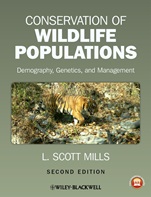
Conservation of Wildlife Populations: Demography, Genetics, and Management
ISBN 9780470671504
Autor: L. Scott Mills
Wydawca: Wiley
Dostępność: 3-6 tygodni
Cena: 631,05 zł
Przed złożeniem zamówienia prosimy o kontakt mailowy celem potwierdzenia ceny.
ISBN13: |
9780470671504 |
ISBN10: |
0470671505 |
Autor: |
L. Scott Mills |
Oprawa: |
Hardback |
Rok Wydania: |
2012-11-23 |
Numer Wydania: |
2nd Edition |
Ilość stron: |
342 |
Wymiary: |
253x192 |
Tematy: |
PS |
Population ecology has matured to a sophisticated science with astonishing potential for contributing solutions to wildlife conservation and management challenges. And yet, much of the applied power of wildlife population ecology remains untapped because its broad sweep across disparate subfields has been isolated in specialized texts. In this book, L. Scott Mills covers the full spectrum of applied wildlife population ecology, including genomic tools for non–invasive genetic sampling, predation, population projections, climate change and invasive species, harvest modeling, viability analysis, focal species concepts, and analyses of connectivity in fragmented landscapes. With a readable style, analytical rigor, and hundreds of examples drawn from around the world, Conservation of Wildlife Populations (2 nd ed) provides the conceptual basis for applying population ecology to wildlife conservation decision–making. Although targeting primarily undergraduates and beginning graduate students with some basic training in basic ecology and statistics (in majors that could include wildlife biology, conservation biology, ecology, environmental studies, and biology), the book will also be useful for practitioners in the field who want to find – in one place and with plenty of applied examples – the latest advances in the genetic and demographic aspects of population ecology. Reviews of the First Edition "...a well–balanced book that combines readable introductions to theory and (often fascinating) real–world examples in approximately equal measure." Bulletin of the British Ecological Society “… If you were to teach an introductory course on conservation biology that focused on the perspective of population biology, this is the text you would want...” Journal of Wildlife Management "... a well–organized, well–written, and... entertaining introduction to the study of population biology..." Ecology “Scott Mills has written a valuable advanced text for those who will be practitioners of wildlife management …a fresh and honest approach to several topics that impact wildlife management but are often ignored.” Heredity “With this book under their belt, students will have the foundation to pursue more advanced coursework and understand why they should. In doing this, Mills has succeeded in filling an important void.” Conservation Biology
List of boxes ix Preface to second edition xi Preface to first edition xii List of symbols xiv Acknowledgments for second edition xv Acknowledgments for first edition xvi PART I BACKGROUND TO APPLIED POPULATION BIOLOGY 1 1 The big picture: human population dynamics meet applied population biology 3 2 Designing studies and interpreting population biology data: how do we know what we know? 14 3 Genetic concepts and tools to support wildlife population biology 33 4 Estimating population vital rates 54 PART II POPULATION PROCESSES: THE BASIS FOR MANAGEMENT 77 5 The simplest way to describe and project population growth: exponential or geometric change 79 6 All stage classes are not equal in their effects on population growth: structured population–projection models 98 7 Density–dependent population change 126 8 Predation and wildlife populations 142 9 Genetic variation and fi tness in wildlife populations 154 10 Dynamics of multiple populations 175 PART III APPLYING KNOWLEDGE OF POPULATION PROCESSES TO PROBLEMS OF DECLINING, SMALL, OR HARVESTABLE POPULATIONS 199 11 Human–caused stressors: deterministic factors affecting populations 201 12 Predicting the dynamics of small and declining populations 224 13 Focal species to bridge from populations to ecosystems 244 14 Population biology to guide sustainable harvest 251 Summary 266 Further Reading 267 Epilogue 269 References 271 Index 301 Colour Plates fall between page 160 and 16
L. Scott Mills is a Professor in the Wildlife Biology Program at The University of Montana. He was a 2009 John Simon Guggenheim Fellow, has received multiple NSF Awards, served on the Board of Governors for the North American Section of the Society for Conservation Biology, and has testified to Congress about the role of ethics in wildlife population biology research. Mills was an invited contributor to the 2007 Intergovernmental Panel on Climate Change Report ( IPCC ) report, and to the Western Governors’ Association Climate Change Working Group . His research and teaching integrates field studies with population models and genetic analyses to understand effects of human perturbations on wildlife populations. Mills’ research on wildlife around the world – from snowshoe hares to marmots, mice to coyotes, bighorn sheep to snow leopards and tigers – has been covered in media outlets including Newsweek, National Geographic, The New York Times, Discovery Channel Canada, Science News, National Public Radio, Nature, Science, and The Nature of Things with David Suzuki.
“Summing Up: Recommended. Lower–division undergraduates through researchers/faculty. ( Choice , 1 November 2013)
Koszyk
Książek w koszyku: 0 szt.
Wartość zakupów: 0,00 zł
Informacje


Kontakt
Gambit
Centrum Oprogramowania
i Szkoleń Sp. z o.o.
Al. Pokoju 29b/22-24
31-564 Kraków
Siedziba Księgarni
ul. Kordylewskiego 1
31-542 Kraków
+48 12 410 5991
+48 12 410 5987
+48 12 410 5989
Subskrypcje
Administratorem danych osobowych jest firma Gambit COiS Sp. z o.o. Na podany adres będzie wysyłany wyłącznie biuletyn informacyjny.
Autoryzacja płatności

Informacje na temat autoryzacji płatności poprzez PayU.

© Copyright 2012: GAMBIT COiS Sp. z o.o. Wszelkie prawa zastrzeżone.
Projekt i wykonanie: Alchemia Studio Reklamy