


Wydawcy
Katalog tematyczny
- Archeologia (109)
- Ekonomia, finanse, business (13704)
- Filozofia (1445)
- Historia (3040)
- Języki i językoznawstwo (2356)
- Lifestyle, hobby i rozrywka (475)
- Medycyna (9704)
- Nauki humanistyczne (4)
- Nauki o Ziemi i środowisku (2638)
- Nauki ścisłe (20412)
- Nauki społeczne (8486)
- Nauki techniczne (13450)
- Budownictwo lądowe (1045)
- Chemia przemysłowa (2258)
- Elektronika i telekomunikacja (3287)
- Energetyka (1122)
- Inne nauki stosowane (363)
- Inżynieria biochemiczna (507)
- Inżynieria transportu (232)
- Mechanika i materiały (3316)
- Nauka o środowisku (321)
- Rolnictwo (507)
- Technika, ogólnie (475)
- Prawo (1696)
- Publikacje informacyjne i interdyscyplinarne (1288)
- Religia i wierzenia (917)
- Technika komputerowa (4067)
- Zdrowie, relacje międzyludzkie i rozwój osobisty (657)





Informacje szczegółowe o książce
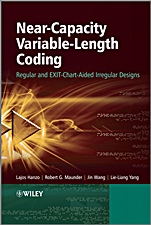
Near–Capacity Variable–Length Coding: Regular and EXIT–Chart–Aided Irregular Designs
ISBN 9780470665206
Autor: Lajos Hanzo, Robert G. Maunder, Jin Wang, Lie–Liang Yang
Wydawca: Wiley
Dostępność: 3-6 tygodni
Cena: 614,25 zł
Przed złożeniem zamówienia prosimy o kontakt mailowy celem potwierdzenia ceny.
ISBN13: |
9780470665206 |
ISBN10: |
0470665203 |
Autor: |
Lajos Hanzo, Robert G. Maunder, Jin Wang, Lie–Liang Yang |
Oprawa: |
Hardback |
Rok Wydania: |
2010-10-01 |
Ilość stron: |
516 |
Wymiary: |
249x174 |
Tematy: |
TJ |
This book provides a cutting edge explanation of VLC codings and their future developments.
Near–Capacity Variable–Length Coding examines the topic in the context of digital multimedia broadcast telecommunications. Providing insight into VLC coding’s applications, characteristics and performance, the book addresses the latest research in the area. Using novel experiments, it systematically introduces Irregular Variable Length Coding (IrVLC), its function in joint source and channel coding, employment to facilitate Unequal Error Protection (UEP) and application to near–capacity operation using Extrinsic Information Transfer (EXIT) chart analysis. Having introduced the topic thoroughly, the mid section is devoted to the authors’ latest techniques, outlining and explaining concepts such as Genetic Algorithm (GA), constructing both RVLCs and VLEC codes and EXIT modules. The book concludes with a chapter on future work on the topic.
– Provides an exhaustive treatment of variable length coding systems and their application to error–prone transmission systems
– One of the first titles to address the subject in such depth, including latest research results
– Topics include: the effect of different free distances of the source codes; vector quantised RVLC–TCM scheme and EXIT systems
Spis treści:
About the Authors
Other Wiley and IEEE Press Books on Related Topics
Acknowledgments
Preface
Chapter 1 Introduction
1.1 Historical Overview
1.2 Applications of Irregular Variable Length Coding
1.3 Motivation and Methodology
1.4 Outline of the Book
1.5 Novel Contributions of the Book
Chapter 2 Information Theory Basics
2.1 Issues in Information Theory
2.2 AdditiveWhite Gaussian Noise Channel
2.3 Information of a Source
2.4 Avera
ge Information of Discrete Memoryless Sources
2.5 Source Coding for a Discrete Memoryless Source
2.6 Entropy of Discrete Sources Exhibiting Memory
2.7 Examples
2.8 Generating Model Sources
2.9 Run–Length Coding for Discrete Sources Exhibiting Memory
2.10 Information Transmission via Discrete Channels
2.11 Capacity of Discrete Channels
2.12 Shannon’s Channel Coding Theorem
2.13 Capacity of Continuous Channels
2.14 Shannon’s Message for Wireless Channels
2.15 Summary and Conclusions
I Regular Concatenated Codes and Their Design
List of Symbols in Part I
Chapter 3 Sources and Source Codes
3.1 Introduction
3.2 Source Models
3.3 Source Codes
3.4 Soft–Decoding of Variable Length Codes
3.5 Summary and Conclusions
Chapter 4 Iterative Source/Channel Decoding
4.1 Concatenated Coding and the Turbo Principle
4.2 SISO APP Decoders and Their EXIT Characteristics
4.3 Iterative Source/Channel Decoding Over AWGN Channels
4.4 Iterative Channel Equalisation, Channel Decoding and Source Decoding
4.5 Summary and Conclusions
Chapter 5 Three–Stage Serially Concatenated Turbo Equalisation
5.1 Introduction
5.2 Soft–in/Soft–outMMSE Equalisation
5.3 Turbo Equalisation Using MAP/MMSE Equalisers
5.4 Three–stage serially concatenated coding and MMSE equalisation
5.5 Approaching the Channel Capacity Using EXIT–Chart Matching and IRCCs .
5.6 Rate–Optimisation of Serially Concatenated Codes
5.7 Joint Source–Channel Turbo Equalisation Revisited
5.8 Summary and Conclusions
II Irregular Concatenated VLCs and Their Design
List of Symbols in Part II
Chapter 6 Irregular Variable Length Codes for Joint Source and Channel Coding
6.1 Introduction
6.2 Overview of proposed scheme
6.3 Transmission frame structure
6.4 VDVQ/RVLC encoding
6.5 APP SISO VDVQ/RVLC decoding
6.6 Simulation results
6.7 Summary
and Conclusions
Chapter 7 Irregular Variable Length Codes for EXIT Chart Matching
7.1 Introduction
7.2 Overview of proposed schemes
7.3 Parameter design for the proposed schemes
7.4 Simulation results
7.5 Summary and Conclusions
Chapter 8 Genetic Algorithm Aided Design of Irregular Variable Length Coding Components
8.1 Introduction
8.2 The free distance metric
8.3 Overview of the proposed genetic algorithm
8.4 Overview of proposed scheme
8.5 Parameter design for the proposed scheme
8.6 Simulation results
8.7 Summary and Conclusions
Chapter 9 Joint EXIT Chart Matching of Irregular Variable Length Coding and Irregular
Unity Rate Coding
9.1 Introduction
9.2 Modifications of the EXIT chart matching algorithm
9.3 Joint EXIT chart matching
9.4 Overview of the transmission scheme considered
9.5 System parameter design
9.6 Simulation results
9.7 Summary and Conclusions
III Applications of VLCs
Chapter 10 Iteratively Decoded VLC Space–Time Coded Modulation
10.1 Introduction
10.2 Space Time Coding Overview
10.3 Two–Dimensional VLC Design
10.4 VL–STCM Scheme
10.5 VL–STCM–ID Scheme
10.6 Convergence Analysis
10.7 Simulation results
10.8 Conclusions
Chapter 11 Iterative Detection of Three–Stage Concatenated IrVLC FFH–MFSK
11.1 Introduction
11.2 System Overview
11.3 Iterative decoding
11.4 System parameter design and Results
11.5 Conclusion
Chapter 12 Conclusions and Future Research
12.1 Chapter 1: Introduction
12.2 Chapter 2: Information Theory Basics
12.3 Chapter 3: Sources and Source Codes
12.4 Chapter 4: Iterative Source/Channel Decoding
12.5 Chapter 5: Three–Stage Serially Concatenated Turbo Equalisation
12.6 Chapter 6: Joint source and channel coding
12.7 Chapters 7 – 9: EXIT chart matching
12.8 Chapter 8: GA–aided Design of Irregular VLC Components
12.9 Chapter
Koszyk
Książek w koszyku: 0 szt.
Wartość zakupów: 0,00 zł
Informacje


Kontakt
Gambit
Centrum Oprogramowania
i Szkoleń Sp. z o.o.
Al. Pokoju 29b/22-24
31-564 Kraków
Siedziba Księgarni
ul. Kordylewskiego 1
31-542 Kraków
+48 12 410 5991
+48 12 410 5987
+48 12 410 5989
Subskrypcje
Administratorem danych osobowych jest firma Gambit COiS Sp. z o.o. Na podany adres będzie wysyłany wyłącznie biuletyn informacyjny.
Autoryzacja płatności

Informacje na temat autoryzacji płatności poprzez PayU.

© Copyright 2012: GAMBIT COiS Sp. z o.o. Wszelkie prawa zastrzeżone.
Projekt i wykonanie: Alchemia Studio Reklamy