


Wydawcy
Katalog tematyczny
- Archeologia (109)
- Ekonomia, finanse, business (13704)
- Filozofia (1445)
- Historia (3040)
- Języki i językoznawstwo (2356)
- Lifestyle, hobby i rozrywka (475)
- Medycyna (9704)
- Nauki humanistyczne (4)
- Nauki o Ziemi i środowisku (2638)
- Nauki ścisłe (20412)
- Astronomia (294)
- Biologia (5119)
- Biochemia (575)
- Biologia człowieka (14)
- Biologia komórkowa (377)
- Biologia molekularna (398)
- Biologia rozwoju (130)
- Biologia, ogólnie (1277)
- Botanika (280)
- Hydrobiologia (92)
- Mikrobiologia (363)
- Mykologia (22)
- Zoologia (303)
- Chemia (6540)
- Fizyka (3309)
- Matematyka (4574)
- Nauki ścisłe, ogólnie (503)
- Nauki społeczne (8486)
- Nauki techniczne (13450)
- Prawo (1696)
- Publikacje informacyjne i interdyscyplinarne (1288)
- Religia i wierzenia (917)
- Technika komputerowa (4067)
- Zdrowie, relacje międzyludzkie i rozwój osobisty (657)





Informacje szczegółowe o książce
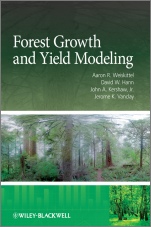
Forest Growth and Yield Modeling
ISBN 9780470665008
Autor: Aaron R. Weiskittel, David W. Hann, John A. Kershaw Jr., Jerome K. Vanclay
Wydawca: Wiley
Dostępność: 3-6 tygodni
Cena: 622,65 zł
Przed złożeniem zamówienia prosimy o kontakt mailowy celem potwierdzenia ceny.
ISBN13: |
9780470665008 |
ISBN10: |
0470665009 |
Autor: |
Aaron R. Weiskittel, David W. Hann, John A. Kershaw Jr., Jerome K. Vanclay |
Oprawa: |
Hardback |
Rok Wydania: |
2011-07-28 |
Ilość stron: |
430 |
Wymiary: |
251x171 |
Tematy: |
PS |
Completely updated and expanded new edition of this widely cited book, Modelling Forest Growth and Yield, 2nd Edition synthesizes current scientific literature, provides insights in how models are constructed, gives suggestions for future developments, and outlines keys for successful implementation of models.
The book describes current modeling approaches for predicting forest growth and yield and explores the components that comprise the various modeling approaches. It provides the reader with the tools for evaluating and calibrating growth and yield models and outlines the steps necessary for developing a forest growth and yield model.
Spis treści:
Preface.
Acknowledgements.
1 Introduction.
1.1 Model development and validation.
1.2 Important uses.
1.3 Overview of the book.
2 Indices of competition.
2.1 Introduction.
2.2 Two–sided competition.
2.2.1 Distance–independent.
2.2.2 Distance–dependent.
2.3 One–sided competition.
2.3.1 Distance–independent.
2.3.2 Distance–dependent.
2.4 Limitations.
2.4.1 Low predictive power.
2.4.2 Distance–independent vs. distance–dependent.
2.4.3 Influence of sampling design.
2.5 Summary.
3 Forest site evaluation.
3.1 Introduction.
3.2 Phytocentric measures of site quality.
3.2.1 Site index.
3.2.2 Plant indicators.
3.2.3 Other phytocentric measures.
3.3 Geocentric measures of site productivity.
3.3.1 Physiographic measures.
3.3.2 Climatic measures.
3.3.3 Soil measures.
3.4 Summary.
4 Whole–stand and size–class models.
4.1 Introduction.
4.2 Whole–stand models.
4.2.1 Yield tables and equations.
4.2.2 Compatible growth and yield equations.
4.2.3 Systems of equations.
4.2.4 State–space models.
4.2.5 Transition matrix models.
4.3 Size–class models.
4.3.1 Stand tab
le projection.
4.3.2 Matrix models.
4.3.3 Diameter–class models.
4.3.4 Cohort models.
4.4 Summary.
5 Tree–level models.
5.1 Introduction.
5.2 Single–tree distance–dependent models.
5.2.1 Example models.
5.3 Tree–list distance–independent models.
5.3.1 Example models.
5.4 Summary.
6 Components of tree–list models.
6.1 Introduction.
6.2 Diameter increment.
6.2.1 Potential diameter increment equations with multiplicative modifiers.
6.2.2 Realized diameter increment equations.
6.3 Height increment.
6.3.1 Potential height increment equations with multiplicative modifiers.
6.3.2 Realized height increment equations.
6.4 Crown recession.
6.4.1 Individual–tree crown recession models.
6.4.2 Branch–level crown recession models.
6.5 Summary.
7 Individual–tree static equations.
7.1 Introduction.
7.2 Total height.
7.3 Crown length.
7.4 Crown width and profile.
7.5 Stem volume and taper.
7.6 Biomass.
7.7 Use of static equations to predict missing values.
7.8 Summary.
8 Mortality.
8.1 Introduction.
8.2 Stand–level mortality.
8.3 Individual–tree–level mortality.
8.4 Mechanistic models of mortality.
8.5 Development and application of mortality equations.
8.6 Summary.
9 Seeding, regeneration, and recruitment.
9.1 Introduction.
9.2 Seeding.
9.2.1 Flowering and pollination.
9.2.2 Seed production.
9.2.3 Seed dispersal.
9.2.4 Seed germination.
9.3 Regeneration.
9.4 Recruitment.
9.4.1 Static.
9.4.2 Dynamic.
9.5 Summary.
10 Linking growth models of different resolutions.
10.1 Introduction.
10.2 Linked stand– and size–class models.
10.2.1 Parameter recovery.
10.2.2 Modified stand table projection.
10.3 Linked stand– and tree–models.
10.3.1 Disaggregation.
10.3.2 Constrained.<
br>10.3.3 Combined.
10.4 Summary.
11 Modeling silvicultural treatments.
11.1 Introduction.
11.2 Genetic improvements.
11.2.1 Stand–level.
11.2.2 Tree–level.
11.3 Early stand treatments.
11.3.1 Stand–level.
11.3.2 Tree–level.
11.4 Thinning.
11.4.1 Stand–level.
11.4.2 Tree–level.
11.5 Fertilization.
11.5.1 Stand–level.
11.5.2 Tree–level.
11.6 Combined thinning and fertilization.
11.6.1 Stand–level.
11.6.2 Tree–level.
11.7 Harvesting.
11.7.1 Stand–level.
11.7.2 Tree–level.
11.8 Summary.
12 Process–based models.
12.1 Introduction.
12.2 Key physiological processes.
12.2.1 Light interception.
12.2.2 Photosynthesis.
12.2.3 Stomatal conductance.
12.2.4 Respiration.
12.2.5 Carbon allocation.
12.2.6 Soil water and nutrients.
12.3 Example models.
12.3.1 Forest–BGC.
12.3.2 CenW.
12.3.3 BALANCE.
12.4 Limitations.
12.4.1 Initialization.
12.4.2 Parameterization.
12.4.3 Scale.
12.4.4 Sensitivity.
12.5 Summary.
13 Hybrid models of forest growth and yield.
13.1 Introduction.
13.2 Types of hybrid models.
13.2.1 Statistical growth equations with physiologically derived covariate.
13.2.2 Statistical growth equations with physiologically derived external modifier.
13.2.3 Allometric models.
13.3 Comparison to statistical models.
13.4 Summary.
14 Model construction.
14.1 Introduction.
14.2 Data requirements.
14.2.1 Stem analysis.
14.2.2 Temporary plots.
14.2.3 Permanent plots.
14.3 Model form.
14.4 Parameter estimation.
14.4.1 Regression.
14.4.2 Quantile regression.
14.4.3 Generalized linear regression models.
14.4.4 Mixed models.
14.4.5 Generalized algebraic difference approach.
14.4.6 System of equations.
14.4.7 Bayesian.
14.4.8 Nonparametric.
14.4.9 Annualization.
14.5 Summary.<
br>15 Model evaluation and calibration.
15.1 Introduction.
15.2 Model criticism.
15.2.1 Model form and parameterization.
15.2.2 Variable selection and model simplicity.
15.2.3 Biological realism.
15.2.4 Compatibility.
15.2.5 Reliability.
15.2.6 Adaptability.
15.3 Model benchmarking.
15.3.1 Statistical tests.
15.3.2 Model error characterization.
15.4 Model calibration.
15.5 Summary.
16 Implementation and use.
16.1 Introduction.
16.2 Collection of appropriate data.
16.3 Generation of appropriate data.
16.4 Temporal scale.
16.5 Spatial scale.
16.6 Computer interface.
16.7 Visualization.
16.8 Output.
16.9 Summary.
17 Future directions.
17.1 Improving predictions.
17.2 Improving input data.
17.3 Improving software.
17.4 Summary.
Bibliography.
Appendix 1: List of species used in the text.
Appendix 2: Expanded outline for ORGANON growth and yield model.
Index.
Koszyk
Książek w koszyku: 0 szt.
Wartość zakupów: 0,00 zł
Informacje


Kontakt
Gambit
Centrum Oprogramowania
i Szkoleń Sp. z o.o.
Al. Pokoju 29b/22-24
31-564 Kraków
Siedziba Księgarni
ul. Kordylewskiego 1
31-542 Kraków
+48 12 410 5991
+48 12 410 5987
+48 12 410 5989
Subskrypcje
Administratorem danych osobowych jest firma Gambit COiS Sp. z o.o. Na podany adres będzie wysyłany wyłącznie biuletyn informacyjny.
Autoryzacja płatności

Informacje na temat autoryzacji płatności poprzez PayU.

© Copyright 2012: GAMBIT COiS Sp. z o.o. Wszelkie prawa zastrzeżone.
Projekt i wykonanie: Alchemia Studio Reklamy