


Wydawcy
Katalog tematyczny
- Archeologia (109)
- Ekonomia, finanse, business (13704)
- Filozofia (1445)
- Historia (3040)
- Języki i językoznawstwo (2356)
- Lifestyle, hobby i rozrywka (475)
- Medycyna (9704)
- Chirurgia (272)
- Inne gałęzie medycyny (1871)
- Medycyna kliniczna (4187)
- Choroby wewnętrzne (514)
- Dermatologia (51)
- Diagnostyka medyczna (3)
- Endokrynologia (144)
- Gastroenterologia (27)
- Geriatria (50)
- Ginekologia i położnictwo (134)
- Hematologia (46)
- Hepatologia (10)
- Kardiologia (71)
- Laryngologia (12)
- Nefrologia (10)
- Neurologia (500)
- Oftalmologia (50)
- Pediatria (33)
- Pulmunologia (32)
- Reumatologia (14)
- Terapia genowa (1)
- Układ mięśniowo-szkieletowy (1)
- Urologia (14)
- Medycyna niekonwencjonalna (14)
- Medycyna przedkliniczna (269)
- Medycyna, ogólnie (1740)
- Medyczne służby pomocnicze (745)
- Studia medyczne (16)
- Weterynaria (548)
- Nauki humanistyczne (4)
- Nauki o Ziemi i środowisku (2638)
- Nauki ścisłe (20412)
- Nauki społeczne (8486)
- Nauki techniczne (13450)
- Prawo (1696)
- Publikacje informacyjne i interdyscyplinarne (1288)
- Religia i wierzenia (917)
- Technika komputerowa (4067)
- Zdrowie, relacje międzyludzkie i rozwój osobisty (657)





Informacje szczegółowe o książce
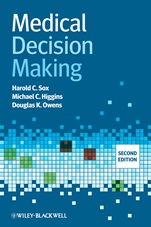
Medical Decision Making
ISBN 9780470658666
Autor: Harold C. Sox, Michael C. Higgins, Douglas K. Owens
Wydawca: Wiley
Dostępność: 3-6 tygodni
Cena: 267,75 zł
Przed złożeniem zamówienia prosimy o kontakt mailowy celem potwierdzenia ceny.
ISBN13: |
9780470658666 |
ISBN10: |
0470658665 |
Autor: |
Harold C. Sox, Michael C. Higgins, Douglas K. Owens |
Oprawa: |
Paperback |
Rok Wydania: |
2013-07-05 |
Numer Wydania: |
2nd Edition |
Ilość stron: |
364 |
Wymiary: |
234x152 |
Tematy: |
MJ |
Medical Decision Making provides clinicians with a powerful framework for helping patients make decisions that increase the likelihood that they will have the outcomes that are most consistent with their preferences. This new edition provides a thorough understanding of the key decision making infrastructure of clinical practice and explains the principles of medical decision making both for individual patients and the wider health care arena. It shows how to make the best clinical decisions based on the available evidence and how to use clinical guidelines and decision support systems in electronic medical records to shape practice guidelines and policies. Medical Decision Making is a valuable resource for all experienced and learning clinicians who wish to fully understand and apply decision modelling, enhance their practice and improve patient outcomes. “There is little doubt that in the future many clinical analyses will be based on the methods described in Medical Decision Making, and the book provides a basis for a critical appraisal of such policies.” – Jerome P. Kassirer M.D., Distinguished Professor, Tufts University School of Medicine, US and Visiting Professor, Stanford Medical School, US
Foreword, xi Preface, xv 1 Introduction, 1 1.1 How may I be thorough yet efficient when considering the possible causes of my patient’s problems? 1 1.2 How do I characterize the information I have gathered during the medical interview and physical examination? 2 1.3 How do I interpret new diagnostic information? 5 1.4 How do I select the appropriate diagnostic test? 5 1.5 How do I choose among several risky treatment alternatives? 6 1.6 Summary, 6 2 Differential diagnosis, 7 2.1 Introduction, 7 2.2 How clinicians make a diagnosis, 8 2.3 The principles of hypothesis–driven differential diagnosis, 11 2.4 An extended example, 21 Bibliography, 26 3 Probability: quantifying uncertainty, 27 3.1 Uncertainty and probability in medicine, 27 3.2 Using personal experience to estimate probability, 34 3.3 Using published experience to estimate probability, 46 3.4 Taking the special characteristics of the patient into account when estimating probability, 57 Problems, 58 Bibliography, 59 4 Understanding new information: Bayes’ theorem, 61 4.1 Introduction, 61 4.2 Conditional probability defined, 64 4.3 Bayes’ theorem, 65 4.4 The odds ratio form of Bayes’ theorem, 69 4.5 Lessons to be learned from Bayes’ theorem, 76 4.6 The assumptions of Bayes’ theorem, 82 4.7 Using Bayes’ theorem to interpret a sequence of tests, 84 4.8 Using Bayes’ theorem when many diseases are under consideration, 88 Problems, 90 Bibliography, 91 5 Measuring the accuracy of diagnostic information, 93 5.1 How to describe test results: abnormal and normal, positive and negative, 93 5.2 Measuring a test’s capability to reveal the patient’s true state, 98 5.3 Howto measure the characteristics of a diagnostic test: a hypothetical case, 106 5.4 Pitfalls of predictive value, 109 5.5 Sources of biased estimates of test performance and how to avoid them, 110 5.6 Spectrum bias, 116 5.7 Expressing test results as continuous variables, 125 5.8 Combining data from several studies of test performance, 134 Problems, 137 Bibliography, 140 6 Expected value decision making, 143 6.1 An example, 145 6.2 Selecting the decision maker, 148 6.3 Decision trees: structured representations for decision problems, 149 6.4 Quantifying uncertainty, 152 6.5 Probabilistic analysis of decision trees, 156 6.6 Expected value calculations, 158 6.7 Sensitivity analysis, 161 6.8 Folding back decision trees, 163 Problems, 168 Bibliography, 168 7 Markov models and time–varying outcomes, 170 7.1 Markov model basics, 170 7.2 Exponential survival model and life expectancy, 189 Problems, 198 Appendix: Mathematical details, 200 Bibliography, 203 8 Measuring the outcome of care – expected utility analysis, 204 8.1 Basic concept – direct utility assessment, 205 8.2 Sensitivity analysis – testing the robustness of utility analysis, 210 8.3 Shortcut – using a linear scale to express strength of preference, 212 8.4 Exponential utility – a parametric model, 213 8.5 Exponential utility with exponential survival, 218 8.6 Multidimensional outcomes – direct assessment, 220 8.7 Multidimensional outcomes – simplifications, 223 8.8 Multidimensional outcomes – quality–adjusted life years (QALY), 228 8.9 Comparison of the two models for outcomes with different length and quality, 232 Problems, 235 Appendix: Mathematical details, 237 Bibliography, 242 9 Selection and interpretation of diagnostic tests, 243 9.1 Taking action when the consequences are uncertain: principles and definitions, 244 9.2 The treatment–threshold probability, 247 9.3 The decision to obtain a diagnostic test, 252 9.4 Choosing between diagnostic tests, 259 9.5 Choosing the best combination of diagnostic tests, 261 9.6 Setting the treatment–threshold probability, 263 9.7 Taking account of the utility of experiencing a test, 275 9.8 A clinical case: test selection for suspected brain tumor, 279 9.9 Sensitivity analysis, 281 Bibliography, 287 10 Cost–effectiveness analysis and cost–benefit analysis, 288 10.1 The clinician’s conflicting roles: patient advocate,member of society, and entrepreneur, 288 10.2 Cost–effectiveness analysis: a method for comparing management strategies, 291 10.3 Cost–benefit analysis: a method for measuring the net benefit of medical services, 298 10.4 Measuring the costs of medical care, 301 Problems, 304 Bibliography, 305 11 Medical decision analysis in practice: advanced methods, 307 11.1 An overview of advanced modeling techniques, 307 11.2 Use of medical decision–making concepts to analyze a policy problem: the cost–effectiveness of screening for HIV, 311 11.3 Use of medical decision–making concepts to analyze a clinical diagnostic problem: strategies to diagnose tumors in the lung, 323 11.4 Use of complexmodels for individual–patient decisionmaking, 330 Bibliography, 333 Index, 337
Koszyk
Książek w koszyku: 0 szt.
Wartość zakupów: 0,00 zł
Informacje


Kontakt
Gambit
Centrum Oprogramowania
i Szkoleń Sp. z o.o.
Al. Pokoju 29b/22-24
31-564 Kraków
Siedziba Księgarni
ul. Kordylewskiego 1
31-542 Kraków
+48 12 410 5991
+48 12 410 5987
+48 12 410 5989
Subskrypcje
Administratorem danych osobowych jest firma Gambit COiS Sp. z o.o. Na podany adres będzie wysyłany wyłącznie biuletyn informacyjny.
Autoryzacja płatności

Informacje na temat autoryzacji płatności poprzez PayU.

© Copyright 2012: GAMBIT COiS Sp. z o.o. Wszelkie prawa zastrzeżone.
Projekt i wykonanie: Alchemia Studio Reklamy