


Wydawcy
Katalog tematyczny
- Archeologia (109)
- Ekonomia, finanse, business (13704)
- Filozofia (1445)
- Historia (3040)
- Języki i językoznawstwo (2356)
- Lifestyle, hobby i rozrywka (475)
- Medycyna (9704)
- Nauki humanistyczne (4)
- Nauki o Ziemi i środowisku (2638)
- Nauki ścisłe (20412)
- Nauki społeczne (8486)
- Nauki techniczne (13450)
- Prawo (1696)
- Publikacje informacyjne i interdyscyplinarne (1288)
- Religia i wierzenia (917)
- Technika komputerowa (4067)
- Zdrowie, relacje międzyludzkie i rozwój osobisty (657)





Informacje szczegółowe o książce
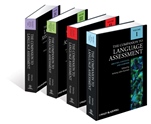
The Companion to Language Assessment: 4 Volume Set
ISBN 9780470655337
Autor: Antony John Kunnan
Wydawca: Wiley
Dostępność: 3-6 tygodni
Cena: 3 429,30 zł
Przed złożeniem zamówienia prosimy o kontakt mailowy celem potwierdzenia ceny.
ISBN13: |
9780470655337 |
ISBN10: |
047065533X |
Autor: |
Antony John Kunnan |
Oprawa: |
Hardback |
Rok Wydania: |
2013-11-15 |
Ilość stron: |
2240 |
Wymiary: |
280x205 |
Tematy: |
CF |
The Companion to Language Assessment is a state–of–the–art overview of the crucial topics for scholars and practitioners of language assessment, teaching, and learning. The four–volume work examines the multifaceted dimensions of language assessment, from the assessment of individual skills, the design of assessments, and the impact on language learners, to how research is conducted and assessment is practiced around the world. Organized thematically by volume, the 140 chapters provide comprehensive coverage of: Volume I: Abilities, Contexts, and Learners : examining the assessed skills of language learners including aptitude, listening, speaking, grammar, and literacy, among others, and assessing learners from young language learners to working professionals; Volume II: Approaches and Development : discussing assessment in the classroom and on a large scale, developmental tools such as designing and writing assessments, and current technological approaches; Volume III: Evaluation, Methodology, and Interdisciplinary Themes: exploring evaluation of assessments through quantitative, qualitative, and mixed approaches, and interdisciplinary themes, among others, from philosophy, language acquisition, forensic sciences, and legal and ethical issues; Volume IV: Assessment Around the World: featuring coverage of assessments in English and other languages from around the world. This work brings together the leading voices and cutting–edge research in this critically important field. It is a key resource for scholars and practitioners in the fields of language teaching and learning, language policy and planning, language assessment and evaluation, and education at all levels. Online edition available on Wiley Online Library at www.companiontolanguageassessment.com
Volume I: Abilities, Contexts, and Learners About the Editor xvii Contributors xviii Introducing The Companion to Language Assessment xli Acknowledgements xlvii Introduction to Volume I xlviii Part 1: Overview 1 1 Fifty Years of Language Assessment, Alan Davies 3 Part 2: Assessing Abilities 23 2 Assessing Aptitude, Catherine J. Doughty 25 3 Assessing Listening, Elvis Wagner 47 4 Assessing Literacy, Sara Cushing Weigle 64 5 Assessing Responses to Literature, Richard Beach 83 6 Assessing Grammar, James E. Purpura 100 7 Assessing Pragmatics, Carsten Roever 125 8 Assessing Pronunciation, Talia Isaacs 140 9 Assessing Speaking, Barry O’Sullivan 156 10 Assessing Vocabulary, David Beglar and Paul Nation 172 11 Assessing Reading, William Grabe and Xiangying Jiang 185 12 Assessing Writing, Deborah Crusan 201 13 Assessing Integrated Skills, Alister Cumming 216 14 Assessing Language and Content, Marguerite Ann Snow and Anne M. Katz 230 15 Assessing Translation, Juliane House 248 16 Assessing Language Varieties, Mingwei Pan and David D. Qian 265 Part 3: Assessment Contexts 283 17 International Assessments, Sauli Takala, Gudrun Erickson, and Neus Figueras 285 18 English Language Proficiency Assessments as an Exit Criterion for English Learners, Mikyung Kim Wolf and Timothy Farnsworth 303 19 Tests of English for Academic Purposes in University Admissions, Xiaoming Xi, Brent Bridgeman, and Cathy Wendler 318 20 Government and Military Assessment, Rachel L. Brooks and Mika Hoffman 338 21 Language Assessment for Court Translators and Interpreters, Piers Armstrong 355 22 Language Testing for Immigration to Europe, Piet Van Avermaet and Reinhilde Pulinx 376 23 Language Testing for Immigration and Citizenship in the Netherlands, Massimiliano Spotti 390 24 Assessment in Asylum–Related Language Analysis, Diana Eades 404 Part 4: Assessing Learners 421 25 Developmental Considerations and Curricular Contexts in the Assessment of Young Language Learners, Alison L. Bailey, H. Margaret Heritage, and Frances A. Butler 423 26 Assessing Heritage Language Learners, Lorena Llosa 440 27 Assessing Teachers’ Language Proficiency, Cathie Elder and Sun Hee Kim 454 28 Assessing the Oral English Abilities of International Teaching Assistants in the USA, Timothy Farnsworth 471 29 Assessing the English Language Proficiency of International Aviation Staff, Ruixia Yan 484 30 Assessing Health Professionals, Lynda Taylor and John Pill 497 31 Assessing Test Takers With Communication Disorders, John W. Oller, Jr. 513 Volume II: Approaches and Development Introduction to Volume II Part 5: Assessment Approaches 32 Large–Scale Assessment, Janna Fox 33 Norm–Referenced Approach to Language Assessment, Jungok Bae 34 Criterion–Referenced Approach to Language Assessment, Thom Hudson 35 Task–Based Language Assessment, Koen Van Gorp and Bart Deygers 36 Computer–Assisted Language Testing, Ruslan Suvorov and Volker Hegelheimer Part 6: Assessment and Learning 37 Performance Assessment in the Classroom, Guoxing Yu 38 Monitoring Progress in the Classroom, Rama Mathew and Matthew E. Poehner 39 Achievement and Growth in the Classroom, Michael J. Kieffer 40 Portfolio Assessment in the Classroom, Muchun Yin 41 Dynamic Assessment in the Classroom, Matthew E. Poehner 42 Diagnostic Feedback in the Classroom, Eunice Eunhee Jang and Maryam Wagner 43 Self–Assessment in the Classroom, Mats Oscarson 44 Peer Assessment in the Classroom, Jette G. Hansen Edwards 45 Test Development Literacy, Kirby C. Grabowski and Jee Wha Dakin Part 7: Assessment Development 46 Defining Constructs and Assessment Design, Joan Jamieson 47 Effect–Driven Test Specifications, Jiyoung Kim and Fred Davidson 48 Writing Items and Tasks, Mary Schedl and Jeanne Malloy 49 Item Banking, Susan Nissan and Robert French 50 Adapting or Developing Source Material for Listening and Reading Tests, Anthony Green 51 Writing Scoring Criteria and Score Reports, Megan Montee and Margaret E. Malone 52 Response Formats, David D. Qian and Mingwei Pan 53 Field Testing of Test Items and Tasks, Daniel J. Reed 54 Using Test–Wiseness Strategy Research in Task Development, Andrew D. Cohen 55 Using Standards and Guidelines, Nick Saville 56 Statistics and Software for Test Revisions, Yo In’nami and Rie Koizumi 57 Standard Setting in Language Testing, Dorry M. Kenyon and Anja Römhild 58 Administration, Scoring, and Reporting Scores, Ari Huhta 59 Detecting Plagiarism and Cheating, Ardeshir Geranpayeh Part 8: Technology and Assessment 60 New Media in Language Assessments, Paul Gruba 61 Using Corpora to Design Assessment, Fiona Barker 62 Eye–Tracking Technology for Reading, Paula M. Winke 63 Acoustic and Temporal Analysis for Assessing Speaking, Okim Kang and Lucy Pickering 64 Computer–Automated Scoring of Written Responses, Nathan T. Carr Volume III: Evaluation, Methodology, and Interdisciplinary Themes Introduction to Volume III Part 9: Designing Evaluations 65 Evaluation of Language Tests Through Validation Research, Carol A. Chapelle and Erik Voss 66 Fairness and Justice in Language Assessment, Antony John Kunnan 67 Accommodations in the Assessment of English Language Learners, Jamal Abedi 68 Consequences, Impact, and Washback, Liying Cheng Part 10: Quantitative Analysis 69 Classical Test Theory, Yasuyo Sawaki 70 Classical Theory Reliability, James Dean Brown 71 Score Dependability and Decision Consistency, James Dean Brown 72 The Use of Generalizability Theory in Language Assessment, George A. Marcoulides and Marsha Ing 73 Exploratory Factor Analysis and Structural Equation Modeling, Gary J. Ockey 74 Questionnaire Development and Analysis, Aek Phakiti 75 Item Response Theory in Language Testing, David P. Ellis and Steven J. Ross 76 Differential Item and Testlet Functioning Analysis, Hong Jiao and Ying–Fang Chen 77 Multifaceted Rasch Analysis for Test Evaluation, Khaled Barkaoui Part 11: Qualitative and Mixed Method Analysis 78 Content Analysis, Evelina D. Galaczi 79 Introspective Methods, Miyuki Sasaki 80 Raters and Ratings, Alistair Van Moere 81 Spoken Discourse, Anne Lazaraton 82 Written Discourse, Lia Plakans 83 Mixed Methods Research, Carolyn E. Turner 84 Writing Research Reports, Kyle McIntosh and April Ginther Part 12: Interdisciplinary Themes 85 Philosophy and Language Testing, Glenn Fulcher 86 Cognition and Language Assessment, James E. Purpura 87 Language Acquisition and Language Assessment, Yasuhiro Shirai and Mary Lou Vercellotti 88 Bilingual Assessment, Usha Lakshmanan 89 Classroom–Based Assessment Issues for Language Teacher Education, Constant Leung 90 Program Evaluation and Language Assessment, Brent A. Green 91 The Interface of Language Assessment and Forensic Contexts, Margaret van Naerssen 92 Language Testing in the Dock, Glenn Fulcher 93 The Influence of Ethics in Language Assessment, Bernard Spolsky 94 Ongoing Challenges in Language Assessment, Lyle F. Bachman Volume IV: Assessment Around the World Introduction to Volume IV Part 13: Current Practices in Assessing English 95 English as a Lingua Franca, Jennifer Jenkins and Constant Leung 96 Assessing English in Australia and New Zealand, Kathryn Hill and Rosemary Erlam 97 Assessing English in North America, Samira ElAtia 98 Assessing English in Mexico and Central America, Caroline Payant and Francisco Javier Barrón Serrano 99 Assessing English in the Middle East and North Africa, Atta Gebril and Russanne Hozayin 100 Assessing English in South Asia, Rama Mathew 101 Assessing English in East Asia, Viphavee Vongpumivitch 102 Assessing English in Southeast Asia, Richard Watson Todd and Chih–Min Shih Assessing English in South America, Matilde V. R. Scaramucci and Adriana Boffi 104 Assessing English in Europe, Gad S. Lim Part 14: Current Practices in Assessing Languages in Africa 105 Assessing Swahili, Katrina Daly Thompson 106 Assessing Shona and Ndebele, Galen Sibanda Part 15: Current Practices in Assessing Languages in North and South America 107 Assessing American Sign Language, Robert J. Hoffmeister, Marlon Kuntze, Sarah A. Fish 108 Assessing Hawaiian, William H. Wilson 109 Assessing North American Indigenous Languages, J. Dean Mellow and Kaitlyn Begg 110 Assessing North American Spanish, M. Rafael Salaberry Part 16: Current Practices in Assessing Languages in the Middle East and South Asia 111 Assessing Arabic, Atta Gebril and Hanada Taha–Thomure 112 Assessing Farsi, Hossein Farhady and Kobra Tavassoli 113 Assessing Hebrew, Ofra Inbar–Lourie 114 Assessing Hindi, Pritha Chandra 115 Assessing Malayalam, Suchitra Sadanandan 116 Assessing Nepali, Madhav P. Pokharel 117 Assessing Sinhala, Priyanvada Abeywickrama and Dushyanthi Mendis 118 Assessing Tamil, Vyjayanthi Sankar 119 Assessing Telugu, K. V. V. L. Narasimha Rao Part 17: Current Practices in Assessing Languages in Southeast and East Asia 120 Assessing Bahasa Melayu and Bahasa Indonesia, May Tan 121 Assessing Cantonese, Wing Sat Chan 122 Assessing Japanese, Yoshinori Watanabe and Kaoru Koyanagi 123 Assessing Korean, Chungsook Kim and Junho Lee 124 Assessing Mandarin Chinese, Luxia Qi and Kai Zhang 125 Assessing Hakka, Southern Min, and Taiwanese Indigenous Languages, Jessica R. W. Wu 126 Assessing Thai, Pranee Kullavanijaya, Viphavee Vongpumivitch, and Debi Jaratjarungkiat Part 18: Current Practices in Assessing Languages in Australia and New Zealand 127 Assessing Australian and New Zealand Indigenous Languages, Gillian Wigglesworth and Peter Keegan 128 Assessing Mâori Indigenous Language Learners, Cath Rau Part 19: Current Practices in Assessing Languages in Europe 129 Assessing Armenian, Rubina Gasparyan and Mirtsa Halajyan 130 Assessing Finnish, Mirja Tarnanen and Eija Aalto 131 Assessing French, Eve Ryan 132 Assessing German, Michaela Perlmann–Balme 133 Assessing Greek, Spiros Papageorgiou 134 Assessing Italian, Giuliana Grego Bolli 135 Assessing Norwegian, Cecilie Carlsen and Eli Moe 136 Assessing Polish, Jo Lewkowicz and Marcin Smolik 137 Assessing Portuguese, Michele Back 138 Assessing Russian, Irshat Madyarov 139 Assessing Spanish, José Ramón Parrondo Rodríguez 140 Assessing Welsh, Emyr Davies
Antony John Kunnan is Professor of English Language and Literature at the National Institute of Education, Nanyang Technological University, Singapore. He has authored and edited books and edited special issues of journals on test validation, test fairness, statistics for language assessment, differential item functioning, and structural equation modeling. His most recent book is Workbook for Statistics in Language Assessment (coauthored with Lyle Bachman, 2005). He was the founding editor of Language Assessment Quarterly , which he edited from 2003 to 2013, and is past president of the International Language Testing Association.
Koszyk
Książek w koszyku: 0 szt.
Wartość zakupów: 0,00 zł
Informacje


Kontakt
Gambit
Centrum Oprogramowania
i Szkoleń Sp. z o.o.
Al. Pokoju 29b/22-24
31-564 Kraków
Siedziba Księgarni
ul. Kordylewskiego 1
31-542 Kraków
+48 12 410 5991
+48 12 410 5987
+48 12 410 5989
Subskrypcje
Administratorem danych osobowych jest firma Gambit COiS Sp. z o.o. Na podany adres będzie wysyłany wyłącznie biuletyn informacyjny.
Autoryzacja płatności

Informacje na temat autoryzacji płatności poprzez PayU.

© Copyright 2012: GAMBIT COiS Sp. z o.o. Wszelkie prawa zastrzeżone.
Projekt i wykonanie: Alchemia Studio Reklamy