


Wydawcy
Katalog tematyczny
- Archeologia (109)
- Ekonomia, finanse, business (13704)
- Filozofia (1445)
- Historia (3040)
- Języki i językoznawstwo (2356)
- Lifestyle, hobby i rozrywka (475)
- Medycyna (9704)
- Nauki humanistyczne (4)
- Nauki o Ziemi i środowisku (2638)
- Nauki ścisłe (20412)
- Nauki społeczne (8486)
- Nauki techniczne (13450)
- Prawo (1696)
- Publikacje informacyjne i interdyscyplinarne (1288)
- Religia i wierzenia (917)
- Technika komputerowa (4067)
- Zdrowie, relacje międzyludzkie i rozwój osobisty (657)





Informacje szczegółowe o książce
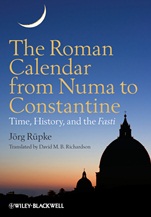
The Roman Calendar from Numa to Constantine: Time, History, and the Fasti
ISBN 9780470655085
Autor: Jörg Rüpke, David M. B. Richardson
Wydawca: Wiley
Dostępność: 3-6 tygodni
Cena: 773,85 zł
Przed złożeniem zamówienia prosimy o kontakt mailowy celem potwierdzenia ceny.
ISBN13: |
9780470655085 |
ISBN10: |
0470655089 |
Autor: |
Jörg Rüpke, David M. B. Richardson |
Oprawa: |
Hardback |
Rok Wydania: |
2011-04-15 |
Ilość stron: |
240 |
Wymiary: |
254x178 |
Tematy: |
HB |
The Roman calendar, in particular in the form of the Julian calendar of Julius Caesar, was used as the basis for what is, globally, the most important calendar today. This calendar evolved in a series of reforms and revolutions and many of its peculiar features, from the name of the months to the number of days, are still visible. This book traces the history and the peculiar form taken by the calendar. Offering new reconstructions of the critical stages of the technical, political, medial, and religious history of the Roman calendar, this book demands serious revisions to previous accounts and provides a definitive history of the Roman calendar. This new history enables a fresh understanding of the history of the Christian calendars and stimulates research on other calendars.
Preface. Map 1 Distribution of preserved calendars (or calendar fragments) of the fasti type from the first century BCE to the fifth century CE. Table 1 List of known copies of fasti. 1 Time’s social dimension. 2 Observations on the Roman fasti . 2.1 A Republican version. 2.2 Forms and functions. 2.3 The fasti and the birth of Augustan epigraphy. 2.4 The question of the archetype. 3 Towards an early history of the Roman calendar. 3.1 Notions of a prehistoric calendar. 3.2 The structure of the month. 3.3 Market cycles. 3.4 Modes of dating. 4 The introduction of the Republican calendar. 4.1 Timing and motivation. 4.2 The character and significance of the reform. 5 The written calendar. 5.1 Gnaeus Flavius. 5.2 NP days and feast–names. 5.3 Cultic and linguistic details. 5.4 The purpose of the fasti . 5.5 The law of Hortensius. 5.6 Implications for the historiography of Roman religion. 5.7 Variants on stone and paper. 6 The Acilian law and the problem of pontifical intercalation. 6.1 The nature of the measures. 6.2 How to intercalate in a ritually correct manner? 6.3 Problems of intercalation. 6.4 Regulating intercalation by means of laws. 7 Reinterpretation of the fasti in the temple of the Muses. 7.1 Marcus Fulvius Nobilior, triumphator . 7.2 Temple dedications in the fasti . 7.3 Ennius. 7.4 All fasti are Fulvian fasti . 8 From Republic to Empire. 8.1 Caesar′s reform of the calendar. 8.2 The calendar as collective memory. 8.3 Augustus and the power of dates. 8.4 The calendar as Roman breviary. 9 The disappearance of marble calendars. 10 Calendar monopoly and competition between calendars. 10.1 One calendar. 10.2 Coexisting and competing developments. 10.3 Eras. 10.4 The calculation of Easter. 10.5 Weekly cycles. 10.6 Fasti christiani? 11 The calendar in the public realm. Abbreviations. References. Sources Index. General Index.
Jörg Rüpke is Fellow in Religious Studies at the Max Weber Centre of the University of Erfurt. His publications include Fasti sacerdotum: A Prosopography of Pagan, Jewish , and Christian Religious Officials in the City of Rome, 300 BC to AD 49 9 (trans. David Richardson, 2008), Religion of the Romans (2007), A Companion to Roman Religion (2007), and Religion and Law in Classical and Christian Rome (co–edited with C. Ando, 2006) David M B Richardson has previously translated Fasti sacerdotum: A Prosopography of Pagan, Jewish, and Christian Religious Officials in the City of Rome, 300 BC to AD 499 (Jörg Rüpke, 2008), and contributed to the English translation of Brill’s New Pauly Encyclopaedia of the Ancient World (2002 onwards).
“This book is a very welcome addition to the study of Roman time. R. has long stood in the top tier of scholars working on the Roman calendar. This book is destined to become an indispensable resource for scholars and students wishing to understand the origins and development of the Roman calendar as a mechanism for marking time, but more particularly as a social construct at the mercy of the political powers of the time.” ( Journal of Roman Studies , 1 August 2013)
Koszyk
Książek w koszyku: 0 szt.
Wartość zakupów: 0,00 zł
Informacje


Kontakt
Gambit
Centrum Oprogramowania
i Szkoleń Sp. z o.o.
Al. Pokoju 29b/22-24
31-564 Kraków
Siedziba Księgarni
ul. Kordylewskiego 1
31-542 Kraków
+48 12 410 5991
+48 12 410 5987
+48 12 410 5989
Subskrypcje
Administratorem danych osobowych jest firma Gambit COiS Sp. z o.o. Na podany adres będzie wysyłany wyłącznie biuletyn informacyjny.
Autoryzacja płatności

Informacje na temat autoryzacji płatności poprzez PayU.

© Copyright 2012: GAMBIT COiS Sp. z o.o. Wszelkie prawa zastrzeżone.
Projekt i wykonanie: Alchemia Studio Reklamy