


Wydawcy
Katalog tematyczny
- Archeologia (109)
- Ekonomia, finanse, business (13704)
- Filozofia (1445)
- Historia (3040)
- Języki i językoznawstwo (2356)
- Lifestyle, hobby i rozrywka (475)
- Medycyna (9704)
- Nauki humanistyczne (4)
- Nauki o Ziemi i środowisku (2638)
- Nauki ścisłe (20412)
- Nauki społeczne (8486)
- Edukacja (229)
- Kryminologia, opieka spełeczna (284)
- Obronność (10)
- Polityka (1389)
- Psychologia (777)
- Socjologia (410)
- Społeczeństwo i kultura (187)
- Nauki techniczne (13450)
- Prawo (1696)
- Publikacje informacyjne i interdyscyplinarne (1288)
- Religia i wierzenia (917)
- Technika komputerowa (4067)
- Zdrowie, relacje międzyludzkie i rozwój osobisty (657)





Informacje szczegółowe o książce
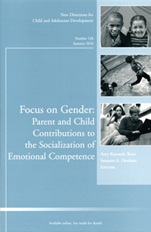
Focus on Gender: Parent and Child Contributions to the Socialization of Emotional Competence: New Directions for Child and Adolescent Development, Number 128
ISBN 9780470647868
Autor: Amy Kennedy Root, Susanne A. Denham
Wydawca: Wiley
Dostępność: 3-6 tygodni
Cena: 162,75 zł
Przed złożeniem zamówienia prosimy o kontakt mailowy celem potwierdzenia ceny.
ISBN13: |
9780470647868 |
ISBN10: |
0470647868 |
Autor: |
Amy Kennedy Root, Susanne A. Denham |
Oprawa: |
Paperback |
Rok Wydania: |
2010-09-29 |
Ilość stron: |
128 |
Wymiary: |
225x154 |
Tematy: |
JC |
This sourcebook provides a comprehensive volume addressing the critical issues in the study of gender, emotion socialization, and the development of emotional competence. Each of the chapters provides evidence for the pervasive role that gender plays in emotional development and provides a framework to better understand the development of emotion in boys and girls. These include:OL {list–style:disc}P:{margin–left 60px}The Role of Gender in the Socialization of Emotion: Key Concepts and Critical IssuesGender Differences in Caregiver Emotion Socialization of Low–Income ToddlersGender and Parents′ Reactions to Children′s Emotion During the Preschool YearsParent–Child Discussions of Anger and Sadness: The Importance of Parent and Child Gender During Middle ChildhoodEmotion Socialization in Adolescence: The Roles of Mothers and FathersSocialization of Emotion: Who Influences Whom and How?
As these chapters demonstrate, gender impacts growth in a multitude of developmental domains, including the development of emotion and emotional competence. although emotions are, in part, biological, the means of emotions and appropriateness of emotional expression are socialized. In the early years of life, socialization primarily takes place via interactions within the family, and characteristics of both parents and children may affect the process of emotion socialization. Gender is one critically important moderator of what and how children learn about emotion because culture determines the appropriateness of emotional displays for males and females.
This is the 128th volume of the Jossey–Bass quarterly report series New Directions for Child and Adolescent Development. The mission of New Directions for Child and Adolescent Development is to provide scientific and scholarly presentations on cutting edge issues and concepts in the field of child and adolescent development. Eac
h volume focuses on a specific "new direction" or research topic, and is edited by an expert or experts on that topic.
Spis treści:
1. The Role of Gender in the Socialization of Emotion: Key Concepts and Critical Issues (Amy Kennedy Root, Susanne A. Denham)
In the introductory chapter, the editors provide an overview of the important role parents play in the development of emotional competence. They highlight the central issues that require address in the fi eld of emotion socialization, including gender of parent, gender of child, and culture.
2. Gender Differences in Caregiver Emotion Socialization of Low–Income Toddlers (Tara M. Chaplin, James Casey, Rajita Sinha, Linda C. Mayes)
The authors explore if child gender affects caregivers′ response to toddlers′ observed anger and sadness/anxiety in a low–income sample. The authors build on their fi ndings to provide a commentary on the developmental implications that may result from gender–differentiated emotion socialization in at–risk children.
3. Gender Differences in the Socialization of Preschoolers′ Emotional Competence (Susanne A. Denham, Hideko Hamada Bassett, Todd M. Wyatt)
Using multiple methods and informants, the authors examine differences in maternal and paternal emotion socialization, as well as differences that may emerge between mothers and fathers as a result of child gender. The contribution of mothers′ and fathers′ emotion socialization practices to preschoolers’ development of emotional competence is also examined.
4. Gender and Parents′ Reactions to Children′s Emotion During the Preschool Years (Amy Kennedy Root, Kenneth H. Rubin)
Focusing on parental emotion socialization beliefs, the authors explore the potential differences that emerge between mothers of sons, mothers of daughters, fathers of sons, and fa
thers of daughters in their responses to children’s hypothetical displays of happiness, anxiety, anger, and disappointment.
5. Parent–Child Discussions of Anger and Sadness: The Importance of Parent and Child Gender During Middle Childhood (Janice Zeman, Carisa Perry–Parrish, Michael Cassano)
Through the analysis of parent–child conversations of emotion, the authors provide support for the importance of parental emotion socialization during the middle childhood period, with differences emerging between mothers and fathers in the socialization practices utilized in the discussion of anger and sadness with their children.
6. Emotion Socialization in Adolescence: The Roles of Mothers and Fathers (Ann E. Brand, Bonnie Klimes–Dougan)
The authors provide evidence for the importance of maternal and paternal emotion socialization during the adolescent years, as well as the impact that parental emotion socialization practices may have on the development of internalizing and externalizing diffi culties.
7. Socialization of Emotion: Who Infl uences Whom and How? (Carolyn Zahn–Waxler)
In this commentary, the author identifi es issues integral to the future study of emotion socialization, including conceptualization, measurement, and child effects. The closing commentary also offers suggestions for future researchers in the fi eld of emotion socialization.
INDEX.
Koszyk
Książek w koszyku: 0 szt.
Wartość zakupów: 0,00 zł
Informacje


Kontakt
Gambit
Centrum Oprogramowania
i Szkoleń Sp. z o.o.
Al. Pokoju 29b/22-24
31-564 Kraków
Siedziba Księgarni
ul. Kordylewskiego 1
31-542 Kraków
+48 12 410 5991
+48 12 410 5987
+48 12 410 5989
Subskrypcje
Administratorem danych osobowych jest firma Gambit COiS Sp. z o.o. Na podany adres będzie wysyłany wyłącznie biuletyn informacyjny.
Autoryzacja płatności

Informacje na temat autoryzacji płatności poprzez PayU.

© Copyright 2012: GAMBIT COiS Sp. z o.o. Wszelkie prawa zastrzeżone.
Projekt i wykonanie: Alchemia Studio Reklamy