


Wydawcy
Katalog tematyczny
- Archeologia (109)
- Ekonomia, finanse, business (13704)
- Filozofia (1445)
- Historia (3040)
- Języki i językoznawstwo (2356)
- Lifestyle, hobby i rozrywka (475)
- Medycyna (9704)
- Nauki humanistyczne (4)
- Nauki o Ziemi i środowisku (2638)
- Nauki ścisłe (20412)
- Nauki społeczne (8486)
- Nauki techniczne (13450)
- Budownictwo lądowe (1045)
- Chemia przemysłowa (2258)
- Elektronika i telekomunikacja (3287)
- Energetyka (1122)
- Inne nauki stosowane (363)
- Inżynieria biochemiczna (507)
- Inżynieria transportu (232)
- Mechanika i materiały (3316)
- Nauka o środowisku (321)
- Rolnictwo (507)
- Technika, ogólnie (475)
- Prawo (1696)
- Publikacje informacyjne i interdyscyplinarne (1288)
- Religia i wierzenia (917)
- Technika komputerowa (4067)
- Zdrowie, relacje międzyludzkie i rozwój osobisty (657)





Informacje szczegółowe o książce
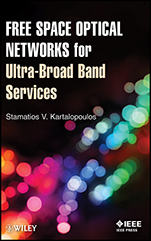
Free Space Optical Networks for Ultra–Broad Band Services
ISBN 9780470647752
Autor: Stamatios V. Kartalopoulos
Wydawca: Wiley
Dostępność: 3-6 tygodni
Cena: 546,00 zł
Przed złożeniem zamówienia prosimy o kontakt mailowy celem potwierdzenia ceny.
ISBN13: |
9780470647752 |
ISBN10: |
0470647752 |
Autor: |
Stamatios V. Kartalopoulos |
Oprawa: |
Hardback |
Rok Wydania: |
2011-09-23 |
Ilość stron: |
256 |
Wymiary: |
260x164 |
Tematy: |
TJ |
The first formal, comprehensive textbook on
implementing free space optical networks
This book provides a comprehensive description of an optical communications technology known as free space optical—a next–generation communications network that uses optical signals through the atmosphere instead of fiber, RF, or microwaves. This technology potentially offers more complex ultrabandwidth communication services simultaneously to multiple users and in a very short time, compared to fiber optic technology. This text presents established and new advancements drawn from the latest research and development in components, networking, operation, and practices.
This book describes the FSO network concepts in simple language. It provides comprehensive coverage in an easy–to–understand, progressive style that starts from the physics of the atmosphere and how it affects optical communications; continues with the design of a network node; and concludes with fiberless network applications from point–to–point to mesh topology. Important areas discussed include:
Propagation of light in the atmosphere and phenomena that affect light propagation
FSO transceiver design
Point–to–point FSO systems
Ring FSO systems
Mesh–FSO systems and integrating the Mesh–FSO with the public network
WDM Mesh–FSO
FSO network security
FSO–specific applications
To meet the needs of both academia and industry, key mathematical formulas are presented along with descriptions, while extensive mathematical analyses are minimized or avoided. Free Space Optical Networks for Ultra–Broad Band Services serves as an ideal text for network communication professionals who enter the free space optical communication field, graduate students majoring in optical communications, optical communication engineers, researchers, managers, and consultants.
Spis treści:
Chapter 1. Propagati
on of Light in Unguided Media
1.1 Introduction
1.2 Laser Beam characteristics
1.3 Atmospheric Layers
1.4 Atmospheric effects on optical signals
1.5 Coding for Atmospheric optical propagation
1.6 LIDAR
Chapter 2. FSO Transceiver Design
2.1 Introduction
2.2 Light sources
2.3 Modulators
2.4 Photodetectors and receivers
2.5 Optical amplification
2.6 Optical signal to noise ratio
2.7 Acquisition, Pointing and Tracking
2.8 Adaptive and Active Optics
2.9 Laser Safety
2.10 Node housing and mounting
Chapter 3. Point–to–Point FSO Systems
3.1 Introduction
3.2 Simple PtP Design
3.3 Point–to–Point with Transponder nodes
3.4 Hybrid FSO and RF
3.5 FSO point–to–multipoint
3.6 FSO point–to–mobile
Chapter 4. Ring FSO Systems
4.1 Introduction
4.2 Ring topologies and service protection
4.3 Ring nodes with add–drop
4.4 Concatenated rings
4.5 Ring to network connectivity
Chapter 5. Mesh FSO Systems
5.1 Introduction
5.2 FSO nodes for mesh topology
5.3 Hybrid Mesh–FSO with RF
5.4 Hybrid FSO–Fiber networks
Chapter 6. WDM Mesh–DSO
6.1 Introduction
6.2 Light attributes
6.3 Optical media
6.4 Interaction of light with matter
6.5 Medium birefringence
6.6 DWDM and CWDM optical channels
6.7 WDM FSO Links
6.8 WDM mesh FSO Networks
6.9 Service protection in mesh–FSO networks
6.10 WDM mesh–FSO versus EM–wireless
Chapter 7. Integrating Mesh–FSO with the Public Network
7.1 Introduction
7.2 The Ethernet protocol
7.3 The TCP/IP protocol
7.4 The ATM protocol
7.5 Wireless protocols
7.6 The Next–generation SONET/SDH protocol
7.7 Next generation SONET/SDH networks
7.8 Next generation protocols
7.9 The GMPLS protocol
7.10 The GFP protocol
7.11 The LCAS protocol
7.12 The LAPS protocol
7.
13 Any protocol over SONET/SDH
Chapter 8. FSO Network Security
8.1 Introduction
8.2 Cryptography
8.3 Security Levels
8.4 Security Layers
8.5 FSO inherent security features
8.6 Conclusion
Chapter 9. FSO Specific Applications
9.1 Introduction
9.2 FSO networks for highway assisted communications
9.3 Mesh–FSO in disaster areas
9.4 Visual Light Communications
9.5 Conclusion
Nota biograficzna:
Stamatios V. Kartalopoulus, PhD, is the Williams Professor in Telecommunications Networking at the ECE/TCOM graduate program at the University of Oklahoma. He has been a Distinguished Speaker of IEEE and has been invited to give keynote speeches internationally. For twenty–two years prior, Dr. Kartalopoulos defined, led, and managed research and development teams in Bell Laboratories, where he received the President′s Award and other awards for excellence. A Fellow of IEEE, he has published more than 250 scientific papers and ten books, and has been awarded twenty patents. In 2010, he received the 2009 Choice Award for Outstanding Academic Titles for his book Security of Information and Communication Networks (Wiley/IEEE Press), and also received the award for Top Cited Article in the period 2005–2010 for his FTTH/B paper in Optical Systems and Networks (Vol. 2, 2005).
Okładka tylna:
The first formal, comprehensive textbook on
implementing free space optical networks
This book provides a comprehensive description of an optical communications technology known as free space optical—a next–generation communications network that uses optical signals through the atmosphere instead of fiber, RF, or microwaves. This technology potentially offers more complex ultrabandwidth communication services simultaneously to multiple users and in a very short time, compared to fiber optic technology. This text presents established and new advancements draw
n from the latest research and development in components, networking, operation, and practices.
This book describes the FSO network concepts in simple language. It provides comprehensive coverage in an easy–to–understand, progressive style that starts from the physics of the atmosphere and how it affects optical communications; continues with the design of a network node; and concludes with fiberless network applications from point–to–point to mesh topology. Important areas discussed include:
Propagation of light in the atmosphere and phenomena that affect light propagation
FSO transceiver design
Point–to–point FSO systems
Ring FSO systems
Mesh–FSO systems and integrating the Mesh–FSO with the public network
WDM Mesh–FSO
FSO network security
FSO–specific applications
To meet the needs of both academia and industry, key mathematical formulas are presented along with descriptions, while extensive mathematical analyses are minimized or avoided. Free Space Optical Networks for Ultra–Broad Band Services serves as an ideal text for network communication professionals who enter the free space optical communication field, graduate students majoring in optical communications, optical communication engineers, researchers, managers, and consultants.
Koszyk
Książek w koszyku: 0 szt.
Wartość zakupów: 0,00 zł
Informacje


Kontakt
Gambit
Centrum Oprogramowania
i Szkoleń Sp. z o.o.
Al. Pokoju 29b/22-24
31-564 Kraków
Siedziba Księgarni
ul. Kordylewskiego 1
31-542 Kraków
+48 12 410 5991
+48 12 410 5987
+48 12 410 5989
Subskrypcje
Administratorem danych osobowych jest firma Gambit COiS Sp. z o.o. Na podany adres będzie wysyłany wyłącznie biuletyn informacyjny.
Autoryzacja płatności

Informacje na temat autoryzacji płatności poprzez PayU.

© Copyright 2012: GAMBIT COiS Sp. z o.o. Wszelkie prawa zastrzeżone.
Projekt i wykonanie: Alchemia Studio Reklamy