


Wydawcy
Katalog tematyczny
- Archeologia (109)
- Ekonomia, finanse, business (13704)
- Filozofia (1445)
- Historia (3040)
- Języki i językoznawstwo (2356)
- Lifestyle, hobby i rozrywka (475)
- Medycyna (9704)
- Nauki humanistyczne (4)
- Nauki o Ziemi i środowisku (2638)
- Nauki ścisłe (20412)
- Astronomia (294)
- Biologia (5119)
- Chemia (6540)
- Chemia analityczna (361)
- Chemia fizyczna (346)
- Chemia nieorganiczna (137)
- Chemia organiczna (535)
- Krystalografia (27)
- Minerologia (46)
- Fizyka (3309)
- Matematyka (4574)
- Nauki ścisłe, ogólnie (503)
- Nauki społeczne (8486)
- Nauki techniczne (13450)
- Prawo (1696)
- Publikacje informacyjne i interdyscyplinarne (1288)
- Religia i wierzenia (917)
- Technika komputerowa (4067)
- Zdrowie, relacje międzyludzkie i rozwój osobisty (657)





Informacje szczegółowe o książce
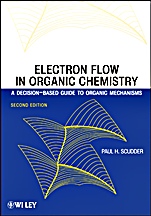
Electron Flow in Organic Chemistry: A Decision–Based Guide to Organic Mechanisms
ISBN 9780470638040
Autor: Paul H. Scudder
Wydawca: Wiley
Dostępność: 3-6 tygodni
Cena: 274,05 zł
Przed złożeniem zamówienia prosimy o kontakt mailowy celem potwierdzenia ceny.
ISBN13: |
9780470638040 |
ISBN10: |
0470638044 |
Autor: |
Paul H. Scudder |
Oprawa: |
Paperback |
Rok Wydania: |
2013-02-05 |
Numer Wydania: |
2nd Edition |
Ilość stron: |
448 |
Wymiary: |
254x178 |
Tematy: |
PN |
Sets forth the analytical tools needed to solve key problemsin organic chemistry
With its acclaimed decision–based approach, Electron Flow inOrganic Chemistry enables readers to develop the essentialcritical thinking skills needed to analyze and solve problems inorganic chemistry, from the simple to complex. The author breaksdown common mechanistic organic processes into their basic units toexplain the core electron flow pathways that underlie theseprocesses. Moreover, the text stresses the use of analytical toolssuch as flow charts, correlation matrices, and energy surfaces toenable readers new to organic chemistry to grasp the fundamentalsat a much deeper level.
This Second Edition of Electron Flow in OrganicChemistry has been thoroughly revised, reorganized, andstreamlined in response to feedback from both students andinstructors. Readers will find more flowcharts, correlationmatrices, and algorithms that illustrate key decision–makingprocesses step by step. There are new examples from the field ofbiochemistry, making the text more relevant to a broader range ofreaders in chemistry, biology, and medicine. This edition alsooffers three new chapters:
Proton transfer and the principles of stability Important reaction archetypes Qualitative molecular orbital theory and pericyclicreactionsThe text′s appendix features a variety of helpful tools,including a general bibliography, quick–reference charts andtables, pathway summaries, and a major decisions guide.
With its emphasis on logical processes rather than memorizationto solve mechanistic problems, this text gives readers a solidfoundation to approach and solve any problem in organicchemistry.
1 BONDING AND ELECTRON DISTRIBUTION 1
1.1 The Decision–Based Approach To Organic Chemistry2
1.2 Ionic And Covalent Bonding 6
1.3 Lewis Structures And Resonance Forms 8
1.4 Curved–Arrow Notation 11
1.5 Nomenclature And Abbreviations 16
1.6 An Orbital View Of Bonding (Supplemental) 18
1.7 The Shapes Of Molecules 21
1.8 Molecular Repulsions, Attractions, And Hydrogen Bonding25
1.9 Conjugation, Vinylogy, Aromaticity 27
1.10 Summary 30
2 THE PROCESS OF BOND FORMATION 34
2.1 Energetics Control Knowledge 35
2.2 Orbital Overlap In Covalent Bond Formation 35
2.3 Orbital Interaction Diagrams 38
2.4 Polarizability And Hard And Soft Acid–Base Theory 41
2.5 Thermodynamics, Position Of Equilibrium 43
2.6 Kinetics, Rate Of Reaction 47
2.7 Solvent Stabilization Of Ions 53
2.8 Enzymatic Catalysis – Lessons From Biochemistry 55
2.9 Summary 57
3 PROTON TRANSFER AND THE PRINCIPLES OF STABILITY61
3.1 Introduction To Proton Transfer 62
3.2 Ranking Of Acids And Bases, The pKa Chart 63
3.3 Structural Factors That Influence Acid Strength 66
3.4 Structural Factors That Influence Base Strength 70
3.5 Carbon Acids & Ranking Of Electron–Withdrawing Groups71
3.6 Calculation Of Keq For Proton Transfer 76
3.7 Proton Transfer Mechanisms 77
3.8 Common Errors 81
3.9 Proton Transfer Product Predictions 82
3.10 Summary 83
4 IMPORTANT REACTION ARCHETYPES 88
4.1 Introduction To Reaction Archetypes 89
4.2 Nucleophilic Substitution At A Tetrahedral Center 89
4.3 Elimination Reactions Create Pi Bonds 110
4.4 Addition Reactions To Polarized Multiple Bonds 124
4.5 Nucleophilic Substitution At A Trigonal Planar Center133
4.6 Electrophilic Substitution At A Trigonal Planar Center140
4.7 Rearrangements To An Electrophilic Carbon 144
4.8 Reaction Archetype Summary 146
5 CLASSIFICATION OF ELECTRON SOURCES 151
5.1 Generalized Ranking Of Electron Sources 151
5.2 Nonbonding Electrons 152
5.3 Electron–Rich Sigma Bonds 154
5.4 Electron–Rich Pi Bonds 155
5.5 Simple Pi Bonds 156
5.6 Aromatic Rings 159
5.7 Summary Of Generic Electron Sources 160
6 CLASSIFICATION OF ELECTRON SINKS 166
6.1 Generalized Ranking Of Electron Sinks 166
6.2 Electron–Deficient Species 167
6.3 Weak Single Bonds 168
6.4 Polarized Multiple Bonds Without Leaving Groups 170
6.5 Polarized Multiple Bonds With Leaving Groups 172
6.6 Summary Of Generic Electron Sinks 173
7 THE ELECTRON FLOW PATHWAYS 179
7.1 The Dozen Most Common Pathways 180
7.2 Six Minor Pathways 191
7.3 Common Path Combinations 197
7.4 Variations On A Theme 201
7.5 Twelve Major Paths Summary And Crosschecks 208
8 INTERACTION OF ELECTRON SOURCES AND SINKS 213
8.1 Source And Sink Correlation Matrix 214
8.2 H–A Sinks Reacting With Common Sources 214
8.3 Y–L Sinks Reacting With Common Sources 218
8.4 sp3 C–L Sinks Reacting With Common Sources222
8.5 C=Y Sinks Reacting With Common Sources 227
8.6 R–C Y Sinks Reacting With Common Sources233
8.7 C=C?Ewg Sinks Reacting With Common Sources 235
8.8 L–C=Y Sinks Reacting With Common Sources 237
8.9 Miscellaneous Reactions 240
8.10 Metal Ions As Electron Sinks 242
8.11 Rearrangements To An Electrophilic Center 243
8.12 Nu–L Reactions 244
8.13 Product Matrix Summary 248
9 DECISIONS, DECISIONS 251
9.1 Decision Point Recognition 252
9.2 Multiple Additions 252
9.3 Regiochemistry & Stereochemistry Of Enolate Formation254
9.4 Ambident Nucleophiles 255
9.5 Substitution Vs. Elimination 258
9.6 Ambident Electrophiles 262
9.7 Intermolecular Vs. Intramolecular 263
9.8 To Migrate Or Not To An Electrophilic Center 264
9.8 Summary 266
10 CHOOSING THE MOST PROBABLE PATH 269
10.1 Problem–Solving In General 270
10.2 General Mechanistic Cross–Checks 274
10.3 The Path–Selection Process 276
10.4 Reaction Mechanism Strategies 278
10.5 Worked Mechanism Examples 279
10.6 Product Prediction Strategies 297
10.7 Worked Product Prediction Examples 297
10.8 Methods For Testing Mechanisms 313
10.9 Lessons from Biochemical Mechanisms 319
10.10 Summary 321
11 ONE–ELECTRON PROCESSES 326
11.1 Radical Structure And Stability 326
11.2 Radical Path Initiation 329
11.3 Major Paths For Radicals Reacting With Neutrals330
11.4 Unimolecular Radical Paths 332
11.5 Termination Radical Paths 333
11.6 Radical Path Combinations 333
11.7 Approaches To Radical Mechanisms 336
11.8 Single Electron Transfer, S.E.T., And ChargedRadicals 338
11.9 Dissolving Metal Reductions 339
11.10 Electron Transfer Initiated Processes 340
11.11 One–Electron Path Summary 340
12 QUALITATIVE M.O. THEORY & PERICYCLIC REACTIONS 343
12.1 Review Of Orbitals As Standing Waves 344
12.2 Molecular Orbital Theory For Linear Pi Systems344
12.3 Molecular Orbital Theory For Cyclic Conjugated PISystems 348
12.4 Perturbation Of The HOMO And LUMO 351
12.5 Delocalization Of Sigma Electrons (Supplemental)352
12.6 Concerted Pericyclic Cycloaddition Reactions 353
12.7 Concerted Pericyclic Electrocyclic Reactions 357
12.8 Concerted Pericyclic Sigmatropic Rearrangements359
12.9 Pericyclic Reactions Summary 361
APPENDIX (A COLLECTION OF IMPORTANT TOOLS) 364
General Bibliography 364
Abbreviations Used in This Text 365
Functional Group Glossary 366
Composite pKa Chart 369
Bond Strength Table 372
Generic Classification Guide 373
Flow Charts for the Classification of Electron Sources and Sinks375
Pathway Summary 375
Trends Guide 380
Major Routes Summary 384
Major Decisions Guide 388
Thermodynamics and Kinetics 390
Generation of Alternate Paths, Reaction Cubes 390
Organic Structure Elucidation Strategies 393
Notes on Nomenclature 399
HINTS TO PROBLEMS FROM CHAPTERS 8, 9, AND 10 404
INDEX 407
PAUL H. SCUDDER, PhD, is Chair of the Division of NaturalSciences and Professor of Chemistry at New College of Florida. Dr.Scudder has been teaching organic chemistry and advanced organicchemistry at the undergraduate level for thirty–four years. Hiscurrent research focuses on physical organic chemistry,specifically reaction mechanisms and theory.
Overall, this book is much more elaborate compared to itspredecessor; it is more than 50 pages longer, contains twoadditional chapters, and has several new features and extensivelogical connections. Summing Up: Highly recommended. Lower–division undergraduates throughprofessionals/practitioners. (Choice, 1November 2013)
Koszyk
Książek w koszyku: 0 szt.
Wartość zakupów: 0,00 zł
Informacje


Kontakt
Gambit
Centrum Oprogramowania
i Szkoleń Sp. z o.o.
Al. Pokoju 29b/22-24
31-564 Kraków
Siedziba Księgarni
ul. Kordylewskiego 1
31-542 Kraków
+48 12 410 5991
+48 12 410 5987
+48 12 410 5989
Subskrypcje
Administratorem danych osobowych jest firma Gambit COiS Sp. z o.o. Na podany adres będzie wysyłany wyłącznie biuletyn informacyjny.
Autoryzacja płatności

Informacje na temat autoryzacji płatności poprzez PayU.

© Copyright 2012: GAMBIT COiS Sp. z o.o. Wszelkie prawa zastrzeżone.
Projekt i wykonanie: Alchemia Studio Reklamy