


Wydawcy
Katalog tematyczny
- Archeologia (109)
- Ekonomia, finanse, business (13704)
- Filozofia (1445)
- Historia (3040)
- Języki i językoznawstwo (2356)
- Lifestyle, hobby i rozrywka (475)
- Medycyna (9704)
- Nauki humanistyczne (4)
- Nauki o Ziemi i środowisku (2638)
- Nauki ścisłe (20412)
- Nauki społeczne (8486)
- Nauki techniczne (13450)
- Prawo (1696)
- Publikacje informacyjne i interdyscyplinarne (1288)
- Religia i wierzenia (917)
- Technika komputerowa (4067)
- Zdrowie, relacje międzyludzkie i rozwój osobisty (657)





Informacje szczegółowe o książce
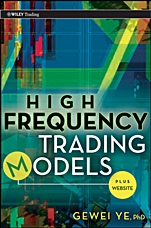
High Frequency Trading Models: + Website
ISBN 9780470633731
Autor: Gewei Ye
Wydawca: Wiley
Dostępność: 3-6 tygodni
Cena: 341,25 zł
Przed złożeniem zamówienia prosimy o kontakt mailowy celem potwierdzenia ceny.
ISBN13: |
9780470633731 |
ISBN10: |
0470633735 |
Autor: |
Gewei Ye |
Oprawa: |
Hardback |
Rok Wydania: |
2011-01-25 |
Ilość stron: |
336 |
Wymiary: |
236x155 |
Tematy: |
KF |
PRAISE FOR
HIGH–FREQUENCY TRADING MODELS
"In his new book, Dr. Ye develops fascinating cross–discipline applications and applies them in a high–frequency setting. Sentiment analysis is a particularly interesting subject included in the book."
—IRENE ALDRIDGE, quantitative portfolio manager and managing partner, Able Alpha Trading, Ltd., and author, High–Frequency Trading: A Practical Guide to Algorithmic Strategies and Trading Systems
"A very detailed discussion on the topic of high–frequency stock trading."
—KARYL B. LEGGIO, PhD, Dean, Sellinger School of Business and Management, Loyola University, Maryland
Filled with in–depth insights and expert advice, this reliable resource takes you through the technology, architecture, and algorithms underlying high–frequency trading models. Along the way, it skillfully covers a variety of issues, including existing revenue models; new revenue models, which include high–frequency trading in derivatives markets; theoretical models for building unique investment strategies for high–frequency trading; and computer algorithms for high–frequency trading and portfolio management.
And to enhance your understanding of the concepts covered within these pages, author Gewei Ye′s Web site, Yeswici.com—which is also a quantitative modeling and computing platform for innovative investment research—contains ancillary materials of the models and computer algorithms mentioned throughout this book.
Engaging and informative, High–Frequency Trading Models is a must–read for anyone who wants to make the most of their time in today′s dynamic markets.
Spis treści:
Preface.
Acknowledgments.
PART I Revenue Models of High–Frequency Trading.
CHAPTER 1 High–Frequency Trading and Existing Revenue Models.
What Is High–
Frequency Trading?
Why High–Frequency Trading Is Important.
Major High–Frequency Trading Firms in the United States.
Existing Revenue Models of High–Frequency Trading Operations.
Categorizing High–Frequency Trading Operations.
Conclusion.
CHAPTER 2 Roots of High–Frequency Trading in Revenue Models of Investment Management.
Revenue Model 1: Investing.
Revenue Model 2: Investment Banking.
Revenue Model 3: Market Making.
Revenue Model 4: Trading.
Revenue Model 5: Cash Management.
Revenue Model 6: Mergers and Acquisitions.
Revenue Model 7: Back–office Activities.
Revenue Model 8: Venture Capital.
Creating Your Own Revenue Model.
How to Achieve Success: Four Personal Drivers.
Conclusion.
CHAPTER 3 History and Future of High–Frequency Trading with Investment Management.
Revenue Models in the Future.
Investment Management and Financial Institutions.
High–Frequency Trading and Investment Management.
Technology Inventions to Drive Financial Inventions.
The Ultimate Goal for Models and Financial Inventions.
Conclusion.
PART II Theoretical Models as Foundation of Computer Algos for High–Frequency Trading.
CHAPTER 4 Behavioral Economics Models on Loss Aversion.
What Is Loss Aversion?
The Locus Effect.
Theory and Hypotheses.
Study 1: The Locus Effect on Inertia Equity.
Study 2: Assumption A1 and A2.
General Discussion.
Conclusion.
CHAPTER 5 Loss Aversion in Option Pricing: Integrating Two Nobel Models.
Demonstrating Loss Aversion with Computer Algos.
Visualizing the Findings.
Computer Algos for the Finding.
Explaining the Finding with the Black–Scholes Formula
Conclusion.
CHAPTER 6 Expanding the Size of Options in Option Pricing.
The NBA Event.
Web Data.
Theoretical Analysis.
The NBA Event and the Uncertainty Account.
Controlled Offline Data.
General Discussion.
Conclusion.
CHAPTER 7 Multinomial Models for Equity Returns.
Literature Review.
A Computational Framework: The MDP Model.
Implicit Consumer Decision Theory.
Empirical Approaches.
Analysis 1: Examination of Correlations and a Regression Model.
Analysis 2: Structural Equation Model.
Contributions of the ICD Theory.
Conclusion.
CHAPTER 8 More Multinomial Models and Signal Detection Models for Risk Propensity.
Multinomial Models for Retail Investor Growth.
Deriving Implicit Utility Functions.
Transforming Likeability Rating Data into Observed Frequencies.
Signal Detection Theory (SDT).
Assessing a Fund′s Performance with SDT.
Assessing Value at Risk with Risk Propensity of SDT for Portfolio Managers.
Defining Risk Propensity Surface.
Conclusion.
CHAPTER 9 Behavioral Economics Models on Fund Switching and Reference Prices.
What Is VisualFunds for Fund Switching?
Behavioral Factors That Affect Fund Switching.
Theory and Predictions.
Study 1: Arbitrary Anchoring on Inertia Equity.
Study 2: Anchor Competition.
Study 3: Double Log Law.
Conclusion.
PART III A Unique Model of Sentiment Asset Pricing Engine for Portfolio Management.
CHAPTER 10 A Sentiment Asset Pricing Model.
What Is Sentiment Asset Pricing Engine?
Contributions of SAPE.
Testing the Effectiveness of SAPE Algos.
Primary Users of SAPE.
Three Implementations of SAPE.
SAPE Extensions: TopTickEngine, FundEngine, PortfolioEngine, and TestEngine.
Summary on SAPE.
Alternative Assessment Tools of Macro Investor Sentiment.
Conclusion.
CHAPTER 11 SAPE for Portfolio Management—Effectiveness and Strategies.
Contributions of SAPE to Portfolio Management.
Intraday Evidence of SAPE Effectiveness.
Trading Strategies Based on the SAPE Funds.
Case Study 1: Execution of SAPE Investment Strategies.
Case Study 2: The Trad
ing Process with SAPE.
Case Study 3: Advanced Trading Strategies with SAPE.
Creating a Successful Fund with SAPE and High–Frequency Trading
Conclusion.
PART IV New Models of High–Frequency Trading.
CHAPTER 12 Derivatives.
What Is a Derivative?
Mortgage–Backed Securities: Linking Major Financial Institutions.
Credit Default Swaps.
Options and Option Values.
The Benefits of Using Options.
Profiting with Options.
New Profitable Financial Instruments by Writing Options.
The Black–Scholes Model As a Special Case of the Binomial Model.
Implied Volatility.
Volatility Smile.
Comparing Volatilities Over Time.
Forwards and Futures.
Pricing an Interest–Rate Swap with Prospect Theory.
The Behavioral Investing Based On Behavioral Economics.
Conclusion.
CHAPTER 13 Technology Infrastructure for Creating Computer Algos.
Web Hosting vs. Dedicated Web Servers.
Setting Up a Dedicated Web Server.
Developing Computer Algos.
Jump Starting Algo Development with PHP Programming.
Jump Starting Algo Development with Java Programming.
Jump Starting Algo Development with C++ Programming.
Jump Starting Algo Development with Flex Programming.
Jump Starting Algo Development with SQL.
Common UNIX/LINUX Commands for Algo Development.
Conclusion.
CHAPTER 14 Creating Computer Algos for High–Frequency Trading.
Getting Probability from Z Score.
Getting Z Scores from Probability.
Algos for the Sharpe Ratio.
Computing Net Present Value.
Developing a Flex User Interface for Computer Algos.
Algos for the Black–Scholes Model.
Computing Volatility with the ARCH Formula.
Algos for Monte Carlo Simulations.
Algos for an Efficient Portfolio Frontier.
Algos for Signal Detection Theory (SDT).
Conclusion.
Notes.
References.
About the Author.
Index.
Nota biograficzna:
GEWEI YE, PhD, t
eaches graduate–level courses on financial engineering, derivatives, and program trading strategies at Johns Hopkins University. Recently, he has released the Sentiment Asset Pricing Engine (SAPE), a Web–based strategy builder for algorithmic trading and high–frequency trading systems (http://sap.yeswici.com). Dr. Ye has been a senior architect or consultant for investment and technology companies such as CitiBank, T. Rowe Price, Federal Reserve Banks, and IBM. He has published about forty articles in peer–reviewed journals or conference proceedings and has been building financial models and computing systems for ten years. Dr. Ye earned a PhD degree from University of Tilburg, the Netherlands.
Okładka tylna:
PRAISE FOR
HIGH–FREQUENCY TRADING MODELS
"In his new book, Dr. Ye develops fascinating cross–discipline applications and applies them in a high–frequency setting. Sentiment analysis is a particularly interesting subject included in the book."
—IRENE ALDRIDGE, quantitative portfolio manager and managing partner, Able Alpha Trading, Ltd., and author, High–Frequency Trading: A Practical Guide to Algorithmic Strategies and Trading Systems
"A very detailed discussion on the topic of high–frequency stock trading."
—KARYL B. LEGGIO, PhD, Dean, Sellinger School of Business and Management, Loyola University, Maryland
Filled with in–depth insights and expert advice, this reliable resource takes you through the technology, architecture, and algorithms underlying high–frequency trading models. Along the way, it skillfully covers a variety of issues, including existing revenue models; new revenue models, which include high–frequency trading in derivatives markets; theoretical models for building unique investment strategies for high–frequency trading; and computer algorithms for high–frequency trading and
portfolio management.
And to enhance your understanding of the concepts covered within these pages, author Gewei Ye′s Web site, Yeswici.com—which is also a quantitative modeling and computing platform for innovative investment research—contains ancillary materials of the models and computer algorithms mentioned throughout this book.
Engaging and informative, High–Frequency Trading Models is a must–read for anyone who wants to make the most of their time in today′s dynamic markets.
Koszyk
Książek w koszyku: 0 szt.
Wartość zakupów: 0,00 zł
Informacje


Kontakt
Gambit
Centrum Oprogramowania
i Szkoleń Sp. z o.o.
Al. Pokoju 29b/22-24
31-564 Kraków
Siedziba Księgarni
ul. Kordylewskiego 1
31-542 Kraków
+48 12 410 5991
+48 12 410 5987
+48 12 410 5989
Subskrypcje
Administratorem danych osobowych jest firma Gambit COiS Sp. z o.o. Na podany adres będzie wysyłany wyłącznie biuletyn informacyjny.
Autoryzacja płatności

Informacje na temat autoryzacji płatności poprzez PayU.

© Copyright 2012: GAMBIT COiS Sp. z o.o. Wszelkie prawa zastrzeżone.
Projekt i wykonanie: Alchemia Studio Reklamy