


Wydawcy
Katalog tematyczny
- Archeologia (109)
- Ekonomia, finanse, business (13704)
- Filozofia (1445)
- Historia (3040)
- Języki i językoznawstwo (2356)
- Lifestyle, hobby i rozrywka (475)
- Medycyna (9704)
- Nauki humanistyczne (4)
- Nauki o Ziemi i środowisku (2638)
- Nauki ścisłe (20412)
- Nauki społeczne (8486)
- Nauki techniczne (13450)
- Budownictwo lądowe (1045)
- Chemia przemysłowa (2258)
- Elektronika i telekomunikacja (3287)
- Energetyka (1122)
- Inne nauki stosowane (363)
- Inżynieria biochemiczna (507)
- Inżynieria transportu (232)
- Mechanika i materiały (3316)
- Nauka o środowisku (321)
- Rolnictwo (507)
- Technika, ogólnie (475)
- Prawo (1696)
- Publikacje informacyjne i interdyscyplinarne (1288)
- Religia i wierzenia (917)
- Technika komputerowa (4067)
- Zdrowie, relacje międzyludzkie i rozwój osobisty (657)





Informacje szczegółowe o książce
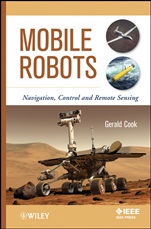
Mobile Robots: Navigation, Control and Remote Sensing
ISBN 9780470630211
Autor: Gerald Cook
Wydawca: Wiley
Dostępność: 3-6 tygodni
Cena: 526,05 zł
Przed złożeniem zamówienia prosimy o kontakt mailowy celem potwierdzenia ceny.
ISBN13: |
9780470630211 |
ISBN10: |
0470630213 |
Autor: |
Gerald Cook |
Oprawa: |
Hardback |
Rok Wydania: |
2011-07-19 |
Ilość stron: |
324 |
Wymiary: |
241x170 |
Tematy: |
TJ |
A unique, accessible guide on mobile robot applications
The use of mobile robots to sense objects of interest plays a vital role in our society, from its value in military maneuvers to the exploration of natural resources to search and rescue operations. Written by an expert in the field, this book is the only resource to explain all the major areas of mobile robot applications—control, navigation, and remote sensing—which are essential to not only detecting desired objects but also providing accurate information on their precise locations. The material can be readily applied to any type of ground vehicle.
In the controls area, both linear and nonlinear models of robot steering are presented. Through these applications, the reader is introduced to linearization and use of linear control design methods for control about a reference trajectory; use of Lyapunov stability theory for nonlinear control design; derivation of optimal control strategies via Pontryagin′s maximum principle; and derivation of a local coordinate system. In navigation, the global positioning system (GPS) is described in detail, as are inertial navigation systems (INS), which are treated in terms of their ability to provide vehicle position as well as altitude. In remote sensing methods, the author addresses the problem of ground registration of detected objects of interest, which provides essential information for any future actions (such as inspection or retrieval).
The book covers control of a robotic manipulator as well as airborne sensing and detection of objects on the ground. It also explains the use of optimal processing via the Kalman Filter when there are multiple detections of the same object, and the decision process of associating detections with the proper objects when tracking multiple objects.
The book′s clear presentation, numerous examples in each chapter, and references combine to make Mobile Robots a textbook for a one–semester elec
trical engineering graduate course on the same subject area. Since the topics covered in this volume cut across traditional curricular boundaries and bring together material from several engineering disciplines, this book also serves as a text for courses taught in mechanical or aerospace engineering, as well as a valuable resource for practicing engineers working in related areas.
Cover Images: (top circle) U.S. Air Force Global Hawk, an unmanned reconnaissance aircraft, photograph reproduced with permission of Airforce Link; (bottom circle) autonomous underwater vehicle, photo taken by an employee of Bluefin Robotics Corporation during U.S. Navy exercise from the HSV Swift; (lower panel) artist′s rendition of Mars Exploration Rover, image by Maas Digital LLC for Cornell University and NASA/JPL.
Spis treści:
Dedication.
Preface.
Introduction to Mobile Robots.
Ch 1. Kinematic Models for Mobile Robots.
1.0 Introduction.
1.1 Vehicles with front–wheel steering.
1.2 Vehicles with Differential–Drive Steering.
Ch 2. Mobile Robot Control.
2.0 Introduction.
2.1 Front–wheel Steered Vehicle, Heading Control.
2.2 Front–wheel steered vehicle, Speed control.
2.3 Control for the Differential–Drive Robot.
2.4 Reference Trajectory and Incremental Control, Front–Wheel Steered Robot.
2.5 Heading Control of Front–Wheel Steered Robot using the Nonlinear Model.
2.6 Computed Control for Heading and Velocity, Front–Wheel Steered Robot.
2.7 heading Control of Differential Drive Robot using the Nonlinear Model.
2.8 Computed Control for Heading and Velocity, Differential–Drive Robot.
2.9 Steering Control along a Path Using a Local Coordinate Frame.
2.10 Optimal Steering of Front–Wheel Steered Vehicle.
Ch 3. Robot Attitude.
3.0 Introduction.
3.1 Definition of yaw, pitch and roll.
3.2 Ro
tation matrix for Yaw.
3.3 Rotation Matrix for Pitch.
3.4 Rotation Matrix for Roll.
3.5 General Rotation Matrix.
3.6 Homogeneous Transformation.
3.7 Rotating a Vector.
Ch 4. Robot Navigation.
4.0 Introduction.
4.1 Introduction.
4.2 Earth–Centered Earth–Fixed Coordinate System.
4.3 Associated Coordinate Systems.
4.4 Universal Transverse Mercator (UTM) Coordinate System.
4.5 Global Positioning System.
4.6 Computing receiver location using GPS.
4.7 Array of GPS Antennas.
4.8 Gimballed Inertial Navigation Systems.
4.9 Strap–Down Inertial Navigation Systems.
4.10 Dead Reckoning or Deduced Reckoning.
4.11 Inclinometer/Compass.
Ch 5. Application of Kalman Filtering.
5.0 Introduction.
5.1 Estimating a fixed quantity using batch processing.
5.2 Estimating a fixed quantity using recursive processing.
5.3 Estimating the state of a dynamic system recursively.
5.4 Estimating the state of a Nonlinear Systems via the Extended Kalman Filter.
Ch 6. Remote Sensing.
6.0 Introduction.
6.1 Camera Type Sensors.
6.2 Stereo Vision.
6.3 Radar Sensing: Synthetic Aperture Radar (SAR).
6.4 Pointing of Range Sensor at Detected Object.
6.5 Detection Sensor in Scanning Mode.
Ch 7. Target Tracking Including Multiple Targets with Multiple Sensors.
7.0 Introduction.
7.1 Regions of Confidence for Sensors.
7.2 Model of Target Location.
7.3 Inventory of Detected Targets.
Ch 8. Obstacle Mapping and its Application to Robot Navigation.
8.0 Introduction.
8.1 Sensors for Obstacle Detection and Geo–registration.
8.2 Dead Reckoning Navigation.
8.3 Use of Previously Detected Obstacles for Navigation.
8.4 Simultaneous Corrections of Coordinates of Detected Obstacles and of the Robot.
Ch 9. Operating a Robotic Manipulator.
9.0 Introduction.
9.1 Forward Kinematic Equations.
9.2 Path Specification in Joint Space
.
9.3 Inverse Kinematic Equations.
9.4 Path Specification in Cartesian Space.
9.5 Velocity Relationships.
9.6 Forces and Torques.
Ch 10. Remote Sensing via UAV’s.
10.0 Introduction.
10.1 Mounting of Sensors.
10.2 Resolution of sensors.
10.3 Precision of vehicle instrumentation.
10.4 Overall geo–registration precision.
Appendix. Demonstrations of Undergraduate Student Robotic Projects.
A.1 Demonstration of the GEONAVOD Robot.
A.2 Demonstration of the Automatic Balancing Robotic Bicycle (ABRB).
Nota biograficzna:
GERALD COOK, ScD, is the Earle C. Williams Professor of Electrical Engineering and past chairman of electrical and computer engineering at George Mason University. He was previously chairman of electrical and biomedical engineering at Vanderbilt University and professor of electrical engineering at the University of Virginia. He is a Life Fellow of the Institute of Electrical and Electronics Engineers (IEEE), as well as a recipient of the IEEE Centennial Award and the IEEE Industrial Electronics Society (IES) Mittelmann Achievement Award. He is a former president of the IEEE Industrial Electronics Society and a former editor–in–chief of the IEEE Transactions on Industrial Electronics.
Okładka tylna:
A unique, accessible guide on mobile robot applications
The use of mobile robots to sense objects of interest plays a vital role in our society, from its value in military maneuvers to the exploration of natural resources to search and rescue operations. Written by an expert in the field, this book is the only resource to explain all the major areas of mobile robot applications—control, navigation, and remote sensing—which are essential to not only detecting desired objects but also providing accurate information on their precise locations. The material can be readily applied to any type of ground vehicle.
In th
e controls area, both linear and nonlinear models of robot steering are presented. Through these applications, the reader is introduced to linearization and use of linear control design methods for control about a reference trajectory; use of Lyapunov stability theory for nonlinear control design; derivation of optimal control strategies via Pontryagin′s maximum principle; and derivation of a local coordinate system. In navigation, the global positioning system (GPS) is described in detail, as are inertial navigation systems (INS), which are treated in terms of their ability to provide vehicle position as well as altitude. In remote sensing methods, the author addresses the problem of ground registration of detected objects of interest, which provides essential information for any future actions (such as inspection or retrieval).
The book covers control of a robotic manipulator as well as airborne sensing and detection of objects on the ground. It also explains the use of optimal processing via the Kalman Filter when there are multiple detections of the same object, and the decision process of associating detections with the proper objects when tracking multiple objects.
The book′s clear presentation, numerous examples in each chapter, and references combine to make Mobile Robots a textbook for a one–semester electrical engineering graduate course on the same subject area. Since the topics covered in this volume cut across traditional curricular boundaries and bring together material from several engineering disciplines, this book also serves as a text for courses taught in mechanical or aerospace engineering, as well as a valuable resource for practicing engineers working in related areas.
Cover Images: (top circle) U.S. Air Force Global Hawk, an unmanned reconnaissance aircraft, photograph reproduced with permission of Airforce Link; (bottom circle) autonomous underwater vehicle, photo taken by an employee of Bluefin Robotics Corporatio
n during U.S. Navy exercise from the HSV Swift; (lower panel) artist′s rendition of Mars Exploration Rover, image by Maas Digital LLC for Cornell University and NASA/JPL.
Koszyk
Książek w koszyku: 0 szt.
Wartość zakupów: 0,00 zł
Informacje


Kontakt
Gambit
Centrum Oprogramowania
i Szkoleń Sp. z o.o.
Al. Pokoju 29b/22-24
31-564 Kraków
Siedziba Księgarni
ul. Kordylewskiego 1
31-542 Kraków
+48 12 410 5991
+48 12 410 5987
+48 12 410 5989
Subskrypcje
Administratorem danych osobowych jest firma Gambit COiS Sp. z o.o. Na podany adres będzie wysyłany wyłącznie biuletyn informacyjny.
Autoryzacja płatności

Informacje na temat autoryzacji płatności poprzez PayU.

© Copyright 2012: GAMBIT COiS Sp. z o.o. Wszelkie prawa zastrzeżone.
Projekt i wykonanie: Alchemia Studio Reklamy