


Wydawcy
Katalog tematyczny
- Archeologia (109)
- Ekonomia, finanse, business (13704)
- Filozofia (1445)
- Historia (3040)
- Języki i językoznawstwo (2356)
- Lifestyle, hobby i rozrywka (475)
- Medycyna (9704)
- Nauki humanistyczne (4)
- Nauki o Ziemi i środowisku (2638)
- Nauki ścisłe (20412)
- Nauki społeczne (8486)
- Edukacja (229)
- Kryminologia, opieka spełeczna (284)
- Obronność (10)
- Polityka (1389)
- Psychologia (777)
- Socjologia (410)
- Społeczeństwo i kultura (187)
- Nauki techniczne (13450)
- Prawo (1696)
- Publikacje informacyjne i interdyscyplinarne (1288)
- Religia i wierzenia (917)
- Technika komputerowa (4067)
- Zdrowie, relacje międzyludzkie i rozwój osobisty (657)





Informacje szczegółowe o książce
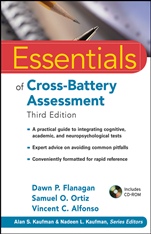
Essentials of Cross–Battery Assessment
ISBN 9780470621950
Autor: Dawn P. Flanagan, Samuel O. Ortiz, Vincent C. Alfonso, Alan S. Kaufman, Nadeen L. Kaufman
Wydawca: Wiley
Dostępność: 3-6 tygodni
Cena: 286,65 zł
Przed złożeniem zamówienia prosimy o kontakt mailowy celem potwierdzenia ceny.
ISBN13: |
9780470621950 |
ISBN10: |
0470621958 |
Autor: |
Dawn P. Flanagan, Samuel O. Ortiz, Vincent C. Alfonso, Alan S. Kaufman, Nadeen L. Kaufman |
Oprawa: |
Paperback |
Rok Wydania: |
2013-05-10 |
Numer Wydania: |
3rd Edition |
Ilość stron: |
576 |
Wymiary: |
214x142 |
Tematy: |
JC |
The Cross–Battery Assessment approach also referred to as the XBA approach is a time–efficient assessment method grounded solidly in contemporary theory and research. The XBA approach systematically integrates data across cognitive, achievement, and neuropsychological batteries, enabling practitioners to expand their traditional assessments to more comprehensively address referral concerns. This approach also includes guidelines for identification of specific learning disabilities and assessment of cognitive strengths and weaknesses in individuals from culturally and linguistically diverse backgrounds.
Like all the volumes in the Essentials of Psychological Assessment series, Essentials of Cross–Battery Assessment, Third Edition is designed to help busy practitioners quickly acquire the knowledge and skills they need to make optimal use of psychological assessment instruments. Each concise chapter features numerous callout boxes highlighting key concepts, bulleted points, and extensive illustrative material, as well as test questions that help you to gauge and reinforce your grasp of the information covered.
Essentials of Cross–Battery Assessment, Third Edition is updated to include the latest editions of cognitive ability batteries, such as the WISC–IV, WAIS–IV, and WJ III COG, and special purpose cognitive tests including the WMS–IV and TOMAL–II. This book now also covers many neuropsychological batteries such as the NEPSY–II and D–KEFS and provides extensive coverage of achievement batteries and special purpose tests, including the WIAT–III, KM–3, WRMT–III and TOWL–4. In all, this book includes over 100 psychological batteries and 750 subtests, all of which are classified according to CHC, and many according to neuropsychological theory. This useful guide includes a timesaving CD–ROM, Essential Tools for Cross–Battery Assessment (XBA) Applications and Interpretation, which allows users to enter data and review results and interpretive statements that may be included in psychological reports.
Clear guidance on integrating cognitive, academic and neuropsychological tests Expert advice on identifying specific learning disabilities Conveniently formatted for rapid referenceOther titles in the Essentials of Psychological Assessment series:
Essentials of Specific Learning Disability Identification Essentials of WAIS–IV Assessment, Second Edition Essentials of WISC–IV Assessment, Second Edition Essentials of WJ III Tests of Achievement Assessment Essentials of Processing Assessment Essentials of WJ III Cognitive Abilities Assessment, Second Edition Essentials of School Neuropsychological Assessment, Second Edition Essentials of Evidence–Based Academic InterventionsSeries Preface xiii
Acknowledgments xv
One Overview 1
Two How to Organize a Cross–Battery Assessment Using Cognitive, Achievement, and Neuropsychological Batteries 45
Three How to Interpret Test Data 121
Four Cross–Battery Assessment for SLD Identification: The Dual Discrepancy/Consistency Pattern of Strengths and Weaknesses in the Context of an Operational Definition 227
Five Cross–Battery Assessment of Individuals From Culturally and Linguistically Diverse Backgrounds 287
Six Strengths and Weaknesses of the Cross–Battery Assessment Approach 351
Seven Cross–Battery Assessment Case Report 365
Appendix A CHC Narrow Ability Definitions and Task Examples 389
Appendix B CHC Broad and Narrow Ability Classification Tables for Tests Published Between 2001 and 2012 399
Appendix C Descriptions of Cognitive, Achievement, and Neuropsychological Subtests by CHC Domain 417
Appendix D Critical Values for Statistical Significance and Base Rate for Composites on Comprehensive Cognitive and Achievement Batteries 425
Appendix E Variation in Task Demands and Task Characteristics of Subtests on Cognitive and Neuropsychological Batteries 431
Marlene Sotelo–Dynega and Tara Cuskley
Appendix F Variation in Task Demands and Task Characteristics of Subtests on Achievement Batteries by IDEA Academic Area 439
Jennifer T. Mascolo
Appendix G Neuropsychological Domain Classifications 445
Appendix H Understanding and Using the XBA PSW–A v1.0 Software Program Tab by Tab 457
Appendix I Cognitive and Neuropsychological Battery–Specific Culture–Language Matrices 485
Appendix J Cross–Battery Assessment Case Reports 503
Jim Hanson, John Garruto, and Karen Apgar
Appendix K Eugene, Oregon, School District Integrated Model for Specific Learning Disability Identification 505
Appendix L Summary of the Expert Consensus Study for Determining CHC Broad and Narrow Ability Classifications for Subtests New to This Edition 517
Appendix M Criteria Used in XBA DMIA v2.0 for Follow–Up on a Two–Subtest Composite 527
Author Index 533
Subject Index 537
About the Authors 553
About the CD 555
The CD–ROM contains the full versions of all Appendices; three software programs that analyze data (Cross–Battery Assessment Data Management and Interpretive Assistant, Pattern of Strengths and Weaknesses Analyzer, and Culture–Language Interpretive Matrix); and a form (Evaluation and Consideration of Exclusionary Factors for SLD Identification).
DAWN P. FLANAGAN, PhD, is Professor of Psychology at St. John′s University in Queens, NY, and Clinical Assistant Professor at the Yale Child Study Center, School of Medicine.
SAMUEL O. ORTIZ, PhD, is Associate Professor of Psychology at St. John′s University in Queens, NY.
VINCENT C. ALFONSO, PhD, is Professor of School Psychology in the Graduate School of Education at Fordham University, New York, New York.
Koszyk
Książek w koszyku: 0 szt.
Wartość zakupów: 0,00 zł
Informacje


Kontakt
Gambit
Centrum Oprogramowania
i Szkoleń Sp. z o.o.
Al. Pokoju 29b/22-24
31-564 Kraków
Siedziba Księgarni
ul. Kordylewskiego 1
31-542 Kraków
+48 12 410 5991
+48 12 410 5987
+48 12 410 5989
Subskrypcje
Administratorem danych osobowych jest firma Gambit COiS Sp. z o.o. Na podany adres będzie wysyłany wyłącznie biuletyn informacyjny.
Autoryzacja płatności

Informacje na temat autoryzacji płatności poprzez PayU.

© Copyright 2012: GAMBIT COiS Sp. z o.o. Wszelkie prawa zastrzeżone.
Projekt i wykonanie: Alchemia Studio Reklamy