


Wydawcy
Katalog tematyczny
- Archeologia (109)
- Ekonomia, finanse, business (13704)
- Filozofia (1445)
- Historia (3040)
- Języki i językoznawstwo (2356)
- Lifestyle, hobby i rozrywka (475)
- Medycyna (9704)
- Nauki humanistyczne (4)
- Nauki o Ziemi i środowisku (2638)
- Nauki ścisłe (20412)
- Nauki społeczne (8486)
- Nauki techniczne (13450)
- Budownictwo lądowe (1045)
- Chemia przemysłowa (2258)
- Elektronika i telekomunikacja (3287)
- Energetyka (1122)
- Inne nauki stosowane (363)
- Inżynieria biochemiczna (507)
- Inżynieria transportu (232)
- Mechanika i materiały (3316)
- Nauka o środowisku (321)
- Rolnictwo (507)
- Technika, ogólnie (475)
- Prawo (1696)
- Publikacje informacyjne i interdyscyplinarne (1288)
- Religia i wierzenia (917)
- Technika komputerowa (4067)
- Zdrowie, relacje międzyludzkie i rozwój osobisty (657)





Informacje szczegółowe o książce
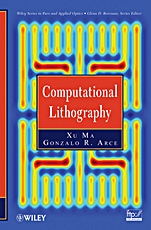
Computational Lithography
ISBN 9780470596975
Autor: Xu Ma, Gonzalo R. Arce
Wydawca: Wiley
Dostępność: 3-6 tygodni
Cena: 565,95 zł
Przed złożeniem zamówienia prosimy o kontakt mailowy celem potwierdzenia ceny.
ISBN13: |
9780470596975 |
ISBN10: |
047059697X |
Autor: |
Xu Ma, Gonzalo R. Arce |
Oprawa: |
Hardback |
Rok Wydania: |
2010-08-06 |
Ilość stron: |
244 |
Wymiary: |
245x166 |
Tematy: |
TJ |
This is the first book to address the optimization of resolution enhancement techniques in optical lithography. It provides an in–depth discussion of RET tools that use model–based mathematical optimization approaches. The book starts with an introduction of optical lithography systems, electric magnetic field principles, and fundamentals of optimization; it goes on to describe algorithms for the development of optimal optical proximity correction, phaseshifting mask, offaxis illumination approaches, and their combinations. The accompanying mathematical derivations and MATLAB® software files make it easy for researchers, scientists, engineers, and graduate students and faculty to apply any of the optimization algorithms.
Spis treści:
Preface.
Acknowledgments.
Acronyms.
1 Introduction.
1.1 Optical Lithography.
1.1.1 Optical Lithography and Integrated Circuits.
1.1.2 Brief History of Optical Lithography Systems.
1.2 Rayleigh’s Resolution.
1.3 Resist Processes and Characteristics.
1.4 Techniques in Computational Lithography.
1.4.1 Optical Proximity Correction.
1.4.2 Phase Shifting Masks.
1.4.3 Offaxis Illumination.
1.4.4 Second Generation RETs.
1.5 Outline.
2 Optical Lithography Systems.
2.1 Partially Coherent Imaging Systems.
2.1.1 Abbe’s Model.
2.1.2 Hopkins Diffraction Model.
2.1.3 Coherent and Incoherent Imaging Systems.
2.2 Approximation Models.
2.2.1 Fourier Series Expansion Model.
2.2.2 Singular Value Decomposition Model.
2.2.3 Average Coherent Approximation Model.
2.2.4 Discussion and Comparison.
2.3 Summary.
3 Rule–based Resolution Enhancement Techniques.
3.1 RET Types.
3.1.1 Rule–based RETs.
3.1.2 Model–based RETs.
3.1.3 Hybrid RETs.
3.2 Rule–based OPC.
3.2.1 Catastrophic OPC.
3.2.2 One–dimensional OPC.
3.2.3 Line–shortening Reduction OPC.
3.2.4
Two–dimensional OPC.
3.3 Rule–based PSM.
3.3.1 Dark–field Application.
3.3.2 Light–field Application.
3.4 Rule–based OAI.
3.5 Summary.
4 Fundamentals of Optimization.
4.1 Definition and Classification.
4.1.1 Definitions in The Optimization Problem.
4.1.2 Classification of Optimization Problems.
4.2 Unconstrained Optimization.
4.2.1 Solution of Unconstrained Optimization Problem.
4.2.2 Unconstrained Optimization Algorithms.
4.3 Summary.
5 Computational Lithography with Coherent Illumination.
5.1 Problem Formulation.
5.2 OPC Optimization.
5.2.1 OPC Design Algorithm.
5.2.2 Simulations.
5.3 Two–phase PSM Optimization.
5.3.1 Two–phase PSM Design Algorithm.
5.3.2 Simulations.
5.4 Generalized PSM Optimization.
5.4.1 Generalized PSM Design Algorithm.
5.4.2 Simulations.
5.5 Resist Modeling Effects.
5.6 Summary.
6 Regularization Framework.
6.1 Discretization Penalty.
6.1.1 Discretization Penalty for OPC Optimization.
6.1.2 Discretization Penalty for Two–phase PSM Optimization.
6.1.3 Discretization Penalty for Generalized PSM Optimization.
6.2 Complexity Penalty.
6.2.1 Total Variation Penalty.
6.2.2 Global Wavelet Penalty.
6.2.3 Localized Wavelet Penalty.
6.3 Summary.
7 Computational Lithography with Partially Coherent Illumination.
7.1 OPC Optimization.
7.1.1 OPC Design Algorithm using the Fourier Series Expansion Model.
7.1.2 Simulations using the Fourier Series Expansion Model.
7.1.3 OPC Design Algorithm using the Average Coherent Approximation Model.
7.1.4 Simulations using the Average Coherent Approximation Model.
7.1.5 Discussion and Comparison.
7.2 PSM Optimization.
7.2.1 PSM Design Algorithm using the Singular Value Decomposition Model.
7.2.2 Discretization Regularization for PSM Design Algorithm.
7.2.3 Simulations.
7.3 Summary.
8 Other RET Optim
ization Techniques.
8.1 Double Patterning Method.
8.2 Post–Processing based on 2D DCT.
8.3 Photoresist Tone Reversing Method.
8.4 Summary.
9 Source and Mask Optimization.
9.1 Lithography Preliminaries.
9.2 Topological Constraint.
9.3 Source Mask Optimization Algorithm.
9.4 Simulations.
9.5 Summary.
10 Coherent Thickmask Optimization.
10.1 Kirchhoff Boundary Conditions.
10.2 Boundary Layer Model.
10.2.1 Boundary Layer Model in Coherent Imaging Systems.
10.2.2 Boundary Layer Model in Partially Coherent Imaging Systems.
10.3 Lithography Preliminaries.
10.4 OPC Optimization.
10.4.1 Topological Constraint.
10.4.2 OPC Optimization Algorithm based on BL Model under Coherent Illumination.
10.4.3 Simulations.
10.5 PSM Optimization.
10.5.1 Topological Constraint.
10.5.2 PSM Optimization Algorithm based on BL Model under Coherent Illumination.
10.5.3 Simulations.
10.6 Summary.
11 Conclusions and New Directions of Computational Lithography.
11.1 Conclusion.
11.2 New Directions of Computational Lithography.
Appendix A Formula derivation in Chapter 5.
Appendix B Manhattan geometry.
Appendix C Formula derivation in Chapter 6.
Appendix D Formula derivation in Chapter 7.
Appendix E Formula derivation in Chapter 8.
Appendix F Formula derivation in Chapter 9.
Appendix G Formula derivation in Chapter 10.
Appendix H Software Guide.
References.
Index.
Koszyk
Książek w koszyku: 0 szt.
Wartość zakupów: 0,00 zł
Informacje


Kontakt
Gambit
Centrum Oprogramowania
i Szkoleń Sp. z o.o.
Al. Pokoju 29b/22-24
31-564 Kraków
Siedziba Księgarni
ul. Kordylewskiego 1
31-542 Kraków
+48 12 410 5991
+48 12 410 5987
+48 12 410 5989
Subskrypcje
Administratorem danych osobowych jest firma Gambit COiS Sp. z o.o. Na podany adres będzie wysyłany wyłącznie biuletyn informacyjny.
Autoryzacja płatności

Informacje na temat autoryzacji płatności poprzez PayU.

© Copyright 2012: GAMBIT COiS Sp. z o.o. Wszelkie prawa zastrzeżone.
Projekt i wykonanie: Alchemia Studio Reklamy