


Wydawcy
Katalog tematyczny
- Archeologia (109)
- Ekonomia, finanse, business (13704)
- Filozofia (1445)
- Historia (3040)
- Języki i językoznawstwo (2356)
- Lifestyle, hobby i rozrywka (475)
- Medycyna (9704)
- Nauki humanistyczne (4)
- Nauki o Ziemi i środowisku (2638)
- Nauki ścisłe (20412)
- Nauki społeczne (8486)
- Nauki techniczne (13450)
- Budownictwo lądowe (1045)
- Chemia przemysłowa (2258)
- Elektronika i telekomunikacja (3287)
- Energetyka (1122)
- Inne nauki stosowane (363)
- Inżynieria biochemiczna (507)
- Inżynieria transportu (232)
- Mechanika i materiały (3316)
- Nauka o środowisku (321)
- Rolnictwo (507)
- Technika, ogólnie (475)
- Prawo (1696)
- Publikacje informacyjne i interdyscyplinarne (1288)
- Religia i wierzenia (917)
- Technika komputerowa (4067)
- Zdrowie, relacje międzyludzkie i rozwój osobisty (657)





Informacje szczegółowe o książce
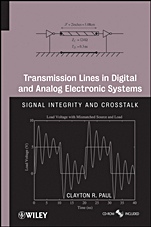
Transmission Lines in Digital and Analog Electronic Systems: Signal Integrity and Crosstalk
ISBN 9780470592304
Autor: Clayton R. Paul
Wydawca: Wiley
Dostępność: 3-6 tygodni
Cena: 565,95 zł
Przed złożeniem zamówienia prosimy o kontakt mailowy celem potwierdzenia ceny.
ISBN13: |
9780470592304 |
ISBN10: |
0470592303 |
Autor: |
Clayton R. Paul |
Oprawa: |
Hardback |
Rok Wydania: |
2010-10-01 |
Ilość stron: |
312 |
Wymiary: |
243x166 |
Tematy: |
TJ |
In the last 30 years there have been dramatic changes in electrical technology––yet the length of the undergraduate curriculum has remained four years. Until some ten years ago, the analysis of transmission lines was a standard topic in the EE and CpE undergraduate curricula. Today most of the undergraduate curricula contain a rather brief study of the analysis of transmission lines in a one–semester junior–level course on electromagnetics. In some schools, this study of transmission lines is relegated to a senior technical elective or has disappeared from the curriculum altogether. This raises a serious problem in the preparation of EE and CpE undergraduates to be competent in the modern industrial world. For the reasons mentioned above, today′s undergraduates lack the basic skills to design high–speed digital and high–frequency analog systems. It does little good to write sophisticated software if the hardware is unable to process the instructions. This problem will increase as the speeds and frequencies of these systems continue to increase seemingly without bound. This book is meant to repair that basic deficiency.
Spis treści:
Chapter 1 Basic Skills and Concepts Having Application to Transmission Lines.
1.1 Units and Unit Conversion.
1.2 Waves, Time Delay, Phase Shift, Wavelength, and Electrical Dimensions.
1.3 The Time Domain vs. the Frequency Domain.
1.3.1 Spectra of Digital Signals.
1.3.2 Bandwidth of Digital Signals.
1.3.3 Computing the Time–Domain Response of Transmission Lines Having Linear Terminations Using Fourier Methods and Superposition.
1.4 The Basic Transmission Line Problem.
1.4.1 Two–Conductor Transmission Lines and Signal Integrity.
1.4.2 Multiconductor Transmission Lines and Crosstalk.
Part I Two–Conductor Lines and Signal Integrity.
Chapter 2
Time–Domain Analysis of Two–Conductor Lines.
2.1 The Transverse ElectroMagnetic (TEM) Mode of Propagation and the Transmission–Line Equations.
2.2 The Per–Unit–Length Parameters.
2.2.1 Wire–Type Lines.
2.2.2 Lines of Rectangular Cross Section.
2.3 The General Solutions for the Line Voltage and Current.
2.4 Wave Tracing and Reflection Coefficients.
2.5 The SPICE (PSPICE) Exact Transmission–Line Model.
2.6 Lumped–Circuit Approximate Models of the Line.
2.7 Effects of Reactive Terminations on Terminal Waveforms.
2.7.1 Effect of Capacitive Terminations.
2.7.2 Effect of Inductive Terminations.
2.8 Matching Schemes for Signal Integrity.
2.9 When Does the Line Not Matter?.
2.10 Effect of Line Discontinuities.
2.11 Driving Multiple Lines.
Chapter 3 Frequency–Domain Analysis of Two–Conductor Lines.
3.1 The Transmission–Line Equations for Sinusoidal, Steady–State Excitation of the Line.
3.2. The General Solution for the Terminal Voltages and Currents.
3.3 The Voltage Reflection Coefficient and Input Impedance to the LIne.
3.4 The Input Impedance to the Line.
3.5 The SPICE Solution.
3.6 Voltage and Current as a Function of Position on the Line.
3.7 Matching and VSWR.
3.8 Power Flow on the Line.
3.9 Alternative Forms of the Results.
3.10 The Smith Chart.
3.11 Effects of Line Losses.
3.12 Lumped–Circuit Approximate Models of the Line.
3.13 Construction of Microwave Circuit Components Using Transmission Lines.
Part II Three–Conductor Lines and Crosstalk.
Chapter 4 The Transmission–Line Equations for Three–Conductor Lines.
4.1 The Transmission–Line Equations for Three–Conductor Lines.
4.2 The Per–Unit–Length Parameters.
4.2.1 Wide–Separation Approximations for Wires.
4.2.2 Numerical Methods.
4.2.2.1 Wires with Dielectric Insu
lations (Ribbon Cables).
4.2.2.2 Conductors Having Rectangular Cross Section (PCB Lands).
Chapter 5 Solution of the Transmission–Line Equations for Lossless, Three–Conductor Lines.
5.1 Decoupling the Transmission–Line Equations with Mode Transformations.
5.2 The SPICE Subcircuit Model.
5.3 Lumped–Circuit Approximate Models of the Line.
5.4 The Inductive–Capacitive Coupling Approximate Model.
Chapter 6 Solution of the Transmission–Line Equations for Lossy, Three–Conductor Lines.
6.1 The Transmission–Line Equations for Three–Conductor, Lossy Lines.
6.2 Characterization of Conductor and Dielectric Losses.
6.2.1 Conductor Losses and Skin Effect.
6.2.2 Dielectric Losses.
6.3 Solution of the Phasor (Frequency–Domain) Transmission–Line Equations for a Lossy, Three–Conductor Line.
6.4 Common–Impedance Coupling.
6.5 The Time–Domain to Frequency–Domain (TDFD) Method.
Appendix A Brief Tutorial on Using PSPICE.
Koszyk
Książek w koszyku: 0 szt.
Wartość zakupów: 0,00 zł
Informacje


Kontakt
Gambit
Centrum Oprogramowania
i Szkoleń Sp. z o.o.
Al. Pokoju 29b/22-24
31-564 Kraków
Siedziba Księgarni
ul. Kordylewskiego 1
31-542 Kraków
+48 12 410 5991
+48 12 410 5987
+48 12 410 5989
Subskrypcje
Administratorem danych osobowych jest firma Gambit COiS Sp. z o.o. Na podany adres będzie wysyłany wyłącznie biuletyn informacyjny.
Autoryzacja płatności

Informacje na temat autoryzacji płatności poprzez PayU.

© Copyright 2012: GAMBIT COiS Sp. z o.o. Wszelkie prawa zastrzeżone.
Projekt i wykonanie: Alchemia Studio Reklamy