


Wydawcy
Katalog tematyczny
- Archeologia (109)
- Ekonomia, finanse, business (13704)
- Filozofia (1445)
- Historia (3040)
- Języki i językoznawstwo (2356)
- Lifestyle, hobby i rozrywka (475)
- Medycyna (9704)
- Nauki humanistyczne (4)
- Nauki o Ziemi i środowisku (2638)
- Nauki ścisłe (20412)
- Astronomia (294)
- Biologia (5119)
- Chemia (6540)
- Chemia analityczna (361)
- Chemia fizyczna (346)
- Chemia nieorganiczna (137)
- Chemia organiczna (535)
- Krystalografia (27)
- Minerologia (46)
- Fizyka (3309)
- Matematyka (4574)
- Nauki ścisłe, ogólnie (503)
- Nauki społeczne (8486)
- Nauki techniczne (13450)
- Prawo (1696)
- Publikacje informacyjne i interdyscyplinarne (1288)
- Religia i wierzenia (917)
- Technika komputerowa (4067)
- Zdrowie, relacje międzyludzkie i rozwój osobisty (657)





Informacje szczegółowe o książce
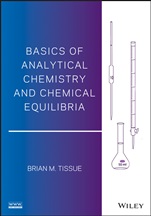
Basics of Analytical Chemistry and Chemical Equilibria
ISBN 9780470592083
Autor: Brian M. Tissue
Wydawca: Wiley
Dostępność: 3-6 tygodni
Cena: 367,50 zł
Przed złożeniem zamówienia prosimy o kontakt mailowy celem potwierdzenia ceny.
ISBN13: |
9780470592083 |
ISBN10: |
0470592087 |
Autor: |
Brian M. Tissue |
Oprawa: |
Paperback |
Rok Wydania: |
2013-08-30 |
Ilość stron: |
426 |
Wymiary: |
252x180 |
Tematy: |
PN |
Enables students to progressively build and apply new skills and knowledge Designed to be completed in one semester, this text enables students to fully grasp and apply the core concepts of analytical chemistry and aqueous chemical equilibria. Moreover, the text enables readers to master common instrumental methods to perform a broad range of quantitative analyses. Author Brian Tissue has written and structured the text so that readers progressively build their knowledge, beginning with the most fundamental concepts and then continually applying these concepts as they advance to more sophisticated theories and applications. Basics of Analytical Chemistry and Chemical Equilibria is clearly written and easy to follow, with plenty of examples to help readers better understand both concepts and applications. In addition, there are several pedagogical features that enhance the learning experience, including: Emphasis on correct IUPAC terminology "You-Try-It" spreadsheets throughout the text, challenging readers to apply their newfound knowledge and skills Online tutorials to build readers' skills and assist them in working with the text's spreadsheets Links to analytical methods and instrument suppliers Figures illustrating principles of analytical chemistry and chemical equilibria End-of-chapter exercises Basics of Analytical Chemistry and Chemical Equilibria is written for undergraduate students who have completed a basic course in general chemistry. In addition to chemistry students, this text provides an essential foundation in analytical chemistry needed by students and practitioners in biochemistry, environmental science, chemical engineering, materials science, nutrition, agriculture, and the life sciences.
I Quantitative analysis using reactions that go to \completion 3 1 Making Measurements 5 1.1 Introduction 5 1.2 GLP and a Few Other Important Acronyms 11 1.3 Precision and Random Error 17 1.4 Discarding a Suspected Outlier 27 1.5 Calibration 30 1.6 Maintaining Accurate Results 44 Practice Exercises 50 2 Sample Preparation, Extractions, and Chromatography 55 2.1 Sampling and Control Samples 55 2.2 Sample Preparation 59 2.3 Solvents and Solutions 65 2.4 Introduction to Solubility 69 2.5 Extraction 72 2.6 Stationary Phases 82 2.7 Solid–Phase Extraction (SPE) 88 2.8 Introduction to Chromatography 90 2.9 Immunoassays 94 Practice Exercises 96 3 Classical Methods 103 3.1 Introduction 103 3.2 Review of Chemical Reactions 105 3.3 Reactions in Aqueous Solution 112 3.4 Gravimetry 121 3.5 Titration 125 3.6 Titration Curves 132 3.7 Coulometry 133 Practice Exercises 136 4 Molecular Spectroscopy 141 4.1 Introduction 141 4.2 Properties of Electromagnetic Radiation 142 4.3 Electromagnetic Spectrum 145 4.4 Spectroscopic Transitions 147 4.5 UV/Vis Absorption Spectroscopy 151 4.6 UV/Vis Instrumentation 152 4.7 Beer–Lambert Law 154 4.8 Molecular Fluorescence 160 Practice Exercises 164 II Reactions that do not go to\completion." Equilibria in aqueous solu–tions 171 5 Acid–Base Equilibria and Activity 173 5.1 Acids and Bases 173 5.2 Weak Acids and Weak Bases 180 5.3 Water and Kw 185 5.4 Acid Strength 191 5.5 The Concept of Activity 199 5.6 Acid–Base Equilibrium Calculations 211 Practice Exercises 219 6 Buffer Solutions and Polyprotic Acids 223 6.1 Buffer Solutions 223 6.2 Alpha Fraction Plots 229 6.3 Weak Acid Titration Curve 233 6.4 Polyprotic Acids 235 Practice Exercises 245 7 Complexation and Precipitation Equilibria 249 7.1 Complex Terminology 250 7.2 Complex Equilibria 253 7.3 Competing Equilibria 261 7.4 Stepwise Complexation 267 7.5 Precipitate Equilibrium 272 7.6 Molar Solubility 281 7.7 Precipitation and Competing Equilibria 289 Practice Exercises 296 Instrumental methods and analytical separations 303 8 Electroanalytical Chemistry 305 8.1 Introduction 305 8.2 Standard Reduction Potentials 308 8.3 Using Half Reactions 313 8.4 Background on Spontaneous Reactions and Equilibrium 320 8.5 Reaction Energies, Voltages, and the Nernst Equation 322 8.6 Electrochemical Cells 326 8.7 Potentiometry 330 8.8 Ion–Selective Electrodes (ISE) 333 8.9 Voltammetry 339 Practice Exercises 346 9 Atomic Spectrometry 351 9.1 Atomization 352 9.2 Atomic Absorption Spectrometry (AAS) 356 9.3 Atomic Emission spectrometry (AES) 363 9.4 Introduction to Mass Spectrometry (MS) 365 9.5 ICP–MS Measurements 368 9.6 Summary 369 Practice Exercises 371 10 Analytical Separations 377 10.1 Thin–Layer Chromatography 378 10.2 Chromatogram Terminology 381 10.3 Column Selection 384 10.4 High Performance Liquid Chromatography 388 10.5 Gas Chromatography 395 10.6 Molecular Mass Spectrometry 398 10.7 Electrophoresis 405 Practice Exercises 409
BRIAN M. TISSUE, PhD, is Associate Professor of Chemistry at Virginia Tech, where he teaches analytical chemistry at both the undergraduate and graduate levels. In addition to curriculum development, Dr. Tissue oversees a research program in nanomaterials and analytical spectroscopy, preparing and testing nanocomposites for catalytic activity. Among his honors, Dr. Tissue has received an NSF Career Award and a Cottrell Scholar Award from the Research Corporation for Science Advancement.
Koszyk
Książek w koszyku: 0 szt.
Wartość zakupów: 0,00 zł
Informacje


Kontakt
Gambit
Centrum Oprogramowania
i Szkoleń Sp. z o.o.
Al. Pokoju 29b/22-24
31-564 Kraków
Siedziba Księgarni
ul. Kordylewskiego 1
31-542 Kraków
+48 12 410 5991
+48 12 410 5987
+48 12 410 5989
Subskrypcje
Administratorem danych osobowych jest firma Gambit COiS Sp. z o.o. Na podany adres będzie wysyłany wyłącznie biuletyn informacyjny.
Autoryzacja płatności

Informacje na temat autoryzacji płatności poprzez PayU.

© Copyright 2012: GAMBIT COiS Sp. z o.o. Wszelkie prawa zastrzeżone.
Projekt i wykonanie: Alchemia Studio Reklamy