


Wydawcy
Katalog tematyczny
- Archeologia (109)
- Ekonomia, finanse, business (13704)
- Filozofia (1445)
- Historia (3040)
- Języki i językoznawstwo (2356)
- Lifestyle, hobby i rozrywka (475)
- Medycyna (9704)
- Nauki humanistyczne (4)
- Nauki o Ziemi i środowisku (2638)
- Nauki ścisłe (20412)
- Astronomia (294)
- Biologia (5119)
- Chemia (6540)
- Chemia analityczna (361)
- Chemia fizyczna (346)
- Chemia nieorganiczna (137)
- Chemia organiczna (535)
- Krystalografia (27)
- Minerologia (46)
- Fizyka (3309)
- Matematyka (4574)
- Nauki ścisłe, ogólnie (503)
- Nauki społeczne (8486)
- Nauki techniczne (13450)
- Prawo (1696)
- Publikacje informacyjne i interdyscyplinarne (1288)
- Religia i wierzenia (917)
- Technika komputerowa (4067)
- Zdrowie, relacje międzyludzkie i rozwój osobisty (657)





Informacje szczegółowe o książce
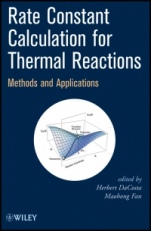
Rate Constant Calculation for Thermal Reactions: Methods and Applications
ISBN 9780470582305
Autor: Herbert DaCosta, Maohong Fan
Wydawca: Wiley
Dostępność: 3-6 tygodni
Cena: 708,75 zł
Przed złożeniem zamówienia prosimy o kontakt mailowy celem potwierdzenia ceny.
ISBN13: |
9780470582305 |
ISBN10: |
0470582308 |
Autor: |
Herbert DaCosta, Maohong Fan |
Oprawa: |
Hardback |
Rok Wydania: |
2012-02-20 |
Ilość stron: |
360 |
Wymiary: |
242x160 |
Tematy: |
PN |
A comprehensive overview of cutting–edge computationalapproaches to estimating rate constants for thermal reactions andtheir applications
When modeling and simulating chemical reactions, researchers areoften forced to choose between using time–consuming but moreaccurate techniques or faster but less precise approaches. RateConstant Calculation for Thermal Reactions: Methods andApplications covers both, showing how different methods can be usedacross a range of different applications.
Including coverage of the theories behind the assortedfirst–principle and approximation methods that have emerged overthe last twenty years examined by major leaders in the field, thebook provides detailed examples of the numerous applications ofthese theories to a wide variety of basic and applied researchareas. These include the study of fuel combustion, unimolecular andbimolecular reactions, liquid solutions, polymerization, and manymore.
A valuable resource for anyone in academia or industry workingin physical chemistry, chemical engineering, or relatedfields such as fuel and automotive sciences RateConstant Calculation for Thermal Reactions makes computationalapproaches to thermal reaction theory accessible by tying themdirectly to real–world applications.
PREFACE xiii
Herbert DaCosta and Maohong Fan
CONTRIBUTORS xv
PART I METHODS 1
1. Overview of Thermochemistry and Its Application toReaction Kinetics 3
Elke Goos and Alexander Burcat
1.1. History of Thermochemistry 3
1.2. Thermochemical Properties 5
1.3. Consequences of Thermodynamic Laws to Chemical Kinetics8
1.4. How to Get Thermochemical Values? 10
1.5. Accuracy of Thermochemical Values 16
1.6. Representation of Thermochemical Data for Use inEngineering Applications 21
1.7. Thermochemical Databases 26
1.8. Conclusion 27
2. Calculation of Kinetic Data Using Computational Methods33
Fernando P. Cossío
2.1. Introduction 33
2.2. Stationary Points and Potential Energy Hypersurfaces 34
2.3. Calculation of Reaction and Activation Energies: Levels ofTheory and Solvent Effects 38
2.4. Estimate of Relative Free Energies: Standard States 47
2.5. Theoretical Approximate Kinetic Constants and Treatment ofData 50
2.6. Selected Examples 51
2.7. Conclusions and Outlook 61
3. Quantum Instanton Evaluation of the Kinetic IsotopeEffects and of the Temperature Dependence of the Rate Constant67
Jiøí Vanícek
3.1. Introduction 67
3.2. Arrhenius Equation, Transition State Theory, and the WignerTunneling Correction 68
3.3. Quantum Instanton Approximation for the Rate Constant69
3.4. Kinetic Isotope Effects 71
3.5. Temperature Dependence of the Rate Constant 73
3.6. Path Integral Representation of Relevant Quantities 75
3.7. Examples 81
3.8. Summary 88
4. Activation Energies in Computational Chemistry ACase Study 93
Michael Busch, Elisabet Ahlberg and Itai Panas
4.1. Introduction 93
4.2. Context and Theoretical Background 95
4.3. Computational Details 99
4.4. Recent Advances and New Results 99
4.5. Concluding Remarks 107
5. No Barrier Theory A New Approach to Calculating RateConstants in Solution 113
J. Peter Guthrie
5.1. Introduction 113
5.2. The Idea Behind No Barrier Theory 114
5.3. How to Define the Surface and Find the Transition State118
5.4. What is Needed for a Calculation? 124
5.5. Applications to Date 125
5.6. Future Prospects for NBT 140
PART II MINIREVIEWS AND APPLICATIONS 147
6. Quantum Chemical and Rate Constant Calculations of ThermalIsomerizations, Decompositions, and Ring Expansions of Organic RingCompounds, Its Significance to Cohbusion Kinetics 149
Faina Dubnikova and Assa Lifshitz
6.1. Prologue 149
6.2. Small Organic Ring Compounds 152
6.3. Pyrrole and Indole 156
6.4. Dihydrofurans and Dihydrobenzofurans 160
6.5. Naphthyl Acetylene Naphthyl Ethylene 166
6.6. Ring Expansion Processes 168
6.7. Benzoxazole Benzisoxazoles 173
6.8. Conclusion 181
7. Challenges in the Computation of Rate Constants for LigninModel Compounds 191
Ariana Beste and A.C. Buchanan, III
7.1. Lignin: A Renewable Source of Fuels and Chemicals 191
7.2. Mechanistic Study of Lignin Model Compounds 196
7.3. Computational Investigation of the Pyrolysis of –O–4Model Compounds 201
7.4. Case Studies: Substituent Effects on Reactions of PhenethylPhenyl Ethers 214
7.5. Conclusions and Outlook 232
8. Quantum Chemistry Study on the Pyrolysis Mechanisms ofCoal–Related Model Compounds 239
Baojun Wang, Riguang Zhang and Lixia Ling
8.1. Introduction to the Application of Quantum ChemistryCalculation to Investigation on Models of Coal Structure 239
8.2. The Model for Coal Structure and Calculation Methods240
8.3. The Pyrolysis Mechanisms of Coal–Related Model Compounds243
8.4. Conclusion 276
9. Ab Initio Kinetic Modeling of Free–RadicalPolymerization 283
Michelle L. Coote
9.1. Introduction 283
9.2. Ab Initio Kinetic Modeling 287
9.3. Quantum Chemical Methodology 291
9.4. Case Study: RAFT Polymerization 296
9.5. Outlook 300
10. Intermolecular Electron Transfer Reactivity for OrganicCompounds Studied Using Marcus Cross–Rate Theory 305
Stephen F. Nelsen and Jack R. Pladziewicz
10.1. Introduction 305
10.2. Determination of G ii (fit) Values307
10.3. Why is the Success of Cross–Rate Theory Surprising?309
10.4. Major Factors Determining Intrinsic Reactivities ofHydrazine Couples 310
10.5. Nonhydrazine Couples 315
10.6. Comparison ofD G ii (fit) withD G ii (self)Values 318
10.7. Estimation of Hab from Experimental Exchange RateConstants and DFT–Computed l 320
10.8. Comparison with Gas–Phase Reactions 333
10.9. Conclusions 333
References 334
INDEX 337
Herbert DaCosta is currently a principal consultant atChem–Innovations LLC and an adjunct professor of chemistry atIllinois Central College. His research interests includeenvironmental catalysis and clean energy, nanomaterial design andsynthesis, computational chemistry, and kinetics.
Maohong Fan is Associate Professor at the University ofWyoming and an adjunct associate professor at the Georgia Instituteof Technology. His research interests include nanomaterialsynthesis and application, green processes for chemical production,and new approaches to clean energy generation.
Koszyk
Książek w koszyku: 0 szt.
Wartość zakupów: 0,00 zł
Informacje


Kontakt
Gambit
Centrum Oprogramowania
i Szkoleń Sp. z o.o.
Al. Pokoju 29b/22-24
31-564 Kraków
Siedziba Księgarni
ul. Kordylewskiego 1
31-542 Kraków
+48 12 410 5991
+48 12 410 5987
+48 12 410 5989
Subskrypcje
Administratorem danych osobowych jest firma Gambit COiS Sp. z o.o. Na podany adres będzie wysyłany wyłącznie biuletyn informacyjny.
Autoryzacja płatności

Informacje na temat autoryzacji płatności poprzez PayU.

© Copyright 2012: GAMBIT COiS Sp. z o.o. Wszelkie prawa zastrzeżone.
Projekt i wykonanie: Alchemia Studio Reklamy