


Wydawcy
Katalog tematyczny
- Archeologia (109)
- Ekonomia, finanse, business (13704)
- Filozofia (1445)
- Historia (3040)
- Języki i językoznawstwo (2356)
- Lifestyle, hobby i rozrywka (475)
- Medycyna (9704)
- Nauki humanistyczne (4)
- Nauki o Ziemi i środowisku (2638)
- Nauki ścisłe (20412)
- Nauki społeczne (8486)
- Nauki techniczne (13450)
- Budownictwo lądowe (1045)
- Chemia przemysłowa (2258)
- Elektronika i telekomunikacja (3287)
- Energetyka (1122)
- Inne nauki stosowane (363)
- Inżynieria biochemiczna (507)
- Inżynieria transportu (232)
- Mechanika i materiały (3316)
- Nauka o środowisku (321)
- Rolnictwo (507)
- Technika, ogólnie (475)
- Prawo (1696)
- Publikacje informacyjne i interdyscyplinarne (1288)
- Religia i wierzenia (917)
- Technika komputerowa (4067)
- Zdrowie, relacje międzyludzkie i rozwój osobisty (657)





Informacje szczegółowe o książce
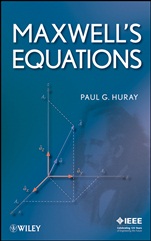
Maxwells Equations
ISBN 9780470542767
Autor: Paul G. Huray
Wydawca: Wiley
Dostępność: 3-6 tygodni
Cena: 643,65 zł
Przed złożeniem zamówienia prosimy o kontakt mailowy celem potwierdzenia ceny.
ISBN13: |
9780470542767 |
ISBN10: |
0470542764 |
Autor: |
Paul G. Huray |
Oprawa: |
Hardback |
Rok Wydania: |
2009-12-08 |
Ilość stron: |
312 |
Wymiary: |
240x156 |
Tematy: |
TJ |
An authoritative view of Maxwell′s Equations that takes theory to practice
Maxwell′s Equations is a practical guide to one of the most remarkable sets of equations ever devised. Professor Paul Huray presents techniques that show the reader how to obtain analytic solutions for Maxwell′s equations for ideal materials and boundary conditions. These solutions are then used as a benchmark for solving real–world problems. Coverage includes:
An historical overview of electromagnetic concepts before Maxwell and how we define fundamental units and universal constants today
A review of vector analysis and vector operations of scalar, vector, and tensor products
Electrostatic fields and the interaction of those fields with dielectric materials and good conductors
A method for solving electrostatic problems through the use of Poisson′s and Laplace′s equations and Green′s function
Electrical resistance and power dissipation; superconductivity from an experimental perspective; and the equation of continuity
An introduction to magnetism from the experimental inverse square of the Biot–Savart law so that Maxwell′s magnetic flux equations can be deduced
Maxwell′s Equations serves as an ideal textbook for undergraduate students in junior/senior electromagnetics courses and graduate students, as well as a resource for electrical engineers.
Spis treści:
Acknowledgments.
Introduction.
1 Foundations of Maxwell’s Equations.
1.1 Historical Overview.
1.2 Role of Electromagnetic Field Theory.
1.3 Electromagnetic Field Quantities.
1.4 Units and Universal Constants.
1.5 Precision of Measured Quantities.
1.6 Introduction to Complex Variables.
1.7 Phasor Notation.
1.8 Quaternions.
1.9 Original Form of Maxell’s Equations.
2 Vector Analysis.
Introduction.
2.1
Addition and Subtraction.
2.2 Multiplication.
2.3 Triple Products.
2.4 Coordinate Systems.
2.5 Coordinate Transformations.
2.6 Vector Differentiation.
2.7 Divergence Theorem.
2.8 Stokes′s Theorem.
2.9 Laplacian of a Vector Field.
3 Static Electric Fields.
Introduction.
3.1 Properties of Electrostatic Fields.
3.2 Gauss’s Law.
3.3 Conservation Law.
3.4 Electric Potential.
3.5 Electric Field for a System of Charges.
3.6 Electric Potential for a System of Charges.
3.7 Electric Field for a Continuous Distribution.
3.8 Conductor in a Static Electric Field.
3.9 Capacitance.
3.10 Dielectrics.
3.11 Electric Flux Density.
3.12 Dielectric Boundary Conditions.
3.13 Electrostatic Energy.
3.14 Electrostatic Field in a Dielectric.
Endnotes.
4 Solution of Electrostatic Problems.
Introduction.
4.1 Poisson’s and Laplace’s Equations.
4.2 Solutions to Poisson’s and Laplace’s Equations.
4.3 Green’s Functions.
4.4 Uniqueness of the Electrostatic Solution.
4.5 Method of Images.
5 Steady Electric Currents.
5.1 Current Density and Ohm’s Law.
5.2 Relation to Circuit Parameters.
5.3 Superconductivity.
5.4 Free Electron Gas Theory.
5.5 Band Theory.
5.6 Equation of Continuity.
5.7 Microscopic View of Ohm’s Law.
5.8 Power Dissipation and Joule’s Law.
5.9 Boundary Condition for Current Density.
5.10 Resistance/Capacitance Calculations.
Endnotes.
6 Static Magnetic Fields.
Introduction.
6.1 Magnetic Force.
6.2 Magnetostatics in Free Space.
6.3 Magnetic Vector Potential.
6.4 The Biot–Savart Law.
6.5 Historical Conclusions.
6.6 Atomic Magnetism.
6.7 Magnetization.
6.8 Equivalent Surface Current Density.
6.9 Equivalent Magnetic Monopole Charge Density.
6.10 Magnetic Field Intensity and Permeability.
6.11 Ferromagnetism.
6.12 Boundary Co
nditions for Magnetic Fields.
6.13 Inductance and Inductors.
6.14 Torque and Energy.
Endnotes.
7 Time–Varrying Fields.
7.1 Faraday’s Law of Induction.
7.2 E&M Equations before Maxwell.
7.3 Maxwell’s Displacement Current.
7.4 Integral Form of Maxwell’s Equations.
7.5 Magnetic Vector Potential.
7.6 Solution of the Time–Dependent Inhomogeneous Potential Wave Equations.
7.7 Electric and Magnetic Field Equations for Source–Free Problems.
7.8 Solutions for the Homogeneous Wave Equation.
7.9 Particular Solution for the Inhomogeneous Wave Equation.
7.10 Time Harmonic Fields.
7.11 Electromagnetic Spectrum.
7.12 Electromagnetic Boundary Conditions.
7.13 Particular Solution for the Wave Equation with Inhomogeneous Boundary Conditions.
7.14 Memristors.
7.15 Electric Vector Potential.
APPENDIX A: MEASUREMENT ERRORS.
APPENDIX B: GRAPHICS AND CONFORMAL MAPPING.
APPENDIX C: VECTORS, MATRICEES, ORTHOGONAL FUNCTIONS.
BIBLIOGRAPHY.
Index.
Nota biograficzna:
Paul G. Huray is Professor of Electrical Engineering at the University of South Carolina where he has taught courses in engineering physics, electromagnetics, signal integrity, the mathematical methods of physics, advanced thermodynamics, and computer communications. Professor Huray introduced the first electromagnetics course to focus on signal integrity, and that program has produced more than eighty practicing signal integrity engineers now employed in academia, industry, and government. He earned his PhD in physics at the University of Tennessee in 1968, conducted research in the Solid State, Chemistry and Physics Divisions at the Oak Ridge National Laboratory, and has worked part–time for the Intel Corporation in developing the physical basis for barriers to circuits with bit rates up to 100 GHz. He has also worked at the Centre d′Études Nucléaires de G
renoble, at Technische Universität Wien, and at the White House Office of Science and Technology Policy.
Okładka tylna:
An authoritative view of Maxwell′s Equations that takes theory to practice
Maxwell′s Equations is a practical guide to one of the most remarkable sets of equations ever devised. Professor Paul Huray presents techniques that show the reader how to obtain analytic solutions for Maxwell′s equations for ideal materials and boundary conditions. These solutions are then used as a benchmark for solving real–world problems. Coverage includes:
An historical overview of electromagnetic concepts before Maxwell and how we define fundamental units and universal constants today
A review of vector analysis and vector operations of scalar, vector, and tensor products
Electrostatic fields and the interaction of those fields with dielectric materials and good conductors
A method for solving electrostatic problems through the use of Poisson′s and Laplace′s equations and Green′s function
Electrical resistance and power dissipation; superconductivity from an experimental perspective; and the equation of continuity
An introduction to magnetism from the experimental inverse square of the Biot–Savart law so that Maxwell′s magnetic flux equations can be deduced
Maxwell′s Equations serves as an ideal textbook for undergraduate students in junior/senior electromagnetics courses and graduate students, as well as a resource for electrical engineers.
Koszyk
Książek w koszyku: 0 szt.
Wartość zakupów: 0,00 zł
Informacje


Kontakt
Gambit
Centrum Oprogramowania
i Szkoleń Sp. z o.o.
Al. Pokoju 29b/22-24
31-564 Kraków
Siedziba Księgarni
ul. Kordylewskiego 1
31-542 Kraków
+48 12 410 5991
+48 12 410 5987
+48 12 410 5989
Subskrypcje
Administratorem danych osobowych jest firma Gambit COiS Sp. z o.o. Na podany adres będzie wysyłany wyłącznie biuletyn informacyjny.
Autoryzacja płatności

Informacje na temat autoryzacji płatności poprzez PayU.

© Copyright 2012: GAMBIT COiS Sp. z o.o. Wszelkie prawa zastrzeżone.
Projekt i wykonanie: Alchemia Studio Reklamy