


Wydawcy
Katalog tematyczny
- Archeologia (109)
- Ekonomia, finanse, business (13704)
- Filozofia (1445)
- Historia (3040)
- Języki i językoznawstwo (2356)
- Lifestyle, hobby i rozrywka (475)
- Medycyna (9704)
- Nauki humanistyczne (4)
- Nauki o Ziemi i środowisku (2638)
- Nauki ścisłe (20412)
- Nauki społeczne (8486)
- Nauki techniczne (13450)
- Prawo (1696)
- Publikacje informacyjne i interdyscyplinarne (1288)
- Religia i wierzenia (917)
- Technika komputerowa (4067)
- Zdrowie, relacje międzyludzkie i rozwój osobisty (657)





Informacje szczegółowe o książce
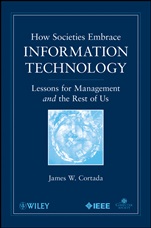
How Societies Embrace Information Technology: Lessons for Management and the Rest of Us
ISBN 9780470534984
Autor: James W. Cortada
Wydawca: Wiley
Dostępność: 3-6 tygodni
Cena: 208,95 zł
Przed złożeniem zamówienia prosimy o kontakt mailowy celem potwierdzenia ceny.
ISBN13: |
9780470534984 |
ISBN10: |
0470534982 |
Autor: |
James W. Cortada |
Oprawa: |
Paperback |
Rok Wydania: |
2009-11-20 |
Ilość stron: |
288 |
Wymiary: |
232x166 |
Tematy: |
KM |
A truly global look at IT deployment and use
No technology in our history has spread as fast as computers and their digital technologies. In How Societies Embrace Information Technology, leading IT authority James Cortada examines how this phenomenon is shaping contemporary society, focusing on the role of corporations and governments. By revealing what history teaches about the adoption of information technologies, Cortada prepares business and government leaders to spot new trends and successfully develop strategies for implementing and managing emerging technologies. Coverage includes:
Summaries of the new best practices based on sixty years of historical experience, all research–based
How technology spread so quickly and completely across the globe
A look at the decision–making process of managers in the private and public sectors
How governments leverage IT to improve their national economies
An examination of the "Information Age" and whether it actually exists
The most current developments in IT
This authoritative reference is ideal for government policymakers and for private–sector managers who routinely make decisions to acquire and use information technology. It is also aimed at academics concerned with the sociology, history, economics, and the effects of IT on contemporary society, as well as business schools and engineering and IT professionals serving in management roles or interested in the managerial/user history of IT.
The author′s royalties on sales of this book will be donated to the IEEE Computer Society′s Educational Activities Board.
Spis treści:
Preface.
1 Introducing the Big Picture.
The presence of information technology.
Megatrends at work.
How societies use technology to shape their world.
Notes and references.
2 How Computers Spread Around the World So Fast.
Definitions and issue
s.
Government–supported/private–sector–driven model.
National champion model.
Asian private–sector–driven model.
Planned economy: public policy model.
Industry–driven model.
Corporate diffusion model.
Application diffusion model.
Technology–standards diffusion model.
Patterns, practices, and implications.
Notes and references.
3 How Governments Leverage Information Technologies to Improve Their National Economies.
A brief historical reminder.
Economic development in a connected world: the big picture.
How governments use it to encourage economic development.
What motivates governments to encourage their citizens and economies to use it?.
Emerging strategies for the most advanced nations compared to rapidly advancing nations.
The special role of labor.
Global recession, twenty–first century style.
Implications for public officials.
Implications for business leaders.
The way forward with policies and practices.
Notes and references.
4 How Managers and Officials Decide What Technology to Use.
The kinds of decisions made by managers.
Types of justification.
Managerial practices.
Some possible less effective practices.
Special role of industries.
Path forward.
Notes and references.
5 Adding Up the Results So Far: Do We Now Live in the Information Age?
Why naming an age is a useful exercise and so hard to do.
What historians can teach us about the process.
The case against the information age.
Can we coexist on the frontiers of a new age?
Lessons for management and a strategy for change.
Concluding thoughts.
Notes and references.
6 An Expanding Role for Scientists and Engineers.
The rise of the computer scientist.
Their role in modern society.
When scientists and tech folk take things into their own hands.
When technologists go green.
Their future world.
An old ro
le made new.
Notes and references.
7 Looking Down the Road into the Twenty–First Century.
How to see the future of an industry.
Knowing how information technology is evolving.
A strategy for managers and public officials.
Special role of the computer science community.
The ultimate trend.
Notes and references.
8 Keeping Up: Bibliographic Essay.
The big picture.
How computers spread around the world.
Governments leveraging it for economic development.
Deciding what technology to use.
Living in the information age.
Role of technologists.
Into the twenty–first century.
Index.
Nota biograficzna:
James W. Cortada has thirty–five years of experience with IBM in various sales, consulting, and managerial positions related to information technology and its use. In particular, he helped design and deploy processes related to employee skills development, including IBM′s worldwide consultant skills certification process, sales processes, and specialized training seminars. An author of more than fifty books on the management and history of information technology, Cortada′s work has been translated into Spanish, Portuguese, Chinese, and Korean.
Okładka tylna:
A truly global look at IT deployment and use
No technology in our history has spread as fast as computers and their digital technologies. In How Societies Embrace Information Technology, leading IT authority James Cortada examines how this phenomenon is shaping contemporary society, focusing on the role of corporations and governments. By revealing what history teaches about the adoption of information technologies, Cortada prepares business and government leaders to spot new trends and successfully develop strategies for implementing and managing emerging technologies. Coverage includes:
Summaries of the new best practices based on sixty years of historical
experience, all research–based
How technology spread so quickly and completely across the globe
A look at the decision–making process of managers in the private and public sectors
How governments leverage IT to improve their national economies
An examination of the "Information Age" and whether it actually exists
The most current developments in IT
This authoritative reference is ideal for government policymakers and for private–sector managers who routinely make decisions to acquire and use information technology. It is also aimed at academics concerned with the sociology, history, economics, and the effects of IT on contemporary society, as well as business schools and engineering and IT professionals serving in management roles or interested in the managerial/user history of IT.
The author′s royalties on sales of this book will be donated to the IEEE Computer Society′s Educational Activities Board.
Koszyk
Książek w koszyku: 0 szt.
Wartość zakupów: 0,00 zł
Informacje


Kontakt
Gambit
Centrum Oprogramowania
i Szkoleń Sp. z o.o.
Al. Pokoju 29b/22-24
31-564 Kraków
Siedziba Księgarni
ul. Kordylewskiego 1
31-542 Kraków
+48 12 410 5991
+48 12 410 5987
+48 12 410 5989
Subskrypcje
Administratorem danych osobowych jest firma Gambit COiS Sp. z o.o. Na podany adres będzie wysyłany wyłącznie biuletyn informacyjny.
Autoryzacja płatności

Informacje na temat autoryzacji płatności poprzez PayU.

© Copyright 2012: GAMBIT COiS Sp. z o.o. Wszelkie prawa zastrzeżone.
Projekt i wykonanie: Alchemia Studio Reklamy