


Wydawcy
Katalog tematyczny
- Archeologia (109)
- Ekonomia, finanse, business (13704)
- Filozofia (1445)
- Historia (3040)
- Języki i językoznawstwo (2356)
- Lifestyle, hobby i rozrywka (475)
- Medycyna (9704)
- Nauki humanistyczne (4)
- Nauki o Ziemi i środowisku (2638)
- Nauki ścisłe (20412)
- Nauki społeczne (8486)
- Nauki techniczne (13450)
- Budownictwo lądowe (1045)
- Chemia przemysłowa (2258)
- Elektronika i telekomunikacja (3287)
- Energetyka (1122)
- Inne nauki stosowane (363)
- Inżynieria biochemiczna (507)
- Inżynieria transportu (232)
- Mechanika i materiały (3316)
- Nauka o środowisku (321)
- Rolnictwo (507)
- Technika, ogólnie (475)
- Prawo (1696)
- Publikacje informacyjne i interdyscyplinarne (1288)
- Religia i wierzenia (917)
- Technika komputerowa (4067)
- Zdrowie, relacje międzyludzkie i rozwój osobisty (657)





Informacje szczegółowe o książce
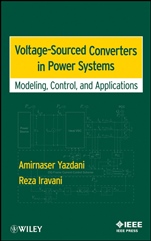
Voltage–Sourced Converters in Power Systems: Modeling, Control, and Applications
ISBN 9780470521564
Autor: Amirnaser Yazdani, Reza Iravani
Wydawca: Wiley
Dostępność: 3-6 tygodni
Cena: 740,25 zł
Przed złożeniem zamówienia prosimy o kontakt mailowy celem potwierdzenia ceny.
ISBN13: |
9780470521564 |
ISBN10: |
0470521562 |
Autor: |
Amirnaser Yazdani, Reza Iravani |
Oprawa: |
Hardback |
Rok Wydania: |
2010-03-05 |
Ilość stron: |
452 |
Wymiary: |
232x169 |
Tematy: |
TJ |
Presents Fundamentals of Modeling, Analysis,
and Control of Electric Power Converters for Power System Applications
Electronic (static) power conversion has gained widespread acceptance in power systems applications; electronic power converters are increasingly employed for power conversion and conditioning, compensation, and active filtering. This book presents the fundamentals for analysis and control of a specific class of high–power electronic converters—the three–phase voltage–sourced converter (VSC). Voltage–Sourced Converters in Power Systems provides a necessary and unprecedented link between the principles of operation and the applications of voltage–sourced converters. The book:
Describes various functions that the VSC can perform in electric power systems
Covers a wide range of applications of the VSC in electric power systems—including wind power conversion systems
Adopts a systematic approach to the modeling and control design problems
Illustrates the control design procedures and expected performance based on a comprehensive set of examples and digital computer time–domain simulation studies
This comprehensive text presents effective techniques for mathematical modeling and control design, and helps readers understand the procedures and analysis steps. Detailed simulation case studies are included to highlight the salient points and verify the designs.
Voltage–Sourced Converters in Power Systems is an ideal reference for senior undergraduate and graduate students in power engineering programs, practicing engineers who deal with grid integration and operation of distributed energy resource units, design engineers, and researchers in the area of electric power generation, transmission, distribution, and utilization.
Spis treści:
PREFACE.
ACKNOWLEDGMENTS.
ACRONYMS.
1 Electro
nic Power Conversion.
1.1 Introduction.
1.2 Power–Electronic Converters and Converter Systems.
1.3 Applications of Electronic Converters in Power Systems.
1.4 Power–Electronic Switches.
1.5 Classification of Converters.
1.6 Voltage–Sourced Converter.
1.7 Basic Configurations.
1.8 Scope of the Book.
PART I FUNDAMENTALS.
2 DC/AC Half–Bridge Converter.
2.1 Introduction.
2.2 Converter Structure.
2.3 Principles of Operation.
2.4 Converter Switched Model.
2.5 Converter Averaged Model.
2.6 Nonideal Half–Bridge Converter.
3 Control of Half–Bridge Converter.
3.1 Introduction.
3.2 AC–Side Control Model of Half–Bridge Converter.
3.3 Control of Half–Bridge Converter.
3.4 Feed–Forward Compensation.
3.5 Sinusoidal Command Following.
4 Space Phasors and Two–Dimensional Frames.
4.1 Introduction.
4.2 Space–Phasor Representation of a Balanced Three–Phase Function.
4.3 Space–Phasor Representation of Three–Phase Systems.
4.4 Power in Three–Wire Three–Phase Systems.
4.5 aβ–Frame Representation and Control of Three–Phase Signals and Systems.
4.6 dq–Frame Representation and Control of Three–Phase Systems.
5 Two–Level, Three–Phase Voltage–Sourced Converter.
5.1 Introduction.
5.2 Two–Level Voltage–Sourced Converter.
5.3 Models and Control of Two–Level VSC.
5.4 Classification of VSC Systems.
6 Three–Level, Three–Phase, Neutral–Point Clamped, Voltage–Sourced Converter.
6.1 Introduction.
6.2 Three–Level Half–Bridge NPC.
6.3 PWM Scheme For Three–Level Half–Bridge NPC.
6.4 Switched Model of Three–Level Half–Bridge NPC.
6.5 Averaged Model of Three–Level Half–Bridge NPC.
6.6 Three&#
8211;Level NPC.
6.7 Three–Level NPC with Capacitive DC–Side Voltage Divider.
7 Grid–Imposed Frequency VSC System: Control in aβ–Frame.
7.1 Introduction.
7.2 Structure of Grid–Imposed Frequency VSC System.
7.3 Real–/Reactive–Power Controller.
7.4 Real–/Reactive–Power Controller Based on Three–Level NPC.
7.5 Controlled DC–Voltage Power Port.
8 Grid–Imposed Frequency VSC System: Control in dq–Frame.
8.1 Introduction.
8.2 Structure of Grid–Imposed Frequency VSC System.
8.3 Real–/Reactive–Power Controller.
8.4 Current–Mode Control of Real–/Reactive–Power Controller.
8.5 Real–/Reactive–Power Controller Based on Three–Level NPC.
8.6 Controlled DC–Voltage Power Port.
9 Controlled–Frequency VSC System.
9.1 Introduction.
9.2 Structure of Controlled–Frequency VSC System.
9.3 Model of Controlled–Frequency VSC System.
9.4 Voltage Control.
10 Variable–Frequency VSC System.
10.1 Introduction.
10.2 Structure of Variable–Frequency VSC System.
10.3 Control of Variable–Frequency VSC System.
PART II APPLICATIONS.
11 Static Compensator (STATCOM).
11.1 Introduction.
11.2 Controlled DC–Voltage Power Port.
11.3 STATCOM Structure.
11.4 Dynamic Model for PCC Voltage Control.
11.5 Approximate Model of PCC Voltage Dynamics.
11.6 STATCOM Control.
11.7 Compensator Design for PCC Voltage Controller.
11.8 Model Evaluation.
12 Back–to–Back HVDC Conversion System.
12.1 Introduction.
12.2 HVDC System Structure.
12.3 DVDC Model System.
12.4 HVDC System Control.
12.5 HVDC System Performance Under an Asymmetrical Fault.
13 Variable–SpeedWind–Power System.
13.1 Introduction.
13.2 Constant–Speed and Variable
–Speed Wind–Power Systems.
13.3 Wind Turbine Characteristics.
13.4 Maximum Power Extraction from A Variable–Speed Wind–Power System.
13.5 Variable–Speed Wind–Power System Based on Doubly–Fed Asynchronous Machine.
APPENDIXA: Space–Phasor Representation of Symmetrical Three–Phase.
Electric Machines.
A.1 Introduction.
A.2 Structure of Symmetrical Three–Phase Machine.
A.3 Machine Electrical Model.
A.4 Machine Equivalent Circuit.
A.5 Permanent–Magnet Synchronous Machine (PMSM).
APPENDIX B: Per–Unit Values for VSC Systems.
B.1 Introduction.
REFERENCES.
INDEX.
Nota biograficzna:
Amirnaser Yazdani, PhD, is an assistant professor in the Department of Electrical and Computer Engineering at the University of Western Ontario. Formerly, he was with Digital Predictive Systems (DPS) Inc., Mississauga, Ontario, active in the design and production of power converters for wind energy systems. Dr. Yazdani has more than ten years of industry experience in the design, modeling, and analysis of switching power converters and railway signaling systems. He is a Senior Member of the IEEE and a professional engineer in the province of Ontario, Canada.
Reza Iravani, PhD, is a professor in the Department of Electrical and Computer Engineering at the University of Toronto. Dr. Iravani is a Fellow of the IEEE and a professional engineer in the province of Ontario, Canada.
Okładka tylna:
Presents Fundamentals of Modeling, Analysis,
and Control of Electric Power Converters for Power System Applications
Electronic (static) power conversion has gained widespread acceptance in power systems applications; electronic power converters are increasingly employed for power conversion and conditioning, compensation, and active filtering. This book presents the fundamentals for analysis and cont
rol of a specific class of high–power electronic converters—the three–phase voltage–sourced converter (VSC). Voltage–Sourced Converters in Power Systems provides a necessary and unprecedented link between the principles of operation and the applications of voltage–sourced converters. The book:
Describes various functions that the VSC can perform in electric power systems
Covers a wide range of applications of the VSC in electric power systems—including wind power conversion systems
Adopts a systematic approach to the modeling and control design problems
Illustrates the control design procedures and expected performance based on a comprehensive set of examples and digital computer time–domain simulation studies
This comprehensive text presents effective techniques for mathematical modeling and control design, and helps readers understand the procedures and analysis steps. Detailed simulation case studies are included to highlight the salient points and verify the designs.
Voltage–Sourced Converters in Power Systems is an ideal reference for senior undergraduate and graduate students in power engineering programs, practicing engineers who deal with grid integration and operation of distributed energy resource units, design engineers, and researchers in the area of electric power generation, transmission, distribution, and utilization.
Koszyk
Książek w koszyku: 0 szt.
Wartość zakupów: 0,00 zł
Informacje


Kontakt
Gambit
Centrum Oprogramowania
i Szkoleń Sp. z o.o.
Al. Pokoju 29b/22-24
31-564 Kraków
Siedziba Księgarni
ul. Kordylewskiego 1
31-542 Kraków
+48 12 410 5991
+48 12 410 5987
+48 12 410 5989
Subskrypcje
Administratorem danych osobowych jest firma Gambit COiS Sp. z o.o. Na podany adres będzie wysyłany wyłącznie biuletyn informacyjny.
Autoryzacja płatności

Informacje na temat autoryzacji płatności poprzez PayU.

© Copyright 2012: GAMBIT COiS Sp. z o.o. Wszelkie prawa zastrzeżone.
Projekt i wykonanie: Alchemia Studio Reklamy