


Wydawcy
Katalog tematyczny
- Archeologia (109)
- Ekonomia, finanse, business (13704)
- Filozofia (1445)
- Historia (3040)
- Języki i językoznawstwo (2356)
- Lifestyle, hobby i rozrywka (475)
- Medycyna (9704)
- Nauki humanistyczne (4)
- Nauki o Ziemi i środowisku (2638)
- Nauki ścisłe (20412)
- Nauki społeczne (8486)
- Nauki techniczne (13450)
- Budownictwo lądowe (1045)
- Chemia przemysłowa (2258)
- Elektronika i telekomunikacja (3287)
- Energetyka (1122)
- Inne nauki stosowane (363)
- Inżynieria biochemiczna (507)
- Inżynieria transportu (232)
- Mechanika i materiały (3316)
- Nauka o środowisku (321)
- Rolnictwo (507)
- Technika, ogólnie (475)
- Prawo (1696)
- Publikacje informacyjne i interdyscyplinarne (1288)
- Religia i wierzenia (917)
- Technika komputerowa (4067)
- Zdrowie, relacje międzyludzkie i rozwój osobisty (657)





Informacje szczegółowe o książce
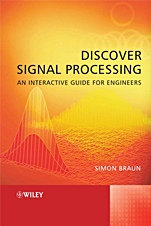
Discover Signal Processing: An Interactive Guide for Engineers
ISBN 9780470519707
Autor: Simon Braun
Wydawca: Wiley
Dostępność: 3-6 tygodni
Cena: 476,70 zł
Przed złożeniem zamówienia prosimy o kontakt mailowy celem potwierdzenia ceny.
ISBN13: |
9780470519707 |
ISBN10: |
0470519703 |
Autor: |
Simon Braun |
Oprawa: |
Hardback |
Rok Wydania: |
2008-01-25 |
Ilość stron: |
366 |
Wymiary: |
252x174 |
Tematy: |
TG |
Signal processing is now a multidisciplinary topic, and one that has applications in many fields including, but not limited to, science, engineering, medicine, finance and the behavioural sciences. Modern software libraries that include dedicated languages and packages designed to simplify the development and application of signal processing techniques are now readily available; however this ease of application means that an understanding of the various techniques is imperative. It is critical that the student or practitioner is able to choose an appropriate processing technique, be aware of potential errors involved and understand how to control them.
Discover Signal Processing exploits the rationale of “learning by doing”; actually attempting and performing a task is the most effective way to remember and understand. It presents the reader with a diverse range of exercises; some intended to recall or practice simple concepts, others more complex & aimed at developing a real understanding of the issues involved. These are accompanied by step–by–step explanations of the tools and techniques required.
Provides systematic, organized and accessible instruction in a complex and mathematical subject.Stresses the understanding, selection and application of available signal processing techniques, as well as identification and control of error mechanisms;Includes more than 60 exercises covering major aspects of signal processing tools & geared at performing or testing specific tasks;Uses MATLABÒas a platform, utilizing its extensive GUI capabilities enabling exercises to be performed using graphical elements only.
Discover Signal Processing provides an excellent & accessible guide to signal processing for mechanical, aeronautical, civil and electronic engineers in their senior/ graduate year. It will also be of interest to those attending CPD courses as well as to practicin
g engineers.
Spis treści:
Preface.
About the Author.
Notation.
Part A: The Exercises.
1 Introduction.
Overview.
The Exercises.
Exercise 1.1.
Exercise 1.2.
Solutions and Summaries.
2 Signals.
Overview.
The Exercises.
Exercise 2.1.
Exercise 2.2.
Exercise 2.3.
Exercise 2.4.
Solutions and Summaries.
3 Fourier Methods.
Overview.
The Exercises.
Exercise 3.1.
Exercise 3.2.
Exercise 3.3.
Exercise 3.4.
Exercise 3.5.
Exercise 3.6.
Exercise 3.7.
Exercise 3.8.
Exercise 3.9.
Exercise 3.10.
Exercise 3.11.
Exercise 3.12.
Solutions and Summaries.
4 Linear Systems.
Overview.
The Exercises.
Exercise 4.1.
Exercise 4.2.
Exercise 4.3.
Solutions and Summaries.
5 Filters.
Overview.
The Exercises.
Exercise 5.1.
Exercise 5.2.
Exercise 5.3.
Exercise 5.4.
Solutions and Summaries.
6 Time Domain Averaging (TDA).
Overview.
The Exercises.
Exercise 6.1.
Exercise 6.2.
Exercise 6.3.
Exercise 6.4.
Solutions and Summaries.
7 Spectral Analysis.
Overview.
The Exercises.
Exercise 7.1(a).
Exercise 7.1(b).
Exercise 7.2.
Exercise 7.3.
Exercise 7.4.
Exercise 7.5.
Exercise 7.6.
Exercise 7.7.
Exercise 7.8.
Exercise 7.9.
Solutions and Summaries.
8 Envelope Detection.
Overview.
The Exercises.
Exercise 8.1.
Solutions and Summaries.
9 The Spectrogram.
Overview.
The Exercises.
Exercise 9.1.
Exercise 9.2.
Solutions and Summaries.
10 Sampling.
Overview.
The Exercises.
Exercise 10.1.
Exercise 10.2.
Exercise 10.3.
Exercise 10.4.
Solutions and Summaries.
11 Identifi cation – Transfer Functions.
Overview.
The Exercises.
Exercise 11.1.
Exercise 11.2.
Exercise 11.3.
Exercise 11.4.
Solutions and Summaries.<
br>12 Model–based Signal Processing.
Overview.
The Exercises.
Exercise 12.1.
Exercise 12.2.
Exercise 12.3.
Solutions and Summaries.
13 Diagnostic Applications for Rotating Machines.
Overview.
The Exercises.
Exercise 13.1.
Exercise 13.2.
Exercise 13.3.
Exercise 13.4.
Exercise 13.5.
Solutions and Summaries.
14 Systems with Delays.
Overview.
The Exercises.
Exercise 14.1.
Exercise 14.2.
Exercise 14.3.
Solutions and Summaries.
Part B.
1 Introduction.
1.1 General Objectives.
1.2 Basic Processing.
1.3 Why the Frequency Domain?
1.4 An Introductory Example.
2 Introduction to Signals.
2.1 Signal Classification.
2.2 Signal Descriptions.
2.3 Correlation Functions.
2.4 Estimation and Errors.
3 Fourier Methods.
3.1 Fourier Series.
3.2 Fourier (Integral) Transform.
3.3 The Uncertainty Principle.
3.4 The Discrete Fourier Transform (DFT).
3.5 The DFT and the Fast Fourier Transform (FFT).
3.6 Discontinuities and Windows.
4 Linear Systems.
4.1 Continuous Systems.
4.2 Discrete Systems.
4.3 A Specifi c Case of a Continuous Linear Systems – Accelerometers.
Appendix 4.A The Lightly Damped SDOF System.
5 Filters.
5.1 Preliminaries.
5.2 Analog and Digital Filters.
5.3 Filter Classifi cation and Specifications.
5.4 IIR Filters.
5.5 FIR Filters.
5.6 The Importance of Linear Phase Filters.
5.7 Design Tools.
6 Time Domain Averaging (Synchronous Averaging).
6.1 Principle.
6.2 Rejection of Nonsynchronous Components.
6.3 TDA with Decaying Memory Process.
7 Spectral Analysis.
7.1 Introduction.
7.2 Representation of Signals in the Frequency Domain.
7.3 Errors and their Control.
7.4 Spectral Analysis: Practical Considerations.
8 Envelopes.
8.1 Introduction.
8.2 The Hilbert Transform (HT).
8.3 Analytic Signals.<
br>8.4 Narrow Band (NB) Signals and their Envelope.
9 The Spectrogram.
9.1 Introduction.
9.2 Time Frequency Methods.
9.3 The Short Time Fourier Transform (STFT) and the Spectrogram.
10 Data Acquisition.
10.1 Data Acquisition and Signal Processing Systems.
10.2 Amplitude Quantization.
10.3 Quantization in Time: The Sampling Theorem.
10.4 Antialiasing Filters.
11 Input/Output Identifi cation.
11.1 Objectives and Overview.
11.2 Frequency Domain Identifi cation: The Noiseless Case.
11.3 Identifi cation with Noise Corrupted Signals.
11.4 Error Mechanisms and their Control in the Identifi cation Process.
11.5 Estimation Errors for the Coherence Function.
12 Model–based Signal Processing.
12.1 General.
12.2 Signal Models.
12.3 Modeling of Signals.
12.4 Model–based Spectral Analysis.
12.5 Model or Selection.
12.6 Model–based Diagnostics.
Appendix 12.A The Correlation Matrix.
13 Machinery Diagnostics: Bearings and Gears.
13.1 Diagnostics and Rotating Machinery.
13.2 Structural Effects.
13.3 Rotating Imbalance.
13.4 Modeling of Roller Bearing Vibration Signals.
13.5 Bearing Vibrations: Structural Effects and Envelopes.
13.6 Modeling of Gear Vibration Signals.
14 Delays and Echoes.
14.1 System with Pure Delays.
14.2 Correlation Functions.
14.3 Cepstral Analysis.
References.
Index.
Nota biograficzna:
Simon Braun is Professor at the Israel Institute of Technology, and has been active in the area of signal processing for four decades. He is the Editor in Chief of the Journal “ Mechanical Systems and Signal Processing” (Elsevier), the “ Encyclopedia of Vibrations (Academic Press) and author of “Mechanical Signature Analysis” (Academic Press). He has authored more than 60 papers in peer – reviewed journals and presented his work at conferences
Koszyk
Książek w koszyku: 0 szt.
Wartość zakupów: 0,00 zł
Informacje


Kontakt
Gambit
Centrum Oprogramowania
i Szkoleń Sp. z o.o.
Al. Pokoju 29b/22-24
31-564 Kraków
Siedziba Księgarni
ul. Kordylewskiego 1
31-542 Kraków
+48 12 410 5991
+48 12 410 5987
+48 12 410 5989
Subskrypcje
Administratorem danych osobowych jest firma Gambit COiS Sp. z o.o. Na podany adres będzie wysyłany wyłącznie biuletyn informacyjny.
Autoryzacja płatności

Informacje na temat autoryzacji płatności poprzez PayU.

© Copyright 2012: GAMBIT COiS Sp. z o.o. Wszelkie prawa zastrzeżone.
Projekt i wykonanie: Alchemia Studio Reklamy