


Wydawcy
Katalog tematyczny
- Archeologia (109)
- Ekonomia, finanse, business (13704)
- Filozofia (1445)
- Historia (3040)
- Języki i językoznawstwo (2356)
- Lifestyle, hobby i rozrywka (475)
- Medycyna (9704)
- Nauki humanistyczne (4)
- Nauki o Ziemi i środowisku (2638)
- Nauki ścisłe (20412)
- Astronomia (294)
- Biologia (5119)
- Biochemia (575)
- Biologia człowieka (14)
- Biologia komórkowa (377)
- Biologia molekularna (398)
- Biologia rozwoju (130)
- Biologia, ogólnie (1277)
- Botanika (280)
- Hydrobiologia (92)
- Mikrobiologia (363)
- Mykologia (22)
- Zoologia (303)
- Chemia (6540)
- Fizyka (3309)
- Matematyka (4574)
- Nauki ścisłe, ogólnie (503)
- Nauki społeczne (8486)
- Nauki techniczne (13450)
- Prawo (1696)
- Publikacje informacyjne i interdyscyplinarne (1288)
- Religia i wierzenia (917)
- Technika komputerowa (4067)
- Zdrowie, relacje międzyludzkie i rozwój osobisty (657)





Informacje szczegółowe o książce
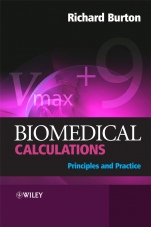
Biomedical Calculations: Principles and Practice
ISBN 9780470519103
Autor: Richard Burton
Wydawca: Wiley
Dostępność: 3-6 tygodni
Cena: 741,30 zł
Przed złożeniem zamówienia prosimy o kontakt mailowy celem potwierdzenia ceny.
ISBN13: |
9780470519103 |
ISBN10: |
047051910X |
Autor: |
Richard Burton |
Oprawa: |
Hardback |
Rok Wydania: |
2008-08-22 |
Ilość stron: |
310 |
Wymiary: |
253x174 |
Tematy: |
PS |
"It is said if you take care of the pennies, the pounds will take care of themselves. Richard Burton′s excellent book takes this approach to calculations applied to the biomedical sciences…This is certainly interesting and engaging but it avoids being complicated." –Journal of Biological Education, April 2009
Biomedical Calculations: Principles and Practice is an accessible, student–friendly introduction to calculating, applying formulae and solving quantitative problems within these subjects. This book targets a problem area for many students and aims to give them the confidence which they are so often lacking when undertaking scientific calculations. It takes a unique approach to the subject and uses unit analysis as a central theme throughout the book to enhance student understanding.
Clearly structured throughout, little basic knowledge of mathematics is assumed, but even the most numerate readers will be interested in the sometimes–novel biological detail. Numerous worked examples, supplementary questions and practice problems are provided and although the book is written to be read in sequence, it will also be a useful reference.
The central theme of the book focuses on the value of unit analysis in solving quantitative problems, with explanations on how to avoid errors in calculations and in checking, understanding and deriving formulae and equations. As a background to this, there is extensive treatment of physical units, both individually (e.g. kg, m, mmol) and in combination (e.g. m s¯², mmol L¯¹), and also of other aspects of quantitative thinking. A variety of topics (mostly from physiology, pharmacology and biochemistry) are used to demonstrate these calculations in practice.
Key features: An accessible, student–friendly introduction for all those hesitant in calculating, applying formulae and solving quantita
tive problems An innovative approach to scientific calculations and how to work with unfamiliar formulae for the biomedical and life sciencesIncludes modern, up to date definition of pH eliminating the need for logarithms and a discussion of the importance of pHClear introduction on how to use the book, guidance on units and unit conversion, and an appendix on basic mathematics and notation Use of unit analysis as a central theme Includes numerous worked examples and supplementary questions throughout the text to enhance student understanding
Spis treści:
Preface.
Acknowledgements.
This book, and how to use it.
PART I.
1. Unit analysis: the neglected key to confidence.
1.1 Calculating with units.
1.2 Ways of writing composite units.
1.3 How unit analysis can guide thinking and help solve problems.
1.4 When to specify substances along with units.
1.5 The need to use appropriate and compatible units in formulae.
1.6 Checking and deriving formulae.
1.7 When unit analysis raises questions about formulae.
1.8 Dimensional analysis.
PART II.
2. Units: length, area, volume, mass, moles and equivalents.
2.1 The Système International and unit prefixes.
2.2 Length and distance.
2.3 Area.
2.4 Volume.
2.5 Mass.
2.6 Moles.
2.7 Equivalents.
2.8 Conversion between units.
Problems.
3. Percentages.
3.1 When percentages mislead: human body fat and fat in milk.
3.2 Heat loss from the body: further questionable percentages.
Problems.
4. Composite units I – density.
4.1 Specific gravity.
4.2 Specific volume.
4.3 Two definitions of body density.
4.4 Thinking about a formula.
Problems.
5. Composite units II – concentration.
5.1 Concentrations: kilograms of water vs litres of solution.
5.2 Simple protein–free salt solutions.
5.3 Millimolar and milli
molal concentrations in blood plasma.
5.4 Some quite different uses for Eq. (5.1).
Problems.
6. Aspects of problem solving.
6.1 Letting unit analysis solve the problem.
6.2 ‘Let x be the unknown’.
Problems.
7. Making up and diluting solutions.
7.1 Preparing 250 mL of 150 mM NaCl from the dry salt.
7.2 Preparing dilutions from stock solutions.
Problems.
8. Calculating drug doses.
Problems.
9. More about solutions – electroneutrality, osmotic pressure and activity.
9.1 The principle of electroneutrality.
9.2 But what about membrane potentials and short–circuit currents?
9.3 Anion gap.
9.4 Osmoles and osmolality.
9.5 Osmolar gap.
9.6 Osmosity.
9.7 Cell contents.
9.8 Effective osmolality, effective osmotic pressure.
9.9 Osmotic shifts of water between cells and extracellular fluid.
9.10 Free and bound concentrations, activities.
PART III.
10. Graphs, straight lines and equations.
10.1 Graphs: some terminology.
10.2 Advice on drawing graphs.
10.3 The equation of a straight line.
10.4 Finding the equation of a line that passes through two specified points.
10.5 Drawing a line that is defined by a specified equation.
10.6 Finding the equation of a line from its gradient and the coordinates of a single point on it.
10.7 Finding the line that best fits a number of points when these lie only roughly in a straight line.
10.8 ‘Proportional’ and ‘inversely proportional’.
10.9 Gradients of curves.
10.10 A note on units.
10.11 On the different kinds of formulae and equations.
Problems.
11. On shapes and sizes.
11.1 Areas and volumes of simple shapes.
11.2 Erythrocytes, cylinders and spheres.
11.3 The swelling of erythrocytes in hypo–osmotic solutions.
11.4 Distortion of erythrocytes in passing along narrow blood vessels.
11.5 An exercise in rear
ranging equations to eliminate an unwanted term.
11.6 Easy and general ways to check algebraic working.
11.7 Solving the equation by trial and error in a spreadsheet.
11.8 Why do we not have naturally spherical erythrocytes?
11.9 General properties of simple geometrical shapes.
11.10 Replacing volumes with masses in these equations.
11.11 A digression on graphs.
11.12 Calculating surface area from volume and height: another exercise in re–arranging equations and eliminating unwanted terms.
11.13 Another digression to check algebraic working.
11.14 Generalizing the formula to include the human body.
11.15 Surface/volume and surface/mass ratios.
11.16 The surface area of the human body.
11.17 Standard formulae for body surface area.
11.18 An exercise in comparing formulae containing exponents.
Problems.
12. Body size, body build, fatness and muscularity: unit analysis as an aid to discovery.
12.1 Variations in fat–free mass with height and age.
12.2 The Rohrer index, or ‘height–weight index of build’.
12.3 The body mass index; estimating body fat from body mass and height.
12.4 Upper arm muscle: how its cross–sectional area varies with body height.
12.5 Weightlifting – and the cross–sectional area of muscle.
12.6 Estimating body fat from skinfold thickness measurements.
12.7 Postscript.
PART IV.
13. Introducing time.
13.1 Frequency.
13.2 Speed and velocity.
13.3 Acceleration.
13.4 Rates of flow of substances carried in fluids.
13.5 Thinking about a formula.
13.6 The concept of renal clearance.
13.7 Relating the clearance formula for renal plasma flow to the Fick Principle.
13.8 Creatinine clearance as a measure of GFR, and a convenient formula for estimating it.
Problems.
PART V.
14. Force, pressure, energy, work and power.
14.1 Force and weight.
14.2 Pressure.
14.3 Columns
Koszyk
Książek w koszyku: 0 szt.
Wartość zakupów: 0,00 zł
Informacje


Kontakt
Gambit
Centrum Oprogramowania
i Szkoleń Sp. z o.o.
Al. Pokoju 29b/22-24
31-564 Kraków
Siedziba Księgarni
ul. Kordylewskiego 1
31-542 Kraków
+48 12 410 5991
+48 12 410 5987
+48 12 410 5989
Subskrypcje
Administratorem danych osobowych jest firma Gambit COiS Sp. z o.o. Na podany adres będzie wysyłany wyłącznie biuletyn informacyjny.
Autoryzacja płatności

Informacje na temat autoryzacji płatności poprzez PayU.

© Copyright 2012: GAMBIT COiS Sp. z o.o. Wszelkie prawa zastrzeżone.
Projekt i wykonanie: Alchemia Studio Reklamy