


Wydawcy
Katalog tematyczny
- Archeologia (109)
- Ekonomia, finanse, business (13704)
- Filozofia (1445)
- Historia (3040)
- Języki i językoznawstwo (2356)
- Lifestyle, hobby i rozrywka (475)
- Medycyna (9704)
- Chirurgia (272)
- Inne gałęzie medycyny (1871)
- Medycyna kliniczna (4187)
- Choroby wewnętrzne (514)
- Dermatologia (51)
- Diagnostyka medyczna (3)
- Endokrynologia (144)
- Gastroenterologia (27)
- Geriatria (50)
- Ginekologia i położnictwo (134)
- Hematologia (46)
- Hepatologia (10)
- Kardiologia (71)
- Laryngologia (12)
- Nefrologia (10)
- Neurologia (500)
- Oftalmologia (50)
- Pediatria (33)
- Pulmunologia (32)
- Reumatologia (14)
- Terapia genowa (1)
- Układ mięśniowo-szkieletowy (1)
- Urologia (14)
- Medycyna niekonwencjonalna (14)
- Medycyna przedkliniczna (269)
- Medycyna, ogólnie (1740)
- Medyczne służby pomocnicze (745)
- Studia medyczne (16)
- Weterynaria (548)
- Nauki humanistyczne (4)
- Nauki o Ziemi i środowisku (2638)
- Nauki ścisłe (20412)
- Nauki społeczne (8486)
- Nauki techniczne (13450)
- Prawo (1696)
- Publikacje informacyjne i interdyscyplinarne (1288)
- Religia i wierzenia (917)
- Technika komputerowa (4067)
- Zdrowie, relacje międzyludzkie i rozwój osobisty (657)





Informacje szczegółowe o książce
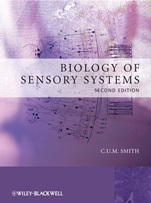
Biology of Sensory Systems
ISBN 9780470518625
Autor: C. U. M. Smith
Wydawca: Wiley
Dostępność: 3-6 tygodni
Cena: 905,10 zł
Przed złożeniem zamówienia prosimy o kontakt mailowy celem potwierdzenia ceny.
ISBN13: |
9780470518625 |
ISBN10: |
0470518626 |
Autor: |
C. U. M. Smith |
Oprawa: |
Hardback |
Rok Wydania: |
2009-01-09 |
Numer Wydania: |
2nd Edition |
Ilość stron: |
534 |
Wymiary: |
253x195 |
Tematy: |
MJ |
Since publication of the first edition, huge developments have taken place in sensory biology research and new insights have been provided in particular by molecular biology. These show the similarities in the molecular architecture and in the physiology of sensory cells across species and across sensory modality and often indicate a common ancestry dating back over half a billion years.
Biology of Sensory Systems has thus been completely revised and takes a molecular, evolutionary and comparative approach, providing an overview of sensory systems in vertebrates, invertebrates and prokaryotes, with a strong focus on human senses.
Written by a renowned author with extensive teaching experience, the book covers, in six parts, the general features of sensory systems, the mechanosenses, the chemosenses and the senses which detect electromagnetic radiation. Other sensory systems are also dealt with, including pain, thermosensitivity and minority senses. Finally the book provides an outline and discussion of philosophical implications.
New in this edition:
● Greater emphasis on molecular biology and intracellular mechanisms
● New chapter on genomics and sensory systems
● Sections on TRP channels, synaptic transmission, evolution of nervous systems, arachnid sensory systems, electroreception in the Monotremata, language and the FOXP2 gene, mirror neurons and the molecular biology of pain
● Updated passages on animal and human olfaction and gestation
Over four hundred illustrations, boxes containing supplementary material and self–assessment questions and a full bibliography at the end of each part make Biology of Sensory Systems essential reading for undergraduate students of biology, zoology, animal physiology, neuroscience, anatomy and physiological psychology. The book is also suitable for postgraduate students in more specialised courses such as vision sciences, optometry, neurophysiology, neuropathol
ogy, developmental biology.
Spis treści:
Preface to Second Edition.
Preface to First Edition.
PART I: PRELIMINARIES.
Chapter 1: Elements.
1.1 Allosteric Effectors.
1.2 Membranes.
1.3 Membrane Signalling Systems.
1.4 Channels and Gates.
1.5 Concluding Remarks.
Chapter 2: Membranes, Action Potentials, Synapses.
2.1 The Measurement of Resting Potentials.
2.2 The Ionic Bases of Resting Potentials.
2.3 Electrotonic Potentials and Cable Conduction.
2.4 Receptor and Generator Potentials.
2.5 Sensory Adaptation.
2.6 Action Potentials.
2.7 Synapses and Synaptic Transmission.
2.8 Concluding Remarks.
Chapter 3: General Features of Sensory Systems.
3.1 Classification of the Senses.
3.2 Modality.
3.3 Intensity.
3.4 Adaptation.
3.5 Receptive Fields.
3.6 Maps of Sensory Surfaces.
3.7 Hierarchical and Parallel Design.
3.8 Feature Extraction and Trigger Stimuli.
3.9 Concluding Remarks.
Box 3.1 Hermann von Helmholtz.
Chapter 4: Classification and Phylogeny.
4.1 Systematics.
4.2 Classification into Six Kingdoms.
4.3 Unicellularity.
4.4 Multicellularity.
4.5 Protostomes and Deuterostomes.
4.6 Classification of the Metazoa.
4.7 Evolution of Nervous Systems.
4.8 Concluding Remarks.
Chapter 5: Genes, Genomics and Neurosensory Systems.
5.1 Introduction.
5.2 Comparative Genomics.
5.3 Genomes and Neurosensory Systems.
5.4 Concluding Remarks.
Box 5.1 Nomenclature of Genes and Proteins.
Part I: Self Assessment.
Part I: Notes, References and Bibliography.
PART II: MECHANOSENSITIVITY.
Chapter 6: Mechanosensitivity of Cell Membranes.
6.1 Mechanosensitive Channels in E. coli.
6.2 Detection of Osmotic Swelling by Hypothalamic Cells in Mammals.
6.3 Concluding Remarks.
Chapter 7: Kinaesthesia.
7.1 Kinaesthetic Mechanisms in Arthropods.
7.1.1 St
retch Receptors in Crustacean Muscle.
7.2 Kinaesthetic Mechanisms in Mammals.
7.3 Concluding Remarks.
Chapter 8: Touch.
8.1 Mechanoreception in Caenorhabditis Elegans.
8.2 Spiders.
8.3 Insects.
8.4 Tactile Receptors in Mammalian Skin.
8.5 Cerebral Analysis of Touch.
8.6 Plasticity of the Somaesthetic Cortex.
8.7 Concluding Remarks.
Chapter 9: Equilibrium and Hearing: The Uses of Hair Cells.
9.1 Anatomy and Physiology of Hair Cells.
9.2 Lateral Line Canals.
9.3 Evolution of the Vertebrate Ear.
9.4 Concluding Remarks.
Box 9.1 Biophysics of Outer Hair Cells.
Box 9.2 Genetics and Deafness.
Chapter 10: Cerebral Analysis.
10.1 The Mammalian Vestibular Pathway and Reflexes.
10.2 The Mammalian Auditory Pathway.
10.3 The Avian Auditory Pathway and the Mapping of Auditory Space by the Barn Owl.
10.4 The Mammalian Auditory Cortex.
10.5 The Bat Auditory System and Echolocation.
10.6 The Human Auditory Cortex and Language.
10.7 Lateralization and the Neuroanatomy of Language.
10.8 Language and the FOXP2 Gene.
10.9 Callosectomy and After.
10.10 Concluding Remarks.
Box 10.1 Broca andWernicke.
Part II: Self Assessment.
Part II: Notes, References and Bibliography.
PART III: CHEMOSENSITIVITY.
Chapter 11: Chemosensitivity in Prokaryocytes.
11.1 Chemosentivity in E. coli.
11.2 Concluding Remarks.
Chapter 12: Mammalian Chemo–Enteroreceptors.
12.1 Location of Mammalian Chemoreceptors for PaO2 and PaCO2.
12.2 Structure.
12.3 Physiology.
12.4 Biochemistry.
12.5 Concluding Remarks.
Chapter 13: Gustation.
13.1 Gustation in Insects.
13.2 Gustation in Mammals.
13.3 Concluding Remarks.
Chapter 14: Olfaction.
14.1 Insect Olfactory Systems.
14.2 Mammalian Olfactory Systems.
14.3 The Vertebrate Vom
eronasal Organ (VNO) and Pheromones.
14.4 Concluding Remarks.
Part III: Self Assessment.
Part III: Notes, References and Bibliography.
PART IV: PHOTOSENSITIVITY.
Box I4.1 Bacteriorhodopsin.
Chapter 15: Invertebrate Vision.
15.1 Designs of Invertebrate Eyes.
15.2 Examples of Invertebrate Eyes.
15.3 Concluding Remarks.
Box 15.1 The Evolution of Opsins.
Box 15.2 Early Genetics of Eyes.
Chapter 16: The Human Eye.
16.1 Anatomy.
16.2 Embryology.
16.3 Detailed Anatomy and Physiology.
16.4 Movements of the Eyeball.
16.5 Concluding Remarks.
Box 16.1 Genetics of Cataract.
Chapter 17: The Retina.
17.1 Retinal Pigment Epithelium (RPE).
17.2 Retina.
17.3 Concluding Remarks.
Chapter 18: Visual Pathways and Cortices.
18.1 Visual Pathways into the Brain.
18.2 Primary Visual Cortex.
18.3 Extrastriate Cortices.
18.4 Face Recognition.
18.5 Prosopagnosia.
18.6 Concluding Remarks.
Box 18.1 The Reality of Cortical Columns.
Box 18.2 Blindsight.
Chapter 19: Other Vertebrate Visual Systems.
19.1 Visual Pigments.
19.2 Photoreceptors.
19.3 Tapeta.
19.4 Retinae.
19.5 Dioptric Apparatus.
19.6 Median Eyes.
19.7 Visual Pathways.
19.8 Visual Centres in the Brain.
19.9 Concluding Remarks.
Part IV: Self Assessment.
Part IV: Notes, References and Bibliography.
PART V: OTHER SENSES.
Chapter 20: Thermosensitivity.
20.1 Molecular Biology.
20.2 Poikilotherms.
20.3 Homeotherms.
20.4 Concluding Remarks.
Chapter 21: Minority Senses.
21.1 Infrared Radiation.
21.2 Polarized Light.
21.3 Electric Fields.
21.4 Magnetic Fields.
21.5 Concluding Remarks.
Chapter 22: Pain.
22.1 The Biological Significance of Pain.
22.2 Neurophysiology of Pain.
22.3 Neuropharmacology of Pain Pathways.
22.4 Referred Pain.
22.5 Gate Theory.
22.6 Concluding Remarks.
Part V: Self As
Koszyk
Książek w koszyku: 0 szt.
Wartość zakupów: 0,00 zł
Informacje


Kontakt
Gambit
Centrum Oprogramowania
i Szkoleń Sp. z o.o.
Al. Pokoju 29b/22-24
31-564 Kraków
Siedziba Księgarni
ul. Kordylewskiego 1
31-542 Kraków
+48 12 410 5991
+48 12 410 5987
+48 12 410 5989
Subskrypcje
Administratorem danych osobowych jest firma Gambit COiS Sp. z o.o. Na podany adres będzie wysyłany wyłącznie biuletyn informacyjny.
Autoryzacja płatności

Informacje na temat autoryzacji płatności poprzez PayU.

© Copyright 2012: GAMBIT COiS Sp. z o.o. Wszelkie prawa zastrzeżone.
Projekt i wykonanie: Alchemia Studio Reklamy